Languages
Tuesday, October 6, 2026



News and Views from the Global South
Education

Technology Meets Creativity on Women’s Empowerment Platform
Eight years ago, at the age of eleven, Fuzia co-founder Riya Sinha decided to start a writing club for school girls. Stemming from this initiative a few years later Sinha, along with co-founder Shraddha Varma, decided to start the online platform for women. Their story and Fuzia's DNA are intrinsically wrapped around each other – and highlight how even in the age of feminism where women’s voices tend to be drowned out, a platform for them can become a global success.
Pacific Partnership launches human rights and social justice-themed poetry book for children
The Pacific Partnership to End Violence Against Women and Girls (Pacific Partnership) programme has launched a poetry anthology publication comprising a collection of Pacific poems and artworks about human rights and social justice suitable for students in Years 7-13.
Katiba at 10: A Landmark Constitution and a Blueprint for Deepening Democracy
On 27 August 2020, we mark the tenth anniversary of the New Constitution of Kenya – a landmark social contract inspired by citizens’ desire for a country characterised by participatory governance, inclusive development, human rights and the rule of law.How Two Young Women Are Working to Improve Access to Contraception in Trinidad and Tobago
According to a 2016 Guttmacher Institute study, 60% of girls ages 15-19 in developing countries who want to avoid pregnancy do not have access to modern contraceptive methods. Women Deliver Young Leaders Kizanne James and Khadija Sinanan dive deeper into stigma around contraceptive use in their home country of Trinidad and Tobago as part of their projects as World Contraception Day Ambassadors.
Future of Education Is Here
There are moments when the world has no choice but to come together. Those moments become historic turning points. This is one of them. We are now faced with the greatest education emergency of our time. Over one billion children are out of school. The COVID-19 pandemic has created an unprecedented crisis of such magnitude and depth that the next generation might neither have the capacity and tools, nor the will, to rebuild - let alone build back better.
Sudan May Have Banned FGM, but the Harsh Practice Continues
Just four months ago, Sudan took the monumental step to ban female genital mutilation, a painful, unnecessary and dangerous procedure that leaves lasting scars. Generally carried out on girls before they reach puberty, genital mutilation is now punishable in Sudan by up to three years in prison and subject to a fine.
Call for Urgent Action by 275 World Leaders on Global Education Emergency In Face of Covid19
We write to call for urgent action to address the global education emergency triggered by COVID-19. With over 1 billion children still out of school because of the lockdown, there is now a real and present danger that the public health crisis will create a COVID generation who lose out on schooling and whose opportunities are permanently damaged. While the more fortunate have had access to alternatives, the world’s poorest children have been locked out of learning, denied internet access, and with the loss of free school meals - once a lifeline for 300 million boys and girls - hunger has grown.
Education Cannot Wait Interviews EU Commissioners Jutta Urpilainen & Janez Lenarčič
The European Commission (EC) is one of the founders of Education Cannot Wait, which was established at the World Humanitarian Summit in 2016 and aims at increasing funding and efficiency in delivering quality education to some 75 million children and youth affected by conflicts, natural disasters and forced displacement. EC plays a major role since in advancing education in the humanitarian-development nexus during crisis. Please elaborate on the EC vision in driving education to achieve humanitarian-development coherence and deliver quality education in situations of crisis, for refugees, for girls, and other stakeholders who are left furthest behind.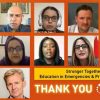
Stronger Together: Education in Emergencies & Protracted Crises
‘Stronger collective efforts and collaboration are key to meeting the urgent education needs of children and youth affected by crises’: this is the unifying message from leaders and youth advocates brought together by Education Cannot Wait (ECW) and Devex in a high-level, Global Discussion held online on 12 August, on the occasion of International Youth Day.
No More Lost Generations: Global Fund Provides Education for Children in Crisis
15-year-old Humaira* sits on the mud floor of her hut in Ukhiya camp, Cox's Bazar, listening as the rain beats down on the tarpaulin roof.
Young South Africans are Shut Out From Work: They Need a Chance to Get Digital Skills
Most young people from disadvantaged backgrounds in South Africa continue to be denied access to information and communications technology because of poor infrastructure and the digital divide.
Keeping Education within the Grasp of Refugee Children
“Not being able to go to school is not something I’d wish on any child in this world,” said 21-year-old Nujeen Mustafa, a young advocate for refugees who fled the Syrian war with her sister. Mustafa, who now lives in Germany, is also the United Nations Human Rights Council (UNHCR) high profile supporter.
STRONGER TOGETHER IN CRISES’ – EDUCATION CANNOT WAIT REACHES 3.5 MILLION CHILDREN AND YOUTH IN HUMANITARIAN CRISES WORLDWIDE
Education Cannot Wait launched its ‘Stronger Together in Crises - Annual Results Report 2019’ today, reaffirming itself as the global fund for education in emergencies and protracted crises. Since the Fund’s inception in 2016, its investments have reached nearly 3.5 million children and youth in many of the world’s worst humanitarian crises.
Building Resilience in Pacific Education
School as we all know it hasn’t changed that much in over a century. However, in the face of new threats to health and wellbeing, the future of those familiar structures that bring teachers and students together is starting to be questioned.
COVID-19 – Some 23.8 Million More Children Will Drop out of School
Countries with low human development are facing the brunt of school lockdowns, with more than 85 percent of their students effectively out of school by the second quarter of 2020, according to a United Nations policy brief on the impact of COVID-19 on education.
The New Poor Post-pandemic: Time for Cushioning the Most Vulnerable in Southeast Asia
After decades of impressive growth, for the first time, Southeast Asia is experiencing a drop in measured human development. The economic fallout from the COVID-19 pandemic will likely take months to reveal itself and years to put right. Yet, a legacy of mobilizing under constraints is leading Southeast Asia’s pandemic response.
With Proper Investment in Youth, Kenya’s Potential for Progress Is Unlimited
Africa’s demographic boom has been hailed as its biggest promise for transforming the continent’s economic and social outcomes, but only if the right investments are made to prepare its youthful population for tomorrow’s world.
Corporate Bailout or Cash Transfers for All, including Children?
The Covid-19 pandemic seems to have spared children from the direct health effects of the virus but the crisis has affected their social and economic rights directly and indirectly beyond what we could have foreseen. And there's no doubt that children who come from more vulnerable backgrounds will feel the long-term impact of the pandemic and the measures taken to prevent its spread the hardest.
Google’s $10 Billion Investment in India Should be Inclusive of Persons with Disabilities
Over the next seven years, Google will invest a whopping $10 billion in India to improve technology, health and education, according to CEO Sundar Pichai. This is unprecedented and could be a game changer that could improve health, education and economic empowerment.
Gender Inequality and Oppression of Women: A Survivor’s Story
“What do you think happens to kerosene when it is poured on your head?” Surya stumbles as she speaks to IPS. “It goes down, it goes trickling down.” When someone speaks to a burn victim, one naturally feels shocked, sad, and sympathetic. But in talking to Surya, who has the major part of her body burned, the feelings were of hope and inspiration. How is it possible to survive this trauma and still have so much love and joy to share?
Inadequate Water & Sanitation Threatens Women’s & Girls’ Development in Senegal
With Tabaski (Eid al-Adha) around the corner, 11-year-old Fatoumata Binta from Terrou Mballing district in M'Bour, western Senegal, wakes up early and joins her brothers Iphrahima Tall and Ismaila to fetch water from a river several miles from home.« Previous Page — Next Page »





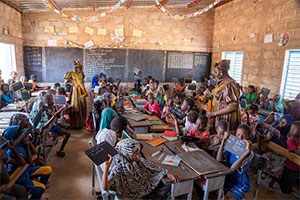 Two teachers work in a classroom in Forces Vives School in Dori, Burkina Faso. Credit: UNICEF/UNI978361
Safe and uninterrupted education is a fundamental right for all children. Education is paramount to global development, as it has been proven that investing in education – especially for girls and children – contributes significantly to economic growth and prosperity. Although more than 1 billion children go to school, many are subjected to conditions that are not conducive to a proper learning environment, including makeshift facilities, a lack of supplies, violence in classrooms, inadequate sanitation, untrained instructors, and widespread school closures. Since 2015, there have been immense gains in education with an increase of 109 million children in school. However, as of 2023, 272 million children are still out of school.
High poverty levels in developing countries also impede children’s access to a proper education. For example, from the early to mid 2000s, Sub-Saharan African nations witnessed a dramatic decline in trained teachers due to inadequate funding in the education sector. Furthermore, major cuts to United States international aid threaten an estimated 23 million additional children's access to education, as USAID‑funded school programmes across Africa and Asia face closure.
Various other factors contribute to the decline of education, notably hunger, which has increased as conflict and climate change interfere with global food production and dissemination. Meanwhile, certain social and cultural practices also impede children’s access to education, with gender inequality, discrimination, child labour, and child marriages preventing millions of children from attending school. Economic conditions such as the inaccessibility of higher education also affect disenfranchised communities across the world. In extreme situations, such as warfare where educational facilities are destroyed in their totality, notably in Gaza and Sudan, entire generations of children might grow up without access to education. Rebuilding educational infrastructure is a long and arduous process, especially when violence persists across generations, and this significantly stunts the development of societal prosperity and stability.
IPS is dedicated to telling the shocking truths about worldwide education through impassioned opinion pieces and comprehensive articles, highlighting global issues that impede worldwide education and the courses of action being taken by organizations such as UNICEF and Education Cannot Wait.

The Week with IPS

NEXT STOP - SDGs
Tracking global progress towards a sustainable world
Tracking global progress towards a sustainable world
