Languages
Wednesday, October 7, 2026



News and Views from the Global South
Education

Fighting India’s Bonded Labour During the COVID-19 Pandemic – Part 1
One of the worst fallouts of the COVID-19 pandemic has been the closure of industries in India, which caused thousands of migrant labourers to return home to villages in Uttar Pradesh, Bihar and Bengal. In a region where the poorest have always been subjected to bonded labour, child labour and slave trafficking, it has meant revisiting the past.
Central Sahel – Shaping peace together with women and young people Statement for International Peace Day
The countries of Central Sahel—Burkina Faso, Mali, and Niger—face an unprecedented crisis, marked by violent extremism, forced displacement, and rising insecurity. The sharp increase in armed attacks on communities, health centres, schools and other public institutions and infrastructure has disrupted livelihoods and access to social services. The impact on affected people is devastating.
Global Leaders Focus on Education in Emergencies & Protracted Crises at ECW’s Global High-level #UNGA75 Event: ‘the Future of Education Is Here for Those Left Furthest Behind’
Education Cannot Wait (ECW) brought together an impressive, diverse line-up of world leaders, policymakers, youth, teachers, celebrities and global advocates to rally around the cause of education in emergencies and protracted crises during the 75th Session of the United Nations General Assembly under the inspiring theme “The Future of Education is Here for Those Left Furthest Behind.”
Education Cannot Wait Mobilizes an Additional US$23.6 Million to Increase Support for Vulnerable Children and Youth – Already Affected by Armed Conflict, Forced Displacement and Protracted Crises – Now Doubly Hit by COVID-19 Pandemic
World leaders today committed to expand education in emergency aid for children and youth impacted by the COVID-19 pandemic – girls and boys already suffering the brunt of armed conflict, forced displacement, climate-change induced disasters and protracted crises – with a focus on the most marginalized, including girls, refugees and children with disabilities.
The Culture of Peace: Change our World for the Better in the Age of COVID 19
Last year, we paid tribute to the 20th Anniversary of the 1999 Declaration of the Program of Action on a Culture of Peace. Today, we need to ask ourselves if we had genuinely carried out our moral responsibilities to transition from a culture of hatred and violence to a culture of tolerance and peace.
Interview with the UN High Commissioner for Refugees, Filippo Grandi
Education Cannot Wait: As the UN agency mandated by the UN General Assembly to provide international protection and seek solutions for refugees, could you please elaborate on the overall importance of education for refugee children as a component of protection and solutions?
Impact of COVID-19 on Women and Children
The impacts of crises are never gender-neutral and COVID-19 is no exception. The pandemic has resulted in increased rates of violence against women and has exacerbated challenges in accessing justice. Women are losing their livelihoods faster than men.
UNESCO launches the “Li Beirut” initiative to support education, putting culture and heritage at the heart of reconstruction efforts
The Director-General of UNESCO, Audrey Azoulay, on Thursday 27 August launched an international fund raising appeal, Li Beirut (For Beirut in Arabic), to support the rehabilitation of schools, historic heritage buildings, museums, galleries and the creative economy, all of which suffered extensive damage in the deadly explosions that shook the Lebanese capital on 4 August.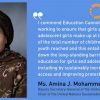
Statement by UN Deputy Secretary-general Amina J. Mohammed at ECW High-level Steering Group
As a friend and strong advocate of Education Cannot Wait, I welcome this opportunity to convey my support for ECW’s critical work and my solidarity with the millions of children and youth who are still being deprived of the opportunity to obtain a quality education because they are caught up in conflict, crisis or disaster.
No ‘Business as Usual’ for Children Post-COVID-19, say Laureates & Leaders
Addressing delegates at the end of the virtual 3rd Fair Share for Children Summit, 2014 Nobel Peace Laureate Kailash Satyarthi told global citizens that “business as usual” in dealing with COVID-19 is not going to be tolerated. “We’re not going to accept the miseries of child labour and trafficking to continue to be normal,” he said.
Save 70 million Lives Through #FairShare of COVID-19 Response Fund, Youth Urge Governments
Young people have added their voice in calling on world leaders to allocate at least 20 percent of the COVID-19 stimulus package to the marginalised children and youth.
Getting the Basics Right – India’s National Education Policy 2020
The National Education Policy 2020 (NEP) lays out a compelling, ambitious agenda for education reform in India. Yet, as others have noted, without concerted action the NEP’s promise will remain unfulfilled.
Hold Corporates Accountable for Using Child Labour, Nobel Laureates Urge World Leaders
The COVID-19 pandemic should give governments across the world an opportunity to hold corporates accountable against child labour. Kailash Satyarthi, the 2014 Nobel Peace Laureate, made this submission at the virtual 3rd Fair Share for Children Summit.

COVID-19 Pandemic an Opportunity to Re-evaluate How we Treat World’s Starving Children
While COVID-19 pandemic has affected the entire world, Nobel Laureates and world leaders have today expressed concern that ongoing crisis is far from being an equaliser. The pandemic has revealed that the most vulnerable and marginalised populations, including and especially children, remain largely unprotected against the virus and its impacts.
Caring for Poorest and Most Underserved Children Vital for Creating a Better World
Kerry Kennedy has a clear mission – along with Nobel laureates and leading international figures – she wishes to ensure that hard-won gains in children’s rights are not destroyed by the economic fallout from the COVID-19 pandemic.
Nobel Laureate Kailash Satyarthi on Where to Find the $1 trillion Needed for Marginalised Children
 Nobel Laureate Kailash Satyarthi says that $1 trillion can solve many of the problems the world's most marginalised communities are facing.
Exclusive: Kailash Satyarthi Warns over a Million Children Could Die Because of COVID-19 Economic Crisis
Nobel Laureate Kailash Satyarthi warns of the danger that over one million children could die, not because of the COVID-19 pandemic, but because of the economic crisis facing their families. In an exclusive interview with IPS, Satyarthi said that without prioritising children we could lose an entire generation as evidence mounts that the number of child labourers, child marriages, school dropouts and child slaves has increased as the COVID-19 pandemic spread across the globe.
COVID-19: Lessons from the Losses
If countries considered Universal Health Coverage (UHC) a central policy in their health systems, the COVID-19 has surely demonstrated the need for its urgent and widespread roll out. The pandemic has upended world systems in a manner that no scientists or sophisticated global intelligence could have foreseen.
Education Cannot Wait Responds to Beirut Explosion with US$1.5 Million in Education in Emergency Funding to Rehabilitate Damaged Schools
Education Cannot Wait (ECW) today approved US$1.5 million in new education in emergency funding in response to last month's explosion in Beirut.
World Risks Losing Entire Generation of Children, Nobel Laureates Warn
The COVID-19 pandemic has upended the lives of millions of people worldwide, accounted for over 869,000 deaths, destabilised the global economy and triggered a marked rise in poverty and hunger in the developing world. But the fallout from one of the most devastating consequences of the spreading virus is on the lives of a growing new generation: children.UNESCO urges action to meet rampant $200 billion annual funding gap for education in poorest countries due to COVID-19
New research by the Global Education Monitoring Report at UNESCO shows an increase in the annual funding gap for education in the poorest countries to as much as US$200 billion a year. These findings are published in the new paper, Act Now: Reduce the impact of COVID-19 on the Cost of Achieving SDG4.« Previous Page — Next Page »





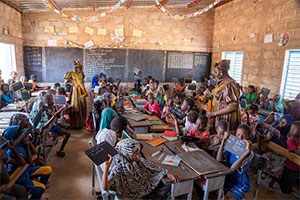 Two teachers work in a classroom in Forces Vives School in Dori, Burkina Faso. Credit: UNICEF/UNI978361
Safe and uninterrupted education is a fundamental right for all children. Education is paramount to global development, as it has been proven that investing in education – especially for girls and children – contributes significantly to economic growth and prosperity. Although more than 1 billion children go to school, many are subjected to conditions that are not conducive to a proper learning environment, including makeshift facilities, a lack of supplies, violence in classrooms, inadequate sanitation, untrained instructors, and widespread school closures. Since 2015, there have been immense gains in education with an increase of 109 million children in school. However, as of 2023, 272 million children are still out of school.
High poverty levels in developing countries also impede children’s access to a proper education. For example, from the early to mid 2000s, Sub-Saharan African nations witnessed a dramatic decline in trained teachers due to inadequate funding in the education sector. Furthermore, major cuts to United States international aid threaten an estimated 23 million additional children's access to education, as USAID‑funded school programmes across Africa and Asia face closure.
Various other factors contribute to the decline of education, notably hunger, which has increased as conflict and climate change interfere with global food production and dissemination. Meanwhile, certain social and cultural practices also impede children’s access to education, with gender inequality, discrimination, child labour, and child marriages preventing millions of children from attending school. Economic conditions such as the inaccessibility of higher education also affect disenfranchised communities across the world. In extreme situations, such as warfare where educational facilities are destroyed in their totality, notably in Gaza and Sudan, entire generations of children might grow up without access to education. Rebuilding educational infrastructure is a long and arduous process, especially when violence persists across generations, and this significantly stunts the development of societal prosperity and stability.
IPS is dedicated to telling the shocking truths about worldwide education through impassioned opinion pieces and comprehensive articles, highlighting global issues that impede worldwide education and the courses of action being taken by organizations such as UNICEF and Education Cannot Wait.

The Week with IPS

NEXT STOP - SDGs
Tracking global progress towards a sustainable world
Tracking global progress towards a sustainable world
