Languages
Sunday, October 18, 2026



News and Views from the Global South
Education

Time for a new Paradigm
The person most qualified to write the foreword for the latest work by Riccardo Petrella, In the Name of Humanity, would actually be Pope Francis, who, using other words but speaking of values and making denouncements, has often argued what the reader will find in its pages.
From Mali: A Lesson in Tolerance
We all adhere to generalizations. For example, while reading and speaking about Muslims and Christians, sweeping opinions might easily become prejudices, particularily if we do not know any individual behind the labels. When I some years ago was working for a Malian NGO, I met a marabout and a Christian who proved that devotees to different religions might find mutual support in their individual beliefs.
The Adolescent Girl Holds the Key to Kenya’s Economic Transformation and Prosperity
Teenage pregnancy in Kenya is a crisis of hope, education and opportunity. The countdown to a New Year has begun. Can 2019 be a year of affirmative action to ensure hope and opportunity for Kenya’s adolescent girl?
The Dark Shadows of Christmas
Christmas is expected to be a peaceful celebration of the birth of Jesus. A time to express love and care for one another. Jesus preached love and compassion, but also told us to be suspicious of imposters: “Beware of the false prophets, who come to you in sheep´s clothing, but inwardly are ravenous wolves”. Wolves are predators who disregard the suffering of their victims. A human wolf is an egomaniac ready to maim and murder, either to please himself or his master, often deluding himself by imagining he serves a higher purpose.
United Towards Achieving Health For All in Kenya
According to Director-General of the World Health Organization (WHO) Dr Tedros Ghebreyesus, the implementation of UHC is “more a political than an economic challenge”.
The Bond that is Educating Girls Across India
Barely five months into the start of Sneha's year at a government school in Bhilwara, a town in India's desert state of Rajasthan, the bubbly 15-year-old was pulled out by her parents. They wanted her to stay at home instead, to look after her four younger siblings and to cook and clean for the family as her parents worked on their farm.
Asia-Pacific Takes Stock of Ambitious Development Targets
Ministers and senior policymakers across Asia and the Pacific are gathered in Bangkok this week to focus on population dynamics at a crucial time for the region. Their goal: to keep people and rights at the heart of the region’s push for sustainable development. They will be considering how successful we have been in balancing economic growth with social imperatives, underpinned by rights and choices for all as enshrined in the landmark Programme of Action stemming from the 1994 International Conference on Population and Development, or ICPD.
Promoting Gender Equality On Front Lines
Last week’s announcement by the UK’s Department for International Development (DFID) of £50m ($64.3m) to help end female genital mutilation (FGM) is great news. The biggest ever financial commitment by any donor, it could be a game changer for the African-led movement to end this abhorrent subjugation of women.
Gender Inequality is Stunting Economic Progress
‘Do not let us off the hook; keep our feet to the fire’. These were the words of the UN Secretary General Mr. Antonio Guterres when he promised to personally lead the global body towards greater gender equality.
Culture, Migration and the Rise of Nationalism
The recent rise of nationalism in some western countries has been fuelled by an anti-immigration campaign based on the assumed negative influences migrants may have on the host country’s “culture”. Nationalists seem to conceive culture as a static concept. However, culture is not invariable, it develops and changes over time and as most things created by humans, it is also connected with power. Generally, when people define themselves as “cultured” they assert themselves as superior to others.
Stopping History from Repeating Itself
When Deputy Principal Rose was a student, there was a week every month that she dreaded: the period every twenty-eight days or so when she had her period. A keen student with an innate love of learning, she loathed this forced truancy.
Educating Children Starts With Parents
Neha is a first-generation learner. Her mother, Hema, a maid, wants her only daughter to grow up to become a government servant. This, according to her, will give her family security, stable water and electricity connections, and also an attached toilet, apart from a better living environment.
Teenage Pregnancy in Kenya: A Crisis of Health, Education and Opportunity
That almost one in five Kenyan teenage girls is a mother represents not only a huge cost to the health sector, but also a betrayal of potential on a shocking scale.
Creating Beauty and Worth from Bamboo Enhances the Livelihoods of Ghana’s Artisans
Yaw Owiredu Mintah from Ghana has been working as an all-round processor of bamboo and rattan since the 1980s. And while he says that he can do most things with bamboo like weaving, framing and finishing, he admits, “I need to improve my skills and designs because all of us are, most of the time, doing the same things.”Access and quality
THAT the State must make available a complete, adequate and integrated system of education is not debated. That everyone who desires to should be admitted to universities or colleges of their choice is not only debatable, it is false! More perverse yet is the proposition that when the State grants students the benefits of free tertiary education, the beneficiaries owe the State no service at all!
Women as Influencers
 The Migrants as Messengers awareness-raising campaign (MaM), developed by the International Organization for Migration (IOM), uses innovative mobile technology to empower migrants to share their experiences and to provide a platform for others to do the same.
Investing in Arab and Asian Youth For a Sustainable Future
As the youth population has increased to unprecedented levels in Arab and Asian regions, governments need to do more to invest in them.
Entrepreneurial about Gender Equality
Asia and the Pacific needs more women entrepreneurs. Women’s economic empowerment and gender equality depend on it, as does the inclusive economic growth needed to achieve the UN’s Sustainable Development Goals. This drives a new initiative by the United Nations Economic and Social Commission for Asia and the Pacific, generously supported by Global Affairs Canada, focused on improving women entrepreneurs’ access to finance in our region.
Q&A: Why Young and Smart Greenpreneurs are the Future of Sustainable Development
Young people – a growing population segment in developing countries – are intrepid innovators and entrepreneurs who can help solve pressing climate and development challenges today.
How Technology Has Changed Lives for the Better
Rose lives in Nairobi. Getting safe, reliable drinking water for her six daughters in the slum where they live used to involve risking disease from an illegally tapped water supply.
Levelling the Playing Field for Persons with Disabilities in the United States
When it was time for Joe Lupinacci to graduate from his high school in Stamford, Connecticut, he knew he wanted to go to college. While other students were deciding which college to apply to, the choice required more thought and research on Lupinacci and his parents’ part. Lupinacci, who has Down Syndrome, needed a college that would meet his needs.« Previous Page — Next Page »





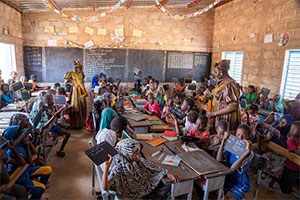 Two teachers work in a classroom in Forces Vives School in Dori, Burkina Faso. Credit: UNICEF/UNI978361
Safe and uninterrupted education is a fundamental right for all children. Education is paramount to global development, as it has been proven that investing in education – especially for girls and children – contributes significantly to economic growth and prosperity. Although more than 1 billion children go to school, many are subjected to conditions that are not conducive to a proper learning environment, including makeshift facilities, a lack of supplies, violence in classrooms, inadequate sanitation, untrained instructors, and widespread school closures. Since 2015, there have been immense gains in education with an increase of 109 million children in school. However, as of 2023, 272 million children are still out of school.
High poverty levels in developing countries also impede children’s access to a proper education. For example, from the early to mid 2000s, Sub-Saharan African nations witnessed a dramatic decline in trained teachers due to inadequate funding in the education sector. Furthermore, major cuts to United States international aid threaten an estimated 23 million additional children's access to education, as USAID‑funded school programmes across Africa and Asia face closure.
Various other factors contribute to the decline of education, notably hunger, which has increased as conflict and climate change interfere with global food production and dissemination. Meanwhile, certain social and cultural practices also impede children’s access to education, with gender inequality, discrimination, child labour, and child marriages preventing millions of children from attending school. Economic conditions such as the inaccessibility of higher education also affect disenfranchised communities across the world. In extreme situations, such as warfare where educational facilities are destroyed in their totality, notably in Gaza and Sudan, entire generations of children might grow up without access to education. Rebuilding educational infrastructure is a long and arduous process, especially when violence persists across generations, and this significantly stunts the development of societal prosperity and stability.
IPS is dedicated to telling the shocking truths about worldwide education through impassioned opinion pieces and comprehensive articles, highlighting global issues that impede worldwide education and the courses of action being taken by organizations such as UNICEF and Education Cannot Wait.

The Week with IPS

NEXT STOP - SDGs
Tracking global progress towards a sustainable world
Tracking global progress towards a sustainable world
