Languages
Monday, October 19, 2026



News and Views from the Global South
Education

‘Women Not Speaking at the Same Table as Men’ Means a Widening Digital Gender Gap in Africa
'Think Bigger', urge the colourful posters on the walls of Ideario, an innovation hub in Chamanculo, a modest neighbourhood in Maputo, Mozambique’s capital. The message is right on target for the new female trainees, eager eyes glued to laptop screens as they learn internet and computer skills.
Land, Water and Education, Priorities for Chile’s Mapuche People
The right to land and water, as well as to multicultural education, are the top priority demands of Mapuche leaders working with their communities in the Araucanía region and in Santiago, Chile’s capital.
Damning U.N. Report Outlines Crimes Against Rohingya As Children Suffer from Trauma One Year Later
At 12, Mohammed* is an orphan. He watched his parents being killed by Myanmar government soldiers a year ago. And he is one of an estimated half a million Rohingya children who have survived and been witness to what the United Nations has called genocide.
Music: Nigeria’s New Cultural Export
It is a cold evening in Antwerp, Belgium’s second-largest city, famous for diamonds, beer, art and high-end fashion. Inside a small restaurant, a mix of the latest American pop and rap—clearly enjoyed by diners—is playing on a radio. Nigerians Olalekan Adetiran and Adaobi Okereke, enjoying a kebab dinner, are startled when the radio begins playing the unmistakable “Ma Lo”—a catchy, midtempo and bass-laden song by popular Nigerian artistes Tiwa Savage and Wizkid.
States Must Act Now to Protect Indigenous Peoples During Migration
States around the world must take effective action to guarantee the human rights of indigenous peoples, says a group of UN experts. In a joint statement marking International day of the World’s Indigenous Peoples, the experts say it is crucial that the rights of indigenous peoples are realised when they migrate or are displaced from their lands:
Beyond Boundaries – Cultural Literacy in Indiana & Rwanda
For ten years now, in special partnership with the community of Musanze, Rwanda, Indiana University (IU) has created meaningful programs and connections across the country. It is an unlikely partnership, one that formed over 10 years ago with a university alum recognizing an opportunity for not only cultural literacy but friendship.
How the Yanadi, an Oppressed Indigenous People in India, are Reclaiming Their Rights One Village At a Time
Under the blazing midday sun, a tractor moves slowly along a dirt trail in Nacharwari Pallem, a village of the Yanadi indigenous people located some three hours from Chennai city in South India. Atop the tractor, women of the village – 36 in all – sit expectantly, ignoring the heat. Squeals of excitement fill the air as the tractor slowly halts near a stretch of rice fields.
Helping Indigenous Peoples Live Equal Lives
Although indigenous peoples are being increasingly recognised by both rights activists and governmental organisations, they are still being neglected in legal documents and declarations. Indigenous peoples are only mentioned in two of the 17 United Nations’ Sustainable Development Goals (SDGs) and only seen in two of the 230 SDG indicators, says indigenous rights expert Chris Chapman.
Slovakia Elevates SDGs to Status of National Priorities
At the High-Level Political Forum, which concluded mid-July, world leaders from 46 countries show-cased their progress in achieving the UN’s 17 Sustainable Development Goals (SDGs), including eradicating extreme poverty and hunger by 2030. All 46 countries produced voluntary national reviews (VNRs) aimed at facilitating the sharing of their experiences, including successes, challenges and lessons learned, with a view to accelerating the implementation of the 2030 SDG Agenda.
No Time to Slow Down While HIV/AIDS is Threatening a New Generation
As the 22nd International AIDS Conference wraps up in Amsterdam, I can’t help but reflect on how far we have come on this journey with the AIDS epidemic.
Educating Girls, The Only Road To Achieve the SDGs
Better and prolonged education can bring down high rates of illiteracy, sexual abuse and early marriage among girls.
Why the delay in implementation?
Eight years have passed since the education ministry had in principle decided to introduce a uniform or cluster system for university admission, yet, the government has failed to implement the system still after all these years. Even a decision to begin the uniform admission procedure with the agricultural universities from this year has been cancelled on grounds of “lack of time for preparations”, although the decision was made in November last year.
Age Appropriate Sexuality Education for Youth Key to National Progress
Fifty years ago at the International Conference on Human Rights, family planning was affirmed to be a human right. It is therefore apt that the theme for this year’s World Population Day is a loud reminder of this fundamental right.
Declining Birth Rates Not Exclusive to Wealthy Nations
Countries do not have to be economically prosperous to move from a situation of high birth and death rates to low fertility and mortality rates. Education, social security, environments conducive to economic development and good value systems are what promote this, as evidenced by the recorded experiences of Asian countries as far apart as Japan and India.
Breaking the Cycle of Child Labor in Peru
Most laborers in Peru are forced into a vicious cycle by circumstance. Faced with low-paying, high-intensity work, they have no choice but to make their children work as well. Having spent their lives neglecting education for labor, those children in turn grow up with no options for income besides low-paying, high-intensity positions - and so on. But in classrooms across one region, a handful of teachers are trying to break that cycle while the children are still young.
The Long and Short of The Digital Revolution
Digital platforms are recasting the relationships between customers, workers, and employers as the silicon chip’s reach permeates almost everything we do—from buying groceries online to finding a partner on a dating website.
EU Urged to Ban Early & Forced Child Marriages
Something historic was initiated at the European Development Days (EDD) in early June: the EDD placed women and girls at the forefront of Sustainable Development. Since its inception in 2006, EDD has become a barometer for ideas in global development.
Food Sustainability, Migration, Nutrition and Women
We worry about how we can continue to put food on our tables; and yet one-third of food is never eaten, instead being lost or wasted. We worry about eating properly, and yet in many countries, poor nutrition, obesity and micronutrient deficiencies are increasingly common. This trend is taking place in the Americas, Oceania, Asia, Africa and in Europe.
Trump is Here to Stay and Change the World
Donald John Trump, 45th and current president of the United States, has been seen in many illustrious circles as an anomaly that cannot last. Well, it is time to look at reality. If we put on the glasses of people who have seen their level of income reduced and are afraid of the future, Trump is here to stay, and he is a result and not a cause.
Fertility Struggles More Open – and Shared on Social Media
Fertility health is an incredibly personal – and often vulnerable – topic. Fertility, infertility, and fertility preservation have gained increased public interest over the past few years. Infertility is formally defined as the inability to achieve pregnancy after one year of unprotected intercourse.
Kenya Can End the Moral Indignity of Child Labour
On 12 June every year is the World Day Against Child Labour. In the world's poorest countries, around one in four children are engaged in work that is potentially harmful to their health.« Previous Page — Next Page »





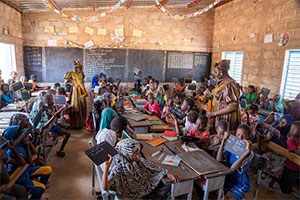 Two teachers work in a classroom in Forces Vives School in Dori, Burkina Faso. Credit: UNICEF/UNI978361
Safe and uninterrupted education is a fundamental right for all children. Education is paramount to global development, as it has been proven that investing in education – especially for girls and children – contributes significantly to economic growth and prosperity. Although more than 1 billion children go to school, many are subjected to conditions that are not conducive to a proper learning environment, including makeshift facilities, a lack of supplies, violence in classrooms, inadequate sanitation, untrained instructors, and widespread school closures. Since 2015, there have been immense gains in education with an increase of 109 million children in school. However, as of 2023, 272 million children are still out of school.
High poverty levels in developing countries also impede children’s access to a proper education. For example, from the early to mid 2000s, Sub-Saharan African nations witnessed a dramatic decline in trained teachers due to inadequate funding in the education sector. Furthermore, major cuts to United States international aid threaten an estimated 23 million additional children's access to education, as USAID‑funded school programmes across Africa and Asia face closure.
Various other factors contribute to the decline of education, notably hunger, which has increased as conflict and climate change interfere with global food production and dissemination. Meanwhile, certain social and cultural practices also impede children’s access to education, with gender inequality, discrimination, child labour, and child marriages preventing millions of children from attending school. Economic conditions such as the inaccessibility of higher education also affect disenfranchised communities across the world. In extreme situations, such as warfare where educational facilities are destroyed in their totality, notably in Gaza and Sudan, entire generations of children might grow up without access to education. Rebuilding educational infrastructure is a long and arduous process, especially when violence persists across generations, and this significantly stunts the development of societal prosperity and stability.
IPS is dedicated to telling the shocking truths about worldwide education through impassioned opinion pieces and comprehensive articles, highlighting global issues that impede worldwide education and the courses of action being taken by organizations such as UNICEF and Education Cannot Wait.

The Week with IPS

NEXT STOP - SDGs
Tracking global progress towards a sustainable world
Tracking global progress towards a sustainable world
