Languages
Sunday, October 18, 2026



News and Views from the Global South
Education

International Women’s Day Needs to Return to its Radical Roots
The theme for International Women’s Day this year doesn’t resonate with us. #BalanceForBetter brings to mind slow gradual change, and assumes that if you provide women and girls with equal access then the society will automatically be better. We know that’s false.
Criminality, School Dropout and Gender Equality
I assume it was the Swedish author Stieg Larsson´s Millenium trilogy (2005-2007) that generated the popularity of Scandinavian Crime Fiction, as well numerous movies and TV-series that followed in its wake. A typical Nordic Noir novel takes place within a gloomy landscape of dreary towns, or a semi-deserted countryside, where under the thin surface of an apparently well-ordered society, murder, misogyny, rape, racism and international crime syndicates are thriving.
The Misconceptions of Contraception
In light of rates of sexually transmitted infections (STIs) and unintended pregnancies, governments are exploring ways to tackle taboos around condoms. In a new study, the UN Population Fund (UNFPA) reviews the availability and accessibility of condoms, hoping to dismantle potentially harmful misconceptions.
Hate Speech Threatens Our Humanity
Do politicians’ words matter? Since becoming US President, Donald J Trump has dismissed his opponents and others he does not like as evil, stupid or both. He has referred to undocumented immigrants as animals, and to poor countries as shitholes.
Local School Is a Model for Energy and Water in Rapa Nui
A school in the capital of Easter Island (Rapa Nui, in the local indigenous tongue) gives an example of clean management with the use of solar energy, rainwater recovery and an organic vegetable garden, as well as rooms and spaces built with waste materials.
World’s Youth Are Being Left Behind
Globally, youth are being left behind in education and employment, threatening the future vision of sustainable, inclusive, and prosperous societies.
Intricacies of a Broken System: A Convict’s Tale
Inaccessible justice and socio-economic inequality act as core components of the United States criminal justice system. Thousands of individuals are denied their basic human rights and treated as a criminal “underclass” in what appears to be a perfectly “legal” and “just” system.
Reverse Engineering for SDGs
When young people from small towns and villages seek higher education they have to usually migrate to big cities leaving their local communities behind. On completion of their degree from the Universities, they generally prefer staying in cities, in search of a good job and a successful career. Though this is a standard practice, it is also a case of lost opportunities, especially for students who pursue higher education in agriculture. Here is why.
Roma the Movie: The Hidden Drama of Domestic Workers
Roma, a 2018 Mexican film written and directed by Alfonso Cuarón, is currently on a triumphal journey through the world. It won the Golden Lion at the Venice Film Festival, the best director and best foreign language film at the Golden Globe Awards, best director and best picture at the Critics´ Choice Awards, best film, best direction and best cinematography at the British Academy Film Awards. Furthermore, Roma has a record high ten nominations for the upcoming Academy Awards (The Oscars). Not at all bad for a black-and-white movie, which appears to have been directed by a sophisticated cineaste and custom-made for an art-house audience. Moreover, Roma deals with a highly controversial and seldom treated theme – the plight of poor, women domestic workers.
Seas of Death and Hope
The Mediterranean Sea is currently a sea of death. On the 20th of June every year, i.e. The World Refugee Day, an organization called UNITED for Intercultural Action publishes a “List of Deaths”, summarising information on where, when and under which circumstances a named individual has died due to the “fatal policies of fortress Europa”. The data are collected through information received from 550 network organisations in 48 countries and from local experts, journalists and researchers in the field of migration. The list issued in 2018 accounted for 27 000 deaths by drowning since 1993, often hundreds at a time when large embarkations capsize. These deaths account for 80 per cent of all the entries,1 there are probably thousands more dead, corpses that were never found and/or not accounted for.
A Truly Global Effort is Needed to Eradicate FGM by 2030
According to official data on the global prevalence of Female Genital Mutilation (FGM) released by UNICEF there are 200 million women and girls in the world who have been cut. Shocking though this statistic is, it seriously underestimates the nature and scale of the problem.
Ethics for artificial intelligence
Owing to our varied circumstances and experiences, there are contradictory tendencies to either exaggerate or underestimate the power and importance of artificial intelligence (AI) in contemporary society.
Back to the Future: Vietnam Now and Then
In 1989 I watched Back to the Future, Part II by Robert Zemickis, a complicated story about a youngster who from 1985 time travelled to 2015. Within the movie I spotted a poster from the imaginary 2015: US AIR Surf Vietnam. Back in 1989 I associated Vietnam with the war that lasted from 1955 to the fall of Saigon in 1975 and by different media was brought into the homes of millions, radicalizing and engaging youngsters, not the least me.
The story of a floating people
(The Daily Star, Bangladesh) - 14 Bede families have set up their oval-shaped makeshift tents on private land in Natun Torki, a village in Kalkini Upazila of Madaripur district. A branch of the Arialkha river flows on the west of Natun Torki. The area is well-known in Barishal for Torki Bandar, a narrow but flowing river on the west. The Bede huts are just on the outskirts of the crowded Natun Torki market.
Bullying is an “Infringement” on Children’s Rights
While rates have decreased, school violence and bullying is still a major global issue, contributing to lasting impacts on youth, a United Nations agency found.
Making Tourism More Responsible
Long before Joy Daniels became the manager of a travel company she was cleaning rooms at a guesthouse. But after joining a Fair Trade-certified business, a place that valued its staff, in a few years she was soon promoted to manager.
World’s First International Day of Education Could Not Come Soon Enough
Children´s education is in a state of emergency when it comes to protracted crises. 75 million school-aged children and young people are in desperate need of educational support, are either in danger of or are already missing out on their education in countries facing war and violence (1*).
A New Spectre is Haunting Europe
After Theresa May’s defeat in the British parliament it is clear that a new spectre is haunting Europe. It is no longer the spectre of communism, which opens Marx’s Manifesto of 1848; it is the spectre of the failure of neoliberal globalisation, which reigned uncontested following the fall of the Berlin Wall, until the financial crisis of 2009.
Is Love an Embarrassment?
I do not understand a word of Persian and cannot determine whether these lines, taken from a German translation, are a correct interpretation of Muhammad Hāfez-e-Shīrāzī´s original poem. Nevertheless, Hāfez, who lived 1315-1390 CE, was apparently one of those great writers able to provide bemused couples with points of reference after being struck by the tumultuous sensation of passionate love.
Argentina’s Indigenous People Fight for Land Rights
Nancy López lives in a house made of clay, wood and corrugated metal sheets, on private land dedicated to agriculture. She is part of an indigenous community of 12 families in northern Argentina that, like almost all such communities, has no title to the land it occupies and lives under the constant threat of eviction.
One Hundred Years of Solitude: Memories and Genocide
Denis Villeneuve´s film Blade Runner 2049 depicts a future where “bioengineered replicants” are used as slaves and killed if they misbehave. Replicants are manufactured and individualized as if they were real humans. They are even implanted with artificial memories, a measure intended to make them more “mental stable”, able to cope with their wretch existence as slave labourers. Dr. Ana Stelline, a character in the movie, explains how she manufactures memories:« Previous Page — Next Page »





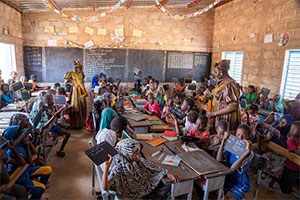 Two teachers work in a classroom in Forces Vives School in Dori, Burkina Faso. Credit: UNICEF/UNI978361
Safe and uninterrupted education is a fundamental right for all children. Education is paramount to global development, as it has been proven that investing in education – especially for girls and children – contributes significantly to economic growth and prosperity. Although more than 1 billion children go to school, many are subjected to conditions that are not conducive to a proper learning environment, including makeshift facilities, a lack of supplies, violence in classrooms, inadequate sanitation, untrained instructors, and widespread school closures. Since 2015, there have been immense gains in education with an increase of 109 million children in school. However, as of 2023, 272 million children are still out of school.
High poverty levels in developing countries also impede children’s access to a proper education. For example, from the early to mid 2000s, Sub-Saharan African nations witnessed a dramatic decline in trained teachers due to inadequate funding in the education sector. Furthermore, major cuts to United States international aid threaten an estimated 23 million additional children's access to education, as USAID‑funded school programmes across Africa and Asia face closure.
Various other factors contribute to the decline of education, notably hunger, which has increased as conflict and climate change interfere with global food production and dissemination. Meanwhile, certain social and cultural practices also impede children’s access to education, with gender inequality, discrimination, child labour, and child marriages preventing millions of children from attending school. Economic conditions such as the inaccessibility of higher education also affect disenfranchised communities across the world. In extreme situations, such as warfare where educational facilities are destroyed in their totality, notably in Gaza and Sudan, entire generations of children might grow up without access to education. Rebuilding educational infrastructure is a long and arduous process, especially when violence persists across generations, and this significantly stunts the development of societal prosperity and stability.
IPS is dedicated to telling the shocking truths about worldwide education through impassioned opinion pieces and comprehensive articles, highlighting global issues that impede worldwide education and the courses of action being taken by organizations such as UNICEF and Education Cannot Wait.

The Week with IPS

NEXT STOP - SDGs
Tracking global progress towards a sustainable world
Tracking global progress towards a sustainable world
