Languages
Wednesday, October 21, 2026



News and Views from the Global South
Education

Africa Grapples With Huge Disparities in Education
At the dawn of independence, incoming African leaders were quick to prioritize education on their development agendas. Attaining universal primary education, they maintained, would help post-independence Africa lift itself out of abject poverty.
Salvaging Our Higher Education
An Economist Intelligence Unit and British Council survey in 2014 reported that Bangladesh had the lowest employability among university graduates in South Asia—nearly half (47) of graduates out of a hundred were unemployed compared to 30 out of 100 in India and Pakistan. There are methodology issues about the calculation. Even then, they indicate a serious problem.
For Many Migrants, No Land Is Sweeter Than Home
Most migrants to Europe, Australia and the United States from Rangpur in northern Bangladesh leave home at a young age and return when they have just passed middle age.
Solving Japan’s Fertility Crisis
While much of the global discussion for decades has been focused on overpopulation and its consequences, less can be said of the risks of low fertility and an ageing population—risks that are currently threatening the future of Japan.Temporal Solace for Poor Schoolchildren
Amid the somber thoughts of Lent, poor families may find temporal solace in the announcement by the Commission on Higher Education (CHEd) on Monday that the free college education program will start this June, and will be extended to more qualified students.Oxford’s Neo-Orientalism
Slowly but surely the world is coming to terms with the gruesome reality of Burma's genocide of the Rohingyas. As early as 2015 London Queen Mary College's State Crimes Initiative alerted the international community of the ongoing genocide in Arakan. Hardly anyone paid heed to that ominous warning. Eventually, as the situation in Arakan took a turn for the worse, taking a heavy toll on Rohingya lives, livelihood and liberty, the progressive elements among the international community acknowledged the unpalatable reality.
A Whole New Decade for Water
As old and new challenges continue to threaten its access, the UN has dedicated the next decade in order to protect a crucial but fragile natural resource: water.
No Ordinary Match
The parched earth made for a tough football pitch, but the youth of Loresho Primary school were determined. It was blue against yellow- two teams competing for the coveted prize of pride and victory.
Water Stress Poses Greatest Threat to MENA Region
This year, World Water Day, celebrated annually on 22 March, is themed “Nature for Water”, examining nature-based solutions (NBS) to the world’s water problems.
The United Nations Strongly Supports Kenya’s Push to Achieve Universal Health Care
Mr. Maina Kiai’s account (Nation, 24 February) of the exciting dialogue hosted at Stanford University, USA does not present a true account of what transpired at that meeting.
Want to Learn How to Save a Planet?
The agricultural sector in the Mediterranean Area is facing tough challenges and incredible opportunities at the same time: beyond a shadow of doubt, the farming sector is experiencing a critical time of change and transition towards a new era.
We Must Protect the Future for Palestinian Refugee Girls
As people across the globe marked International Women’s Day (IWD) on March 8, the safe and secure education and possibilities for the future of millions of young girls and women who are Palestinian refugees across the Middle East remained in danger.
Press for Progress: Women’s Equality & Political Participation
March 8, 2018 International Women’s Day offers another opportunity to reflect on the progress made towards gender equality and women’s political rights.
I Am a Migrant and I Work in Rome
– Mika, age 35, arrived in Italy five years ago from Bangladesh, and actually came to Rome on a flight in search of work for a better life. He now works alongside other Romans in the outdoor food market in Piazza San Cosimato in Trastevere, selling food products, such as pasta, olive oil, spices and after dinner liquors, mostly from southern Italy. He is well versed in their ingredients, origins in Puglia and preparation process. He is there every day and feels good about the life he has created here.Projects from India and Morocco receive UNESCO King Hamad Bin Isa Al-Khalifa Prize for Innovation in Education
Paris 3 March—The 2017 UNESCO King Hamad Bin Isa Al-Khalifa Prize will be awarded to the CLIx programme (India) and the GENIE programme (Morocco) during a ceremony at UNESCO Headquarters on 7 March (12 noon to 1pm, Room I). Founded in 2005, the Prize recognizes two outstanding projects that make innovative use of Information and Communication Technologies (ICTs) in education.
A Step Towards the Light: Ending Human Trafficking
A new initiative aims to use data to shed light on a pervasive multi-billion dollar criminal industry: human trafficking. Created by the International Organization for Migration and Polaris, the Counter-Trafficking Data Collaborative (CTDC) is the world’s first human trafficking data portal.
Inequality also Relates to Education, Health & Illiteracy, not Wealth Alone
Antipoverty group Oxfam International got a lot of attention for claiming that there’s a global “inequality crisis,” but a far more important point is entirely neglected: globally, income distribution is less unequal than it has been for 100 years.
“No Time to Waste” in Ending FGM
More than 200 million women around the world have experienced some kind of female genital mutilation (FGM) and more could be at risk, a UN agency said.
Survival of Indigenous Tribes in Bangladesh Starts at School
Just before sundown on Jan. 30, a group of women day labourers from the Shantal indigenous community are in a rush to wind up their work harvesting potatoes in a field in the village of Boldipukur, some 15 km away from Rangpur district in northern Bangladesh.
Groups Condemn U.S. Cuts to Palestinian Refugee Agency
International organizations have criticized the United States’ decision to cut more than half of planned funding to a UN agency serving Palestinian refugees.UN Urges Comprehensive Approach to Sexuality Education
Close to 10 years after its first edition, a fully updated International Technical Guidance on Sexuality Education published today by UNESCO advocates quality comprehensive sexuality education to promote health and well-being, respect for human rights and gender equality, and empowers children and young people to lead healthy, safe and productive lives.« Previous Page — Next Page »





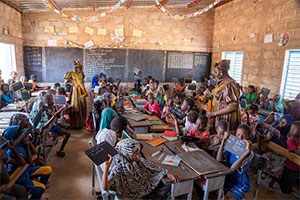 Two teachers work in a classroom in Forces Vives School in Dori, Burkina Faso. Credit: UNICEF/UNI978361
Safe and uninterrupted education is a fundamental right for all children. Education is paramount to global development, as it has been proven that investing in education – especially for girls and children – contributes significantly to economic growth and prosperity. Although more than 1 billion children go to school, many are subjected to conditions that are not conducive to a proper learning environment, including makeshift facilities, a lack of supplies, violence in classrooms, inadequate sanitation, untrained instructors, and widespread school closures. Since 2015, there have been immense gains in education with an increase of 109 million children in school. However, as of 2023, 272 million children are still out of school.
High poverty levels in developing countries also impede children’s access to a proper education. For example, from the early to mid 2000s, Sub-Saharan African nations witnessed a dramatic decline in trained teachers due to inadequate funding in the education sector. Furthermore, major cuts to United States international aid threaten an estimated 23 million additional children's access to education, as USAID‑funded school programmes across Africa and Asia face closure.
Various other factors contribute to the decline of education, notably hunger, which has increased as conflict and climate change interfere with global food production and dissemination. Meanwhile, certain social and cultural practices also impede children’s access to education, with gender inequality, discrimination, child labour, and child marriages preventing millions of children from attending school. Economic conditions such as the inaccessibility of higher education also affect disenfranchised communities across the world. In extreme situations, such as warfare where educational facilities are destroyed in their totality, notably in Gaza and Sudan, entire generations of children might grow up without access to education. Rebuilding educational infrastructure is a long and arduous process, especially when violence persists across generations, and this significantly stunts the development of societal prosperity and stability.
IPS is dedicated to telling the shocking truths about worldwide education through impassioned opinion pieces and comprehensive articles, highlighting global issues that impede worldwide education and the courses of action being taken by organizations such as UNICEF and Education Cannot Wait.

The Week with IPS

NEXT STOP - SDGs
Tracking global progress towards a sustainable world
Tracking global progress towards a sustainable world
