Languages
Thursday, October 22, 2026



News and Views from the Global South
Education

Tourism Should Be Regulated, Before It Is Too Late…
This year, we will have 3 million tourists each day wandering the world. This massive phenomenon is without precedent in human history and is happening (as usual), with only one consideration in mind: money. We should pause and take a look at its social, cultural and environmental impact and take remedial measures, because they are becoming seriously negative if things are left as they are.
Question Paper Leaks
It's that time of the year again, the season traditionally known for weddings and pitthas. But seasons undergo changes, and the winter can barely live up to its name anymore. And with that we should reconsider what things we associate with this time—a phenomenon that truly characterises this winter. I propose that the winter of 2017 be remembered as the season of question paper leaks, given the almost daily reports this month, sparing no grade, starting from class I.
“Only Our Youth Can Save the Planet” – Kumi Naidoo
"Today’s youth should think of new solutions for old problems like climate change and social injustice." That's the strong message of the South African activist Kumi Naidoo. The former executive director of Greenpeace says young people need to be more innovative and visionary, "because the solutions of my generation have failed."
Rise of Teenage Pregnancy Deters Development Goals
A few years ago, someone shared a video with me that deeply impacted me. It was called "The Girl Effect". In three minutes, the video demonstrates the fate of millions of girls and teenagers around the world.
The acclaimed art installation UNPACKED: Refugee Baggage opened for one month at UNICEF House on 5 December.
UNPACKED showcases testimonies of refugees resettled in the US. These testimonies tell their struggles and triumphs using suitcases; a testament to their resilience and powerful journeys.
Empowering Women Improves Communities, Ensures Success for Generations
At an event held on October 29 at the International Fund for Agricultural Development (IFAD) Gender Awards 2017, five countries were honored for impressive achievements in gender equality and women’s empowerment despite harsh conditions and numerous daunting situational and societal obstacles. The five countries are Bangladesh, Mozambique, Colombia, Morocco, and Mauritania. The IFAD supported projects in these countries have ambitious goals for a more egalitarian future. To date these projects have successfully provided women with decision-making opportunities, skill training, and increased autonomy through the development of their own livelihoods.
Girls in Afghanistan—and Everywhere Else—Need Toilets
"I never come here, just because of boys," Atifa says, pointing at the door of the stall. "They're opening the door." Atifa, a sixth grader in Kabul, Afghanistan, attends a school of 650 girls. Since they study in tents in a vacant lot, the only toilets the girls have access to are on the far side of the boys' school next door. The school is one of a very few for girls in the area, so some students walk over an hour each way to get there.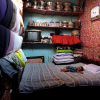
Nations without Nationality – An ‘Unseen’ Stark Reality
Here’s another ‘unseen’ stark reality—that of millions of people around the world who are deprived of their identity, living without nationality. Their total number is by definition unknown and their only ‘sin” is that they belong to an ethnic, religious or linguistic minority in the country where they have often lived for generations.
Adolescent Health Congress Skirts Issue of Abuse, Trafficking
Twenty-year-old Gogontlejang Phaladi of Mahalapye, Botswana is grateful she was never sent to a so-called “hyena” like scores of girls in neighboring Malawi were.
Stopping Child Marriage Forever
The mother moved in like a tigress to save her cub. In 2015, when her 13-year-old daughter Shumi Akhter was about to be married off, Panna Begum pleaded with her husband, Dulal Mia, to cancel the marriage he’d arranged for their daughter.
Rules and Regulations. We Need them to Protect Minimum Standards in Education
Two years have already passed since the global education goal, SDG 4, was set by governments. But the vision of that goal has not yet fully trickled down to the country level. We need to know who is responsible for achieving this goal.
Let’s Harness the Egalitarian Spirit of Sport for Global Cohesion
24 October has been celebrated as United Nations Day since 1948. In his message to the world the UN Secretary General, Mr Antonio Guterres remarked, “When we achieve human rights and human dignity for all people – they will build a peaceful, sustainable and just world”.
Good Men Should Not be Quiet Spectators in Sexual Assaults
The pain and anger of more than a million people who tweeted #MeToo in the last week have crowded social media with personal stories of sexual harassment or assault.
An Inequality Beyond Wealth: Gaps in Women’s Health
While many often focus on wealth disparities, economic inequality is often a symptom and cause of other inequalities including women’s access to sexual and reproductive health.
Driven to Extremes–How Poverty Fuels Extremism, and How to Help Africa’s Youth
Poverty is a blight, and one that disproportionately affects sub-Saharan Africa. It is a vast and complex issue whose tentacles reach into many areas, including climate change, sustainable development and–crucially–global security. The link between poverty and violent extremism is compelling, and means that if we want to address extremism, we must fight inequality too.
Can the Kenyan Lion Kick High Enough to Be the South Korean Tiger of Africa?
In 1953 South Korea emerged from the ravages of a debilitating war, yet the total gross domestic product in nominal terms has surged 31,000 fold since 1953.
Up to 100 Million Girls Vulnerable to Child Marriage
Over 20,000 girls are married before the age of 18 every day around the world as countries continue to lack legal protections, according to a new study.
More Public Spending, Not Tax Cuts, for Sustainable, Inclusive Growth
The Trump administration’s promise to increase infrastructure spending should break the straightjacket the Republicans imposed on the Obama administration after capturing the US Congress in 2010. However, in proportionate terms, it falls far short of Roosevelt’s New Deal effort to revive the US economy in the 1930s.
Even in School, More Than Half of All Children Aren’t Learning, Says UNESCO
Six out of ten children in the world are not achieving basic proficiency in reading and mathematics, a new report by the United Nations Educational, Scientific and Cultural Organization (UNESCO) shows.
Gov’t Actions, Not Religion, ‘Tipping Point’ for African Youths Joining Violent Extremism
Government action, rather than religious ideology, is a stronger predictor for radicalization in Africa, according to a two-year landmark study by the United Nations Development Programme (UNDP).
Monitoring Progress on UN’s Sustainable Development Goals
Two years ago, world leaders joined together to endorse a new and ambitious agenda not to reduce poverty but to eradicate it, not to lessen hunger but to end it once and for all, and not to overlook inequality but jointly to attack it.« Previous Page — Next Page »





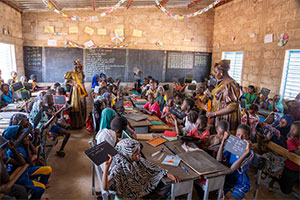 Two teachers work in a classroom in Forces Vives School in Dori, Burkina Faso. Credit: UNICEF/UNI978361
Safe and uninterrupted education is a fundamental right for all children. Education is paramount to global development, as it has been proven that investing in education – especially for girls and children – contributes significantly to economic growth and prosperity. Although more than 1 billion children go to school, many are subjected to conditions that are not conducive to a proper learning environment, including makeshift facilities, a lack of supplies, violence in classrooms, inadequate sanitation, untrained instructors, and widespread school closures. Since 2015, there have been immense gains in education with an increase of 109 million children in school. However, as of 2023, 272 million children are still out of school.
High poverty levels in developing countries also impede children’s access to a proper education. For example, from the early to mid 2000s, Sub-Saharan African nations witnessed a dramatic decline in trained teachers due to inadequate funding in the education sector. Furthermore, major cuts to United States international aid threaten an estimated 23 million additional children's access to education, as USAID‑funded school programmes across Africa and Asia face closure.
Various other factors contribute to the decline of education, notably hunger, which has increased as conflict and climate change interfere with global food production and dissemination. Meanwhile, certain social and cultural practices also impede children’s access to education, with gender inequality, discrimination, child labour, and child marriages preventing millions of children from attending school. Economic conditions such as the inaccessibility of higher education also affect disenfranchised communities across the world. In extreme situations, such as warfare where educational facilities are destroyed in their totality, notably in Gaza and Sudan, entire generations of children might grow up without access to education. Rebuilding educational infrastructure is a long and arduous process, especially when violence persists across generations, and this significantly stunts the development of societal prosperity and stability.
IPS is dedicated to telling the shocking truths about worldwide education through impassioned opinion pieces and comprehensive articles, highlighting global issues that impede worldwide education and the courses of action being taken by organizations such as UNICEF and Education Cannot Wait.

The Week with IPS

NEXT STOP - SDGs
Tracking global progress towards a sustainable world
Tracking global progress towards a sustainable world
