Languages
Saturday, November 7, 2026



News and Views from the Global South
Energy
U.S.: Nuke Plants Back in Vogue, as Climate Bill Stalls
After decades of debate, the United States is poised to build its first new nuclear reactors since the early 1970s.CLIMATE CHANGE: U.N. to Mobilise Funds for Developing Nations
After countries failed to reach a binding agreement on greenhouse gas emissions at the crucial Climate Change Conference in Copenhagen last December, the United Nations moving forward to enforce a pledge to help developing countries cope with the worst impacts.ENERGY: Planting New Seeds for the Take-Off
A salty, crunchy salad herb known to gourmands as samphire could revolutionise agriculture in the Middle East by providing food, fodder and fuel without using a single drop of freshwater.ENERGY: Nuclear Does Not Make Economic Sense Say Studies
The enormous technical and financial risks involved in the construction and operation of new nuclear power plants make them prohibitive for private investors, rebutting the thesis of a renaissance in nuclear energy, say several independent European studies.U.S.: Gas Prices, Economy Raise Stakes for Cleaner Cars
The Chinese auto industry surpassed the U.S. in car sales last year, according to a recent report, raising the question of whether this represents a bump in the road for the U.S. auto industry or a long-term shift to other means of transportation.
ENERGY-MEXICO: Big and Small Firms Harness Sun’s Rays
It was Isabel Cortés, the family matriarch, who started the project. In 1990, she started looking for a way to market xoconostle, the sour variety of the nopal cactus fruit that is abundant in this arid part of central Mexico, in the Mezquital valley.MIDEAST: Gaza Energy Crisis Averted – For Now
Pressure exerted on the Palestinian Authority (PA) by international and regional officials has given Gazans a last minute reprieve, albeit temporary, from plunging into darkness and plummeting temperatures.
ETHIOPIA: Dam Critics Won’t Go Away
Ethiopia is building a 240-metre high dam on the Omo River that is intended to end the country's electricity shortage and supply power to neighbouring countries. Not everyone's happy.U.S.: Ill Omens for Senate Climate Legislation
Delivering his State of the Union address before both houses of Congress and a global audience on Jan. 27, U.S. President Barack Obama asked for passage of "a comprehensive energy and climate bill with incentives that will finally make clean energy the profitable kind of energy in America."CLIMATE CHANGE: European Firms See Windfall in Renewable Energy
European governments failed to help along an international treaty to stop global warming at the United Nations climate change summit in December, but their engineering and power industries see business opportunities in renewable energy sources and their smart management.
ENERGY-PORTUGAL: Racing for Renewables
Just a decade ago, criticism rained down on sunny, windy Portugal for not making the most of nature's gifts to develop renewable energy sources. Now all signs indicate that it did not fall on deaf ears, as the country has become a leader in the field.
NIGERIA: No Oil Company Will Know Peace in the Creeks
Three flow stations in the oil-rich Niger Delta have had to be closed after a pipeline was sabotaged, according to Royal Dutch Shell.MIDEAST: Clean Energy Faces Tough Financial Climate
Renewable energy projects in the Middle East could be scaled back or scuttled unless fresh sources of financing are found.EUROPE: Privatised Services Back in Public Hands
After the wave of de-privatisation of water services facilities that started across the world two years ago, municipalities in Europe are now buying back the electricity utilities they sold to private investors in the late 1980s and early 1990s.
CLIMATE CHANGE: Wanted – Methane-Free Livestock
At first glance, the Riswick farm is just another modern agricultural facility: in the middle of broad cultivated fields stand recently built barns, similar to so many other farms across Europe.BIODIVERSITY: A Tipping Point on Species Loss?
Humanity is destroying the network of living things that comprise our life support system. While this sawing-through-the-branch-we're-perched-on is largely unintentional, world leaders can't say they didn't know what's going on: 123 countries promised to take urgent action in 2003 but have done little to stem the rising tide of extinctions in what's known as the extinction or biodiversity crisis.ENVIRONMENT: Seeking a Consumer Culture Revolution
The last 50 years have seen an unprecedented and unsustainable spike in consumption, driven by a culture of consumerism that has emerged over that period, says a report released Tuesday by the Worldwatch Institute.
EGYPT: Rooftops Empower the Poor
In one of the poorest and most populous neighborhoods of Cairo, Hussein Soliman and his family live in a small apartment that is a model of clean energy living.
TANZANIA: Addressing Energy Crisis Through Alternatives and Efficiency at Household Level
Tanzania's electricity grid is fed by a mixture of natural gas, diesel and hydropower; however, over the past few years the country has experienced severe blackouts and power rationing in urban areas due to drought and subsequent low-water levels.
CLIMATE CHANGE: Doors Opening for Carbon Tax
With the chance for a global climate change treaty on hold, a tax on greenhouse gases could be an effective alternative for discouraging the activities that create emissions, say economists and environmentalists.
ENERGY-ICELAND: Osmotic, Tidal Power Show Promise
Iceland already gets over 72 percent of its energy from renewable, hydroelectric and geothermal sources, but Icelanders are ambitious when it comes to energy and scientists are now looking at osmotic and tidal power to meet future energy needs.« Previous Page — Next Page »





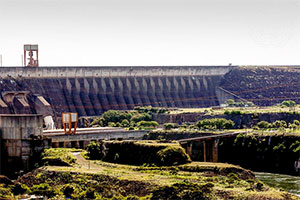 UN Power Plant, Paraguay. Credit: UN Photo/Evan Schneider
Energy has posed a great challenge for economies around the world. As global energy consumption skyrockets throughout the years, so does the need for sustainable solutions. The Sustainable Development Goals are essential in providing people with access to safe, affordable, and sustainable energy sources that minimize harm on the planet. Progress towards these goals opens the door for an advancement in modernization for communities on a global level and allows for a potential mitigation of tensions between nations.
The UN’s Summit of the Future in 2024 offered new initiatives that are being taken to achieve these goals, including a decreased reliance on fossil fuels, a switch to renewable energy sources, and improved climate financing.
IPS is well positioned to provide relevant, insightful, and compelling analysis of recent updates and measures being taken around the world to achieve a cleaner future.

The Week with IPS

NEXT STOP - SDGs
Tracking global progress towards a sustainable world
Tracking global progress towards a sustainable world
