Languages
Saturday, November 7, 2026



News and Views from the Global South
Energy
CLIMATE CHANGE: Copenhagen Fizzled, California Forges Ahead
As countries failed to reach a substantive climate change pact at Copenhagen last week, action at the subnational level has emerged as one of the likeliest paths toward significant climate action.U.S.: Aging Coal Plants Still a Fixture in South
As governments negotiate future greenhouse gas emissions in Copenhagen, a recent report from Environment America has highlighted the problem of the United States' older coal-fired power plants, which generated nearly three-quarters of U.S. carbon dioxide emissions from power plants in 2007.
CLIMATE CHANGE: ‘Cut Fossil Fuel Subsidies but Compensate the Poor’
Cutting governmental subsidies for fossil energy could lead to a 10 percent reduction in greenhouse gas emissions by 2050 as compared to 1990 levels, says a recent study by the Organisation for Economic Cooperation and Development.
CLIMATE CHANGE-CUBA: “Energy is an Instrument of Power”
"Energy is an instrument of power. Whoever has energy, controls the world," Cuban expert Luis Bérriz said in an address to Klimaforum, the civil society meeting being held in parallel to the UN conference on climate change in the Danish capital.
ARGENTINA: Solar Villages Light Up the Andes
The residents of the Puna, the dry Andean highlands in northern Argentina, are cut off from everything - except the sun. Living on arid land thousands of metres above sea level, they are on their way to becoming "solar villages."
ENVIRONMENT-ICELAND: Do-it-Yourself Renewable Energy Catches On
When Innovation Centre Iceland (ICI) managers began courses in farming renewable energy in October they were unprepared for the enthusiastic response from citizens.
Q&A: “We’re Here to Insert Some Reality into an Unreal Situation”
Bill McKibben is a U.S. writer, environmentalist and the founder of 350.org, an international climate campaign. His first book, "The End of Nature", was published in 1989 and is regarded as the first book written for a general audience about climate change.
CLIMATE CHANGE: From Dirty Fuels to Clean Technology
Tomorrow’s polluters are today’s emerging economies. To develop without retracing the polluting steps of the West, requires green technology, an expensive option for Africa.US: One Step Closer to Unilateral Sanctions Against Iran
Congress has given new momentum to a bill imposing unilateral sanctions on Iran - a move seen by many as an ineffective form of sanctions and potentially antagonistic against valuable U.S. allies on the U.N. Security Council. This comes ahead of the end of the year deadline set by U.S. President Barack Obama for Tehran to respond to a proposed agreement to export most of its enriched uranium for processing in Russia and France.FINLAND: Biodiesel Breakthrough or Environmental Nightmare?
As Finnish energy major Neste Oil scales up production of its ‘green’ diesel NExBTL, environmental activists fear that more land will go under palm oil plantations at the expense of Southeast Asia’s threatened rainforests.
CLIMATE CHANGE: Brazil Defends Biofuels
Being the world’s largest producer and exporter of ethanol it is natural for the Brazilian government and its partners to push biofuels as the only real alternative for a world trying wean itself away from fossil fuels that contribute to global warming.
CLIMATE CHANGE: Poor Vendors in Swaziland Worried by ‘Flora Protection Law’
For close to three decades, Jeremiah Mkhonta has earned a living by selling firewood by the roadside. It's not exactly lucrative: the father of 15 often goes for a fortnight without even selling a single four dollar bundle of firewood.
OIL: A Market Psychology of Fear?
With or without a binding deal at the climate talks in Copenhagen this month, it seems the world may have to cut its oil consumption, as emerging geological and economic trends limit the availability and affordability of petroleum.CLIMATE CHANGE: Negawatts and Smart Grids
Electricity is indispensable to modern life, but its generation is responsible for 40 percent of the carbon dioxide emissions that cause global warming and climate change.
ENERGY-MEXICO: Big Plans for Ethanol from Algae
The Mexican company BioFields will begin production in 2014 of an algae-based biofuel at a site 300 kilometres from its border with the United States, which is likely to be its biggest customer.
ENERGY-US: Paper Mill Is Reborn, Sans Fossil Fuels
A paper mill that runs without fossil fuels and has a neutral carbon footprint? That's the goal for Flambeau River Papers in Park Falls, Wisconsin, and the company is already on its way, thanks to a switch to biomass fuel, plus a biorefinery in the works.INDIA: Indo-U.S. Nuclear Deal on Track, But Kinks Remain
As Indian Prime Minister Manmohan Singh wound down his state visit to the United States, Indian analysts say a major achievement has been ensuring that the civilian nuclear agreement between the two countries is on track.DEVELOPMENT: Lights Out – World’s Poor Remain in the Dark
With the flip of a switch, a light comes on or an electric toothbrush revs to power. If service is cut, either for repairs or because of a natural cause, there will most likely be much fuss about how quickly power is restored - to people who live in the developed world.
ZAMBIA: Putting Waste to Work
When Obed Mumba first came to the Zambian copper mining town of Ndola in search of work, it was still known reverently as "Ku kalale" - the land of the white man. In the decades since, he has witnessed his Kabushi township outgrow the limited dreams of its planners.CLIMATE CHANGE: The Danish Example
Whether a new internationally binding treaty to reduce greenhouse gases and forestall climate change will be signed next month remains to be seen. What is clear though, is that if there is a place in the world that deserves to be the stage where this treaty ought to be signed, it is the Danish capital of Copenhagen.
ENERGY-TANZANIA: Charcoal a Dirty Trade-Off
The sun is setting slowly over Dar es Salaam's Tabata Changombe neighbourhood. Ameenah and Skukulu Juma lean against the corrugated iron walls of their makeshift charcoal shop.« Previous Page — Next Page »





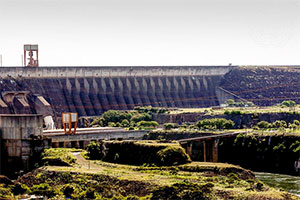 UN Power Plant, Paraguay. Credit: UN Photo/Evan Schneider
Energy has posed a great challenge for economies around the world. As global energy consumption skyrockets throughout the years, so does the need for sustainable solutions. The Sustainable Development Goals are essential in providing people with access to safe, affordable, and sustainable energy sources that minimize harm on the planet. Progress towards these goals opens the door for an advancement in modernization for communities on a global level and allows for a potential mitigation of tensions between nations.
The UN’s Summit of the Future in 2024 offered new initiatives that are being taken to achieve these goals, including a decreased reliance on fossil fuels, a switch to renewable energy sources, and improved climate financing.
IPS is well positioned to provide relevant, insightful, and compelling analysis of recent updates and measures being taken around the world to achieve a cleaner future.

The Week with IPS

NEXT STOP - SDGs
Tracking global progress towards a sustainable world
Tracking global progress towards a sustainable world
