Languages
Sunday, November 8, 2026



News and Views from the Global South
Humanitarian Emergencies

Collective Amnesia in Famine Response and Resilience-Building
The emerging drought-induced humanitarian crisis—prevailing in countries from Niger in West Africa to Somalia in East Africa—and conflict-driven famine conditions in South Sudan, Somalia, and Northeast Nigeria, have become a regular phenomenon.
Caribbean Rolls Out Plans to Reduce Climate Change Hazards
Climate change remains inextricably linked to the challenges of disaster risk reduction (DRR). And according to the head of the United Nations Office for Disaster Risk Reduction (UNISDR), Robert Glasser, the reduction of greenhouse gases is “the single most urgent global disaster risk treatment”.
FEATURED VIDEO: Searching for Solutions to Disaster Risk Management
 Climate change remains inextricably linked to the challenges of disaster risk reduction (DRR). And according to the head of the United Nations Office for Disaster Risk Reduction (UNISDR), Robert Glasser, the reduction of greenhouse gases is “the single most urgent global disaster risk treatment”.

Climate-Smart Agriculture – From Tanzania to Vietnam
As part of efforts to move towards "climate-smart" agriculture, several countries have shared In a meeting in Rome new experiences on how to produce food in ways that help farmers cope with the impacts of climate change and to reduce greenhouse gas emissions in agriculture.
20 Million People Could ‘Starve to Death’ in Next Six Months
Urgent action is needed to save the lives of people facing famine in North Eastern Nigeria, Somalia, South Sudan and Yemen, the UN leading food and agriculture agency’s chief on April 28 warned. "If nothing is done, some 20 million people could starve to death in the next six months."
Building resilient rural livelihoods is key to helping Yemen
People in Yemen are currently suffering from the world’s largest humanitarian crisis. More than 17 million people around Yemen’s rugged landscape are acutely food insecure, and the figure is likely to increase as the ongoing conflict continues to erode the ability to grow, import, distribute and pay for food. More than 7 million people are on the verge of famine, while the rest are marginally meeting the minimum day-to-day nutritional needs thanks to external humanitarian and livelihoods support. Large-scale famine is a real risk that will cast an awful shadow for generations to come.
Middle East, Engulfed by a ‘Perfect Storm’
A perfect storm has engulfed the Middle East, and continues to threaten international peace and security.
Civil Society: “Everyday Things Are Getting Worse” for Children in Yemen
Persistent attacks on health care in Yemen is severely impacting children’s well-being, civil society detailed at the launch of a report.
Yemen, World’s Largest Humanitarian Crisis
With 18.8 million people –nearly 7 in 10 inhabitants-- in need of humanitarian aid, including 10.3 million requiring immediate assistance, Yemen is now the largest single-nation humanitarian crisis in the world, the United Nations informs while warning that the two-year war is rapidly pushing the country towards “social, economic and institutional collapse.“
Financing Key to Reaching Everyone, Everywhere with Water & Sanitation
Eighteen months ago, UN member-states pledged a new set of goals on eradicating extreme poverty and creating a fairer, more sustainable planet by 2030. This week, we have alarming evidence that at least one of those goals – Sustainable Development Goal 6, to reach everyone everywhere with access to water and sanitation – is already in peril.
The Unbearable Cost of Drought in Africa
Nearly 50 per cent of all emergency multilateral food assistance to Africa is due to natural disasters, with advancing droughts significantly threatening both livelihoods and economic growth, warns the African Union through its ground-breaking extreme weather insurance mechanism designed to help the continent’s countries resist and recover from the ravages of drought.
The Ebola Crisis: Lessons Learned for Developing Nations
The Group of 77 has pointed out that the Ebola crisis of 2014-2015 proved that “no country is immune from a disease outbreak, no matter where it emerges”
World Must Act Now on Lake Chad Basin Crisis: FAO DG Graziano da Silva
Food assistance is a priority and the only way to prevent the crisis from worsening in the Lake Chad Basin, is to support food production according to José Graziano da Silva, Director-General of the Food and Agriculture Organization of the United Nations.
Humanity and Social Justice, a Must for the Future of Work – Ryder
“The future of work must be inspired by considerations of humanity, of social justice and peace. If it is not, we are going to a dark place, we are going to a dangerous place,” said the head of the leading world body specialised on labour issues.
No U.S. Refuge for Syrians Even After Military Strikes
U.S. President Donald Trump Thursday night described the deepening Syrian refugee crisis as partial justification for the first direct U.S. airstrike against the Syrian government, even though the United States still bans all refugees from Syria.
UN Strengthens Kenya’s Resilience to Disaster
Kenya’s lack of capacity to cope with wide-scale disaster has seen thousands of households continue to live precarious lives, especially in light of erratic and drastically changing weather patterns.
Work, What Future? Seven Big Questions Needing Urgent Response
Around the world, profound changes in the nature of work are underway, that’s clear. So it is a fact that the on-going transformations in the world of labour are disrupting the connection between work, personal development and community participation.
“Devastating Consequences” for Women, Girls as U.S. Defunds UN Agency
The U.S. has withdrawn all of its funding to the UN Population Fund (UNFPA), an agency that works on family planning and reproductive health in over 150 countries.
Brazilian Capoeira Heals Wounds in the DRC
On the earthen floor, to the sound of a single-string percussion instrument called a Berimbau, Congolese children stand in a circle practicing rhythmic movements with their arms and feet and chanting.
Two UN Experts Found Dead in DRC, Search Continues for Interpreter, Drivers
The bodies of two UN experts have been found in the Democratic Republic of Congo (DRC) two weeks after their team went missing.
Slaves
For over 400 years, more than 15 million men, women and children were the victims of the transatlantic slave trade, one of the darkest chapters in human history. Slavery is, nevertheless, far from being just a chapter of the past—it still there, with estimated 21 million victims of forced labour and extreme exploitation around the world--nearly the equivalent to of the combined population of Scandinavian countries.« Previous Page — Next Page »





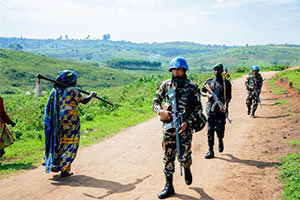 MONUSCO Peacekeepers and FARDC Soldiers Patrol Fataki Area. Credit: UN Photo/Jorkim Jotham Pituwa
Conflict, human rights violations, natural disasters, and famine have been at the forefront of concerns for humanitarian organizations. The escalation of humanitarian crises has led to over 239 million people in need of humanitarian assistance at the start of 2026, as estimated by OCHA’s Global Humanitarian Overview. The 2025 humanitarian appeal received only $12 billion, the lowest funding in over a decade, which has left 24 million fewer people reached in comparison to 2024. Conflict has remained the primary driver of crisis.
Humanitarian emergencies massively impact progress towards the Sustainable Development Goals (SDGs), adversely affecting economic development, inequality, education, planetary well-being, and poverty. Millions of people are faced with reduced access to essential services, including shelter, food, healthcare, and access to clean drinking water. UN Organizations such as UNHCR and the United Nations Children’s Fund (UNICEF) are committed to providing direct relief to affected communities when state governments cannot.
The United Nations 2024 Summit of the Future discussed measures that will be taken to reduce global inequality and promote peacekeeping efforts around the world. The recent UN Climate Change Conference (COP30) in Belém, Brazil, agreed to mobilize $1.3 trillion annually for climate action by 2035, operationalize the loss and damage fund, and triple adaptation finance. However, a fossil fuel transition commitment was not secured, despite climate change and the greenhouse effect being major contributors to humanitarian crises worldwide.
Countries across the world have also rallied to end humanitarian crises, as witnessed in conflicts such as Palestine and Ukraine. IPS is committed to providing relevant and in-depth reports of humanitarian emergencies around the world and their implications.

The Week with IPS

NEXT STOP - SDGs
Tracking global progress towards a sustainable world
Tracking global progress towards a sustainable world