Languages
Saturday, November 21, 2026



News and Views from the Global South
Development & Aid

From Irregular Migrant to Graduate Lawyer: One Woman’s Journey to Success
Masters of Laws student Khoudia Ndiaye will graduate from Senegal’s University Cheikh Anta Diop (UCAD) next year. The 24-year-old, who specialised in notarial law and dreams of becoming a notary, wants to bring justice closer to local communities like those in her local district of Hann Bel-Air, in Senegal’s capital Dakar, where she rarely sees female lawyers.
“No One Listened to Us!” The Ixiles of Guatemala
According to the Mexican Interior Ministry more than 7,000 Central American migrants have during the last month arrived at the US-Mexico border. Despite warnings by officials that they will face arrests, prosecution and deportation if they enter US territory, migrants state they intend to do so anyway, since they are fleeing persecution, poverty and violence. This is not new, in 1995 I visited Ixil and Ixcan, two Guatemalan areas mainly inhabited by Ixiles. My task was to analyse the impact of a regional development programme aimed at supporting post-conflict indigenous communities. United Nations has estimated that between 1960 and 1996 more than 245,000 people (mostly civilians) had been killed, or "disappeared" during Guatemalan internal conflicts, the vast majority of the killings were attributed to the army, or paramilitary groups.
Pakistan: Food Security and Reducing the Price of Wheat
Robert W. Fogel, the 1993 Nobel Prize Laureate for Economics, through his work on “efficiency wages”, pointed out that hungry and undernourished workers are not as productive as well fed and healthy workers. At the level of an individual firm, it would thus make sense for an employer to pay wages that are high enough to allow workers access to food and other necessities – even if such wages are higher than the going market rate.
African Media Poorly Represented at the United Nations Climate Change Negotiations
As negotiations at the United Nations conference on climate change come to a close, the highest expectation is that finally, there will be a rulebook to guide countries on what should be done to slow down greenhouse gas emissions that make the earth warmer than necessary, and how countries can adapt to the impacts of climate change.
Q&A: Many African Countries Already Live the Future of 2°C Warmer
As the United Nations climate conference nears an end, all eyes are on the negotiators who have been working day and night for the past two weeks to come up with a Rulebook for implementation of the Paris Agreement.
Decoding Article 6 of the COP24 Climate Negotiations
It is close to curtain call for the United Nations’ Climate Conference in Katowice, Poland, with ministers from around the world negotiating the text for a “rulebook” to implement the historic 2015 Paris Agreement for climate action. Amidst the various issues being debated, one of the most technical and complicated is Article 6 of the agreement, which focuses on the country plans for climate action.
Costa Rica: First Country to Protect Sustainable Fisheries of Large Pelagics Species
Twelve years ago, in a restaurant in Puntarenas on the pacific coast of Costa Rica, a group of long line fishermen met with three UNDP conservation specialists.
Q&A: Making Green Growth a Success Across the Globe
When the Global Green Growth Institute’s (GGGI) Director General Frank Rijsberman’s son was looking for a job following graduation, he saw that oil companies were paying the highest salaries. But Rijsberman, who has been working in the sustainable development sector for decades, knew better. He told his son that those very same oil companies would soon go broke. And instead advised him to seek employment with renewable energy companies as they would soon be the ones making money.
Why Did You Come to Marrakech?
The whole world met at Marrakech, Morocco, during the two days of the Global Compact for Migration. IPS met six people to ask what led them to come to this international event.

Q&A: Conflict in Africa makes Migration Compact Useless
The recently adopted Global Compact for Safe, Orderly and Regular Migration continues to generate enormous debate as to its pros and cons. Evans Tekenge Manuika, head of Association des Travailleurs Immigrés au Maroc, who spoke to IPS at the conference, warned that the Compact will remain a dead letter without peace in Africa.
Reactions on the Ground to the Global Compact for Migration
This week the famous and beautiful Moroccan city of Marrakech is hosting the intergovernmental conference on the Global Compact for Safe, Orderly and Regular Migration (GCM), accompanied by a multitude of civil society events among the city’s palm-tree-lined streets. IPS spoke with a number of participants from different backgrounds about the adoption of the GCM and what it means for the future of migration and migrants.
GCM Adoption: An Approval for Change or Business as Usual?
The Global Compact on Migration is now official. But what next? To get a better idea, IPS spoke to journalists and representatives of civil society attending the Global Compact for Safe, Orderly and Regular Migration (GCM) conference to find out their views on what it might achieve when to comes to “safe, orderly and regular migration.”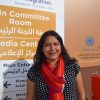
Q&A: How Will the Global Compact for Migration Aid the Work of Civil Society
Claudia Interiano from Fundación para la Justicia y el Estado Democratico de Derecho, a Latin American organisation that works to access justice for persons killed or missing during transit through Mexico to the United States, spoke to IPS about the foreseeable future of migration in a world after the end of the Global Compact for Safe, Orderly and Regular Migration (GCM) conference.
Final Thoughts as the Global Compact for Migration Starts its Own Long Journey Against the Odds
As the red carpets are rolled up in Marrakesh after two days of intense declarations and commitments by more than 160 countries, what are the smaller players in this global phenomenon taking back with them?

New Science Shows Climate-Smart Farming is Within Reach
Until the United Nations climate talks in Bonn last year, no clear plan to include agriculture in climate negotiations existed. This was troubling, considering agriculture contributes 19-29% of global greenhouse gases, and changing temperatures are making it harder to farm. This is having an increasingly prominent effect on food security -- hunger levels have now risen for the third year in a row.
Political Commitment Key to Health for All
One of my proudest accomplishments as the former UN secretary-general was playing a part in the ambitious global agenda for sustainable development (SDGs), including the goal of universal health coverage (UHC) by 2030.
Bamboo — the Magic Bullet to Rapid Carbon Sequestration?
As thousands of environmental technocrats, policy makers and academics work round the clock to come up with strategies for mitigation and adaptation to climate change at the United Nations’ conference in Katowice, Poland, one scientist is asking Parties to consider massive bamboo farming as a simple but rapid way of sequestering carbon from the atmosphere.
Time to Follow EU’s Lead & Step Up Climate Action with 2050 Plans
As climate negotiators, experts and activists are gathering in Katowice, Poland, for the international climate talks, much of the focus will be on immediate issues. Laying down the ground rules of the 2015 Paris Agreement and wrapping up the first global review of countries’ progress to date are high on the agenda.
Radio Migration – the Station with a Different Message about Migration
The topic of migration has been beaming across the airwaves of Marrakech, Morocco, to bring light to the Global Compact for Safe, Orderly and Regular Migration conference (GCM) and all its myriad components.
“No to the pact of Marrakech!”
 At the same time more than 160 countries adopted the Global Compact for Safe, Orderly and Regular Migration (GCM), on the streets of Marrakech pro-migration groups and activists gathered in the city centre to chant: “No to the pact of Marrakech!”

A Migrant Turned Saviour of Others
Seven years ago, when Cameroon began experiencing inter-regional conflict, Armand Loughy, a 55-year old Cameroonian psychiatrist, strapped her youngest child on her back and with her five other children embarked on the dangerous Journey from Cameroon towards Rabat, Morocco’s capital. They fled the deteriorating security situation in Cameroon, looking for a better life.« Previous Page — Next Page »


 2026 High-level Political Forum on Sustainable Development. Credit: UN Photo/Eskinder Debebe
In 2015, the United Nations and its Member States adopted the Sustainable Development Goals (SDGs) in an effort to make the world a more sustainable and peaceful place for future generations. Progress on the 17 SDGs has been uneven, and inequality persists across the globe. 10 years after adoption, the 2025 UN SDGs Report revealed that only 35% of the SDG targets are on track, with more than half moving too slowly, and 18% moving backwards from the 2015 baseline. Poverty remains one of the world’s most pressing issues, with hunger, violence, and inequality impeding the opportunities for all people to achieve success. In September 2024, the United Nations Summit of the Future introduced a new goal: to eradicate global poverty by 2030, ensure universal rights to basic services, and increase the overall standard of living in terms of industrialization, economic well-being, citizen health, and literacy. Furthermore, recent shifts in United States foreign aid policy – notably, major budget cuts to USAID and the termination of thousands of development programmes– have severely threatened vital lifelines of financial aid to impoverished communities around the world. Additionally, the United States’ withdrawal from the Paris Climate Agreement has undercut international efforts at sustainable development. With the upcoming 2030 deadline, the UN Secretary-General has called for urgent multilateralism across six priority areas: food systems, energy, digital connectivity, education, jobs and social protection, and climate and biodiversity. IPS sheds light on marginalized communities that struggle on a daily basis to survive and have their stories heard and respected.
Updated by Yilan Batista and Shuli Wong August 2026

The Week with IPS

NEXT STOP - SDGs
Tracking global progress towards a sustainable world
Tracking global progress towards a sustainable world
