Languages
Wednesday, November 11, 2026



News and Views from the Global South
Population
BULGARIA: Roma Treated like Trash
Recent violent episodes involving Roma in Bulgaria emphasise the deep prejudice against this ethnic group, as well as politicians' intention to turn anti-Roma feelings into electoral gains.HEALTH: No Sex Education Please – We’re Indian
Though adolescents are said to be at the centre of the AIDS epidemic and India has the largest number of infections in Asia, this conservative country continues to shy away from incorporating sex education in school curricula.MIGRATION: Big Investor? Welcome to Portugal
Portugal’s new immigration law has drawn fire from foreign workers’ associations, who accuse the authorities of favouritism towards university graduates and those who have plenty of money to invest in the country.DEVELOPMENT: EU Parliament May Insist on Health Aid
The European Union's only directly elected body is demanding increased aid for basic health and education in poor countries before it approves next year's budget for the 27-nation bloc.SRI LANKA: Calls for Int'l Intervention Met With Chauvinism
When Sri Lankan health minister Nimal Siripala de Silva shocked delegates to the 8th International Congress on AIDS in Asia and the Pacific (ICAAP) by telling them that "when the western world was living in jungles, we were leading a civilised life,’’ it marked the chauvinism of President Mahinda Rajapakse’s nationalist government.
ELECTIONS-GUATEMALA: Rigoberta Menchu Running for the Long Term
The first indigenous woman candidate for president of Guatemala, Rigoberta Menchú, is behind in the polls, but the very fact that she is standing is an important precedent and a sign that the political system is more open, analysts say.MEXICO-US: 32-Year-Old Immigrant Never Dreamed She Would Become a Symbol
Elvira Arellano, the undocumented Mexican immigrant who took refuge in a U.S. church for a year before she was deported and separated from her eight-year-old son never imagined becoming the face of the struggle for immigrant rights. "But now that I am, I hope to help change the reputation of ‘terrorists’ that they have pinned on us," she said.DOMINICAN REPUBLIC: Children of Haitians Fight for Birth Certificates
Authorities in the Dominican Republic are denying growing numbers of people of Haitian descent identity documents on the argument that their parents are illegal immigrants.EAST TIMOR: Keeping Youth Off Political Violence
Once a month, 24-year-old Emilia Soares scours the streets of her neighbourhood persuading youth to attend a local assembly. She is a youth leader in Suco Bidau Santana, a residential area in the east of the capital and one of the rare ones who escaped the civil strife of the last few years.ITALY: Boats, Deaths, the Usual
Mid-August, a normal week in Lampedusa, a small Italian island in the Mediterranean Sea. In all, 439 illegal migrants, including a 15-day old baby, arrived from North Africa in old motorboats. The same week, 20 bodies were found off the coast, victims of earlier shipwrecks.HEALTH-SOUTH-EAST ASIA: Fortified Flour – Key Nutrition Strategy
When Indonesian women and children tuck into cups of ‘Indomie’, a popular brand of instant noodles, they are assured a tasty staple healthier than most other brands sold across South-east Asia.PERU: Anti-Poverty Plan Shrouded In Mystery
Peruvian President Alan García says that one of the pillars of his strategy to radically reduce poverty in his country is a new plan which, although it is fully operational, remains a mystery to the majority of Peruvians.BRAZIL: New Security Plan Combines Prevention and Punishment
After deploying the federal police in Brazil’s most violent cities, the government of Luiz Inácio Lula da Silva is now implementing integrated social policies as the preventive arm of its new public security programme.
ARGENTINA: From Wetlands to Desert, But No One Listening Upstream
The western portion of the Argentine province of La Pampa was a veritable oasis 50 years ago, with natural vegetation, thriving crops and abundant livestock. But the arbitrary management of the Atuel river upstream in the neighbouring province of Mendoza has transformed what were once wetlands and fertile farmland into a desert.BRAZIL: Controversial Bill to Sterilise Younger Women
A draft law to reduce the minimum age for women to undergo voluntary sterilisation in Brazil’s public hospitals from 25 to 18 is vigorously opposed by the government.NICARAGUA: ‘Invisible’ Victims of Pesticide Protest Government Neglect
For months, more than 3,000 Nicaraguans in a makeshift camp in the centre of Managua have been demanding a government response to their health needs and legal backing for their cause. They have been poisoned by the pesticide Nemagon, but in spite of their protests they are apparently invisible to those in power.COLOMBIA: FARC Hostages Died in Military-Rebel Shootout
The deaths of 11 of the 12 regional lawmakers being held hostage by Colombia’s FARC rebels may have occurred in the midst of fighting between the insurgents guarding the hostages and the "Junglas", an elite military unit, according to a reconstruction of events based on interviews by IPS.CULTURE-JAPAN: Theatre as Trauma Therapy for Children
Theatre can help children cope with violence they face during conflict situations, says a group of professional directors and peace activists.ENVIRONMENT-MEXICO: High Voltage Conflict Over Dam
Campesinos in the southern Mexican state of Guerrero have been blocking access to an area where the government wants to build a huge dam and hydroelecric station, since 2003.LABOUR-UAE: Illegal Immigrants Grab Amnesty Offer
Long queues, desperate hearts and hopeful faces - these days a human drama unfolds outside many an embassy in the United Arab Emirates (UAE).HEALTH-ASIA: Hope Sets Tone for AIDS Congress
The 8th International Congress on AIDS in Asia and the Pacific (ICAAP) opened here with a strong message of hope, anchored on the fact that the world's most populous region still has relatively low prevalence rates of HIV despite problems of poverty, discrimination and stigma.« Previous Page — Next Page »





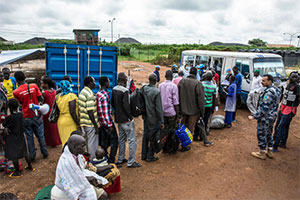 One Thousand Internally Displaced Persons (IDPs) Relocated from Tomping Camp in South Sudan. Credit: UN Photo/Isaac Billy
It took hundreds of thousands of years for the world’s human population to cross one billion in 1804. Approximately 200 years later, the population has multiplied sevenfold. In 2023, the global population crossed 8 billion, and is expected to reach 9 billion before 2050. With the planet more crowded than ever, it is essential to keep track of population trends, urbanization, migration, and reproduction across the world.
Life expectancy has seen significant strides in the past century, largely due to economic development and increased standards of living. On the contrary, trends in global fertility are shifting, with certain regions in Africa and Asia reporting higher rates, while parts of Europe and North America report stagnant or lower rates. This is in part due to differences in sexual and reproductive healthcare, as well as societal and economic conditions around the world. For example, child marriage is prevalent in certain societies, where childbearing is also considered a familial duty. Meanwhile, stagnating economies frequently experience lower marriage and childbearing rates.
The increase in migration and urban development around the world is also linked to global population trends. By 2050, it is expected that approximately 66 percent of all people will live in cities. Furthermore, global crises such as warfare and natural disasters also prompt transnational migration. Transnational migration is linked to a variety of socioeconomic issues in both host and receiving countries: migrants often leave developing countries with less access to educational and economic opportunities and arrive in developed countries where they are frequently the targets of ethnic, racial, and cultural discrimination, and economic exploitation. Recent crises in Europe and the United States demonstrate the importance of advocating for migrants worldwide. As migrants from the Global South are increasingly stripped of their legal and civic rights in unlawful deportations, or targeted in acts of identity-based violence, it is essential to keep track of population trends and protect the human rights of migrant populations. Climate-related disasters are now a major driver of displacement, with nearly half of all new internal displacements in 2025 being disaster-related.
IPS is devoted to covering issues surrounding population trends, migration, and reproduction through its compelling articles, which use both statistics and human stories to provide readers with robust and informative viewpoints.

The Week with IPS

NEXT STOP - SDGs
Tracking global progress towards a sustainable world
Tracking global progress towards a sustainable world
