Languages
Wednesday, November 11, 2026



News and Views from the Global South
Population
INT’L WOMEN’S DAY: Mexican Rape Victims Denied Right to Abortion
A woman or girl is raped every four minutes on average in Mexico. But if they get pregnant, there is no guarantee that their right to an abortion as rape victims will be recognised, due to administrative hurdles and outright obstruction by authorities, says a new report released Tuesday.WOMEN-CHILE: Sexual and Reproductive Rights, Now!
The first annual report by the Chilean Observatory of Gender Equity in Health calls for legislation on sexual and reproductive rights for women, making therapeutic abortion legal once again, and making emergency contraception available to all women.VENEZUELA: Land Reform Tripped Up by Red Tape, Lack of Planning
The Venezuelan government has distributed more than two million hectares to 160,000 landless rural families over the last three years in an agrarian reform effort that has been marked by a certain lack of planning, say experts.INT’L WOMEN’S DAY: Activists in Chile Elated, But Won’t Let Down Their Guard
Although they are pleased that Michelle Bachelet will become Chile's first female president, just three days after International Women's Day (Mar. 8), women's organisations in this South American country will make it clear on Wednesday that they have no plans to let down their guard.AGRICULTURE: FAO and Brazil Resuscitate Agrarian Reform
The second International Conference on Agrarian Reform and Rural Development (ICARRD), taking place this week in the southern Brazilian city of Porto Alegre, will be dusting off long-buried issues. The first edition took place 27 years ago in Rome.ARGENTINA: Young Women Lured into Trafficking by Job Ads
The ads read: "presentable young ladies", "no qualifications or experience required", "easy work," "good conditions," and "hours by arrangement". They often offer salaries of over 2,000 dollars.MIGRATION-LATIN AMERICA: Many Women Seek New Life Across Borders
Seven years ago, Melania decided to leave her native Peru to try her luck as a domestic employee in Chile, prompted by the difficult economic situation in her home country. She was followed soon after by her boyfriend and, later, her two sisters.JAPAN: Wives Stash Cash to Freedom
Masami, 57, is waiting for the day when she can divorce her husband, a respected professor of medicine she married 32 years ago.AFRICA: Warming Threatens Key Water Sources
Declines in rainfall caused by global warming threaten rivers and other local sources of fresh water in densely populated areas of Africa, according to a new study published here by Science magazine Friday.MEXICO: Miners Strike in Support of Union Leader
The recent deaths of 65 miners in Mexico gave rise to a spate of allegations of corruption and complaints of exploitative working conditions in the mining industry, whose national union has gone on strike.PERU: Rights of Isolated Indigenous Communities Violated by Amazon Pipeline
A report by the Office of the People's Defender in Peru states that the basic rights of indigenous communities living near the Camisea gas field have been affected by the foreign companies operating in the country's Amazon jungle region.DEVELOPMENT-ARGENTINA: The Forgotten North
Poverty and unemployment rates are on the wane in Argentina, and infant mortality is also in retreat. But these ills are holding out in the neglected north, which has been bypassed by development.EDUCATION-BRAZIL: Bill Would Reserve Quotas for Blacks, Indigenous Students
Universities, which have traditionally reproduced or heightened social inequality in Brazil by consolidating the position of the wealthy élite, are now being called upon to do the opposite, by opening their doors preferentially to the poor, and to blacks and indigenous people.CHILE: Mapuche Political Party to Pursue Autonomy
The first Mapuche political party will be founded this year, to seek autonomy and self-government for the largest group of indigenous people in Chile. But a rocky road lies ahead.MIDEAST: Israeli Russians Could Swing the Vote
Although Israeli pollsters peg the Kadima Party as the frontrunner in winning next month's elections, it is still uncertain who will secure the coveted Russian vote that always plays a critical role on polling day.HEALTH: AIDS Stigma, a Major Hurdle in the Caribbean
The discrimination that people living with HIV face on a day-to-day level in the Caribbean results in frequent violations of their basic rights and is a major hurdle to the implementation of anti-AIDS programmes, say U.N. officials..COLOMBIA: France Calls for Hostage Swap
At 5:08 AM Thursday, Colombian journalist Herbin Hoyos announced on the Caracol Radio station that he had French Foreign Minister Philippe Douste-Blazy on the line.RELIGION: Christian Churches Call for Dialogue with Muslims
Dialogue has been one of the most frequently mentioned words at the ninth assembly of the World Council of Churches (WCC), which ends Friday in this southern Brazilian city after 10 days of debates marked by the controversy triggered by the publication of caricatures of the Prophet Muhammad in newspapers in Europe.MIGRATION-LATIN AMERICA: Unmarked Graves Across the U.S. Border
Sex: male. Age and nationality: unknown. Cause of death: drowning. Place and date: U.S. southern border, October 2005. This is the stark record left behind by a Latin American migrant who now lies in an unmarked grave, like thousands of others who have died without reaching their goal.POLITICS-ASIA: People Power Fizzling Out?
She was pregnant with her first child, and a woman on the run. She was on a ''wanted list'' for her human rights campaigns. She had little choice but to go ''underground'' to escape the brutal clutches of the dictatorship.CHILE: Indigenous Children Torn Between Farm Work and Homework
They dream of becoming doctors, lawyers or reporters, but they are more likely to face a future of working as chauffeurs or domestics. Raised in poverty, Aymara and Mapuche indigenous children from the northern and southern regions of Chile tend to drop out of school to go to work.« Previous Page — Next Page »





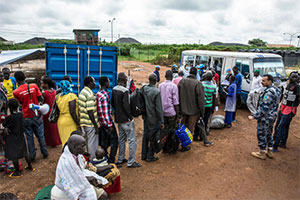 One Thousand Internally Displaced Persons (IDPs) Relocated from Tomping Camp in South Sudan. Credit: UN Photo/Isaac Billy
It took hundreds of thousands of years for the world’s human population to cross one billion in 1804. Approximately 200 years later, the population has multiplied sevenfold. In 2023, the global population crossed 8 billion, and is expected to reach 9 billion before 2050. With the planet more crowded than ever, it is essential to keep track of population trends, urbanization, migration, and reproduction across the world.
Life expectancy has seen significant strides in the past century, largely due to economic development and increased standards of living. On the contrary, trends in global fertility are shifting, with certain regions in Africa and Asia reporting higher rates, while parts of Europe and North America report stagnant or lower rates. This is in part due to differences in sexual and reproductive healthcare, as well as societal and economic conditions around the world. For example, child marriage is prevalent in certain societies, where childbearing is also considered a familial duty. Meanwhile, stagnating economies frequently experience lower marriage and childbearing rates.
The increase in migration and urban development around the world is also linked to global population trends. By 2050, it is expected that approximately 66 percent of all people will live in cities. Furthermore, global crises such as warfare and natural disasters also prompt transnational migration. Transnational migration is linked to a variety of socioeconomic issues in both host and receiving countries: migrants often leave developing countries with less access to educational and economic opportunities and arrive in developed countries where they are frequently the targets of ethnic, racial, and cultural discrimination, and economic exploitation. Recent crises in Europe and the United States demonstrate the importance of advocating for migrants worldwide. As migrants from the Global South are increasingly stripped of their legal and civic rights in unlawful deportations, or targeted in acts of identity-based violence, it is essential to keep track of population trends and protect the human rights of migrant populations. Climate-related disasters are now a major driver of displacement, with nearly half of all new internal displacements in 2025 being disaster-related.
IPS is devoted to covering issues surrounding population trends, migration, and reproduction through its compelling articles, which use both statistics and human stories to provide readers with robust and informative viewpoints.

The Week with IPS

NEXT STOP - SDGs
Tracking global progress towards a sustainable world
Tracking global progress towards a sustainable world
