Languages
Saturday, November 21, 2026



News and Views from the Global South
Poverty & SDGs
HEALTH-BRAZIL: Older Women at Higher Risk from AIDS
The HIV infection rate in women over 50 in Brazil has more than tripled since 1996, making this population group the prime target of the government's HIV/AIDS prevention campaign during the carnival festivities.
Q&A: 'Move Beyond Goodwill To Action'
Efforts to free fiscal resources for social spending over the past few years have started to pay off in Zambia, where government is reporting a positive trend of poverty alleviation and social development. But progress is uneven.
INDIA/PAKISTAN: Peaceful Pink Panties to Tame Right-Wing Goons
Outraged by an attack by right-wing Hindu militants on women emerging from a pub in Mangalore, Karnataka state, activists in India have initiated a ‘Pink Chaddi’ (underwear) campaign in which they are sending pink panties to members of the Sri Ram Sena (Army of Lord Ram) on Valentines’ Day.
Q&A: Development Cooperation Needs Greater Equity
As the economic meltdown spreads to the far corners of the world, developing nations are increasingly strengthening their social and economic ties, bolstering the growing new concept of South-South cooperation - in trade, investment, transport, health care, education, climate change, communications and disaster reduction.VENEZUELA: Social Issues Played Down in Referendum Campaign
A mob seized a man suspected of rape in El Valle, a populous district in the southwest of the Venezuelan capital, beat him to death, and then burned his corpse - twice over, so that the press could film and photograph the scene. In spite of the horrifying images, few public figures mentioned the case.DEVELOPMENT: Swiss Aid Growing Despite Depression
The global economic and financial crisis has raised questions about whether the level of official development aid from the rich world will be maintained in future, at a time when the needs of the developing and emerging countries are growing as a result of the crisis.HEALTH: Privatised Care More Placebo than Panacea
Rich countries and the World Bank should stop pushing privatised health care in poor countries, Oxfam International said Wednesday.ECONOMY-SOUTH AFRICA: 'We Need Interventions'
The markets will be hanging on Trevor Manuel's every word when South Africa's minister of finance delivers his thirteenth Budget Speech on February 11. Expectation is even greater among poor communities, the unemployed and workers as the world's longest serving finance minister signals his government's economic plans in the face of the global economic crisis.
HEALTH-ARGENTINA: No End to Chagas Disease
After two years of the government health programme "Argentina justa, Argentina sin Chagas" (Fair Argentina, Chagas-Free Argentina) the fight against the endemic disease of that name is weakening, according to experts.
POVERTY: Cash Transfers Transform Lives of Malawi’s Poor
Malawi has taken major strides towards reducing poverty and hunger in the country. Government’s cash transfer scheme has managed to reach many of those usually unable to access grants due to lengthy and complicated bureaucratic processes and assessments.
Q&A: "Sanitation Is Becoming a Social Movement"
While 2008 - declared by the U.N. as the "International Year of Sanitation" - came and went with 2.6 billion people, including almost one billion children, still living without basic facilities, UNICEF's sanitation and hygiene senior advisor, Therese Dooley, says there is reason for hope.
Q&A: ‘Development Must Adapt to Water Resources We Have’
Environmental experts warn that one of the first effects of climate change will be scarcity of water, especially throughout the African continent. Already depleted water resources will become even more scarce.EDUCATION-ZAMBIA: Communities Doing it For Themselves
"My mother has no job and she cannot afford the cost of educating me and my sister at the government school," says 12-year-old Muyunda Nyamba. But the little boy is one of 37,000 children from Zambia's poorest neighbourhoods beginning the new school year calendar at community-run schools.COTE D’IVOIRE: Formal Economy Returns to the North
Mamadou Dembélé has removed all the contraband products he has sold for the past in six years at his shop in Bouaké in central Ivory Coast. This is due to the gradual return of government control in the area - occupied by the rebellion launched in the country in September 2002.
ZIMBABWE: Teachers' Strike Infringes Children’s Right to Education
The crisis of Zimbabwe’s education sector is deepening by the day, as the country’s schools remain closed due to the unremitting teachers strike.ECONOMY-JAPAN: Meltdown Prompts ODA Boost To Asia
Japanese Prime Minister Taro Aso told the World Economic Forum (WEF) at the Swiss mountain resort of Davos on Saturday that Japan will provide 17 billion US dollars worth of aid to stimulate Asia’s economies.
EAST AFRICA: Increasing Women's Participation in Government
Kenya’s poor record of improving percentage of women in decision making positions has come under scrutiny, but its neighbours are doing significantly better.BURKINA FASO: Grain Shortage Despite Record Harvest
Looking worried, Hadja Mamounata Belegda, commercial grain farmer, rubs the beads of her rosary between her fingers and ponders the consequences of grain shortages on the market in Burkina Faso.
Q&A: Water Pushed to the Limit
When it comes to water, "humanity does not have the full awareness of the danger it is facing and will only act under extreme circumstances. The bad news is that those extremes are drawing near," Manuel Baquedano, president of the Chilean non-governmental Institute of Political Ecology, told Tierramérica.SWAZILAND: Simple Solution – Save Rainwater
It's so early, the frogs are still croaking, as women push forward holding firmly onto their buckets while dodging cattle that are also scrambling for water in the pond at Gebeni. It has rained only a few times since the wet season began in October, and competition for water begins as early as 5:00 am.HEALTH: U.S. Urged to Pay Fair Share of Global Fund
The Global Fund to Fight AIDS, Tuberculosis (TB) and Malaria is facing a critical funding gap of five billion dollars - an amount that could save nearly two million lives in the coming year, leading public health advocates said at a teleconference Thursday.« Previous Page — Next Page »


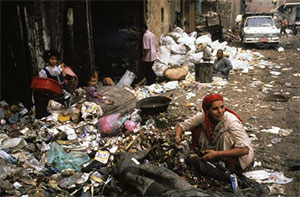 Romani people in Cairo, Egypt, forage through trash. Credit: UN Photo/Armineh Johannes
In 2015, the United Nations adopted the Sustainable Development Goals (SDGs) in an effort to promote “peace and prosperity for people and the planet.” To achieve that goal, it is essential to provide equal opportunities and access to basic services to all people. The 2025 UN SDG Report found that 35% of the 169 SDG targets are on track or making moderate progress, while 18% have reversed compared to the 2025 baseline. One in ten people still live in extreme poverty, one in eleven experience food insecurity, and over 1.1 billion people live in slums without access to clean water and sanitation. It is imperative to acknowledge the societal, technological, economic, and political issues that sustain poverty in countries around the world. Eradicating poverty will require significant frameworks in policy and governance on a national and international scale to ensure that all people will have equal access to basic services and economic opportunities by 2030. Furthermore, a dramatic reduction of United States foreign aid in 2025, including the termination of 83% of USAID programmes, threatens to erode years of fragile development gains.
Throughout the world, violent conflict and natural disasters also contribute to extreme poverty. The complete destruction of infrastructure and blockage of aid has significantly impoverished Palestine since October 7th. The destructive impact of Hurricane Maria in Puerto Rico left $91 billion in damage. An inadequate US government response also revealed significant and enduring questions within the issue of mitigating poverty: how do we rebuild infrastructure after its destruction? How do we restimulate economic development and bring in financial aid after disasters? Similar questions have been raised in the realm of regional cooperation, as devastating floods have wrecked hundreds of thousands of homes across multiple Southeast Asian nations in the past few years. Furthermore, the COVID-19 pandemic has greatly exacerbated the global poverty crisis, particularly in developing countries, setting back the United Nations goal of eradicating poverty by 2030.
IPS is committed to providing comprehensive features that focus on the persisting environmental, sociopolitical, and systemic issues that sustain poverty, and the steps taken worldwide towards poverty eradication.

The Week with IPS

NEXT STOP - SDGs
Tracking global progress towards a sustainable world
Tracking global progress towards a sustainable world

