Languages
Friday, October 9, 2026



News and Views from the Global South
Poverty & SDGs
Global Summit of Development Banks Fails to Learn from Destructive Past
This week, 450 public development banks from around the world met for the Finance in Common Summit at the Paris Peace Forum. They gathered to discuss how they can direct their combined investments of over USD 2 trillion - 10% of total investments in the world - “to support the transformation or the global economy” and “build new forms of prosperity that take care of people and the planet.”
In India, Ending FGM Demands Truth and Transparency
“My daughter is eight years old. In May 2017, I had her ‘Khatna,’ her circumcision, done. I had taken her to a traditional cutter. Once back home I made her sleep on the bed. After some time, around 4:00 p.m. I took her to the bathroom, she was bleeding as if she had started her menses. It seemed like she was urinating blood. By 6:00 p.m. my daughter had been bleeding so heavily, the blood had soaked three bed sheets and I was very worried. And my daughter was quiet and she also kept asking me if she will be fine.” Excerpt from: How I got her from the hands of death: WeSpeakOut study 2018
More Children in Zimbabwe Are Working to Survive: What’s Needed
The ability of Zimbabwean families to take care of children has been compromised by a collapsing economy, compounded by COVID-19. About 4.3 million people in rural communities, including children, are food insecure this year. The World Food Programme indicates that at least 60% of the population of Zimbabwe need food aid.
Is Development for the World Bank Mainly Doing Business?
The World Bank has finally given up defending its controversial, but influential Doing Business Report (DBR). In August, the Bank “paused” publication of the DBR due to a “number of irregularities” after its much criticized ranking system was exposed as fraudulent.
Q & A: Escalating Tensions in Ethiopia adds to Tenuous Refugee Setting
Already reeling from conflict, extreme weather events and growing displacement due to the COVID-19 pandemic, escalating tensions in Ethiopia’s Tigray region have placed the country on the brink of civil war and many are looking to Nobel Peace Prize-winning Prime Minister Abiy Ahmed to avert a potential humanitarian disaster.
From Paraguay to Italy: Development at All Costs
I am speaking with Gladys and Raúl about civic space in Paraguay, when Raúl suddenly tells me about the fires. Thick smoke has reached the capital Asunción where he is based. In October, Paraguay became Dante’s Inferno.
Growing Resilient Food Systems Post Covid Is Key for Africa
When it comes to food security, the challenge is not always about producing more - it’s also about quality: producing food that is wholesome and preserved safely.
Solving the Challenge of Food Security Key to Peacebuilding in the Sahel
In 2013, when Jamila Ben Baba started her company, the first privately owned slaughterhouse in Mali, she did so in the midst of a civil war as Tuareg rebels grouped together in an attempt to administer a new northern state called Azawad. Ben Baba, who is originally from Timbuktu, in northern Mali — where much of the civil war conflict took place — based the business in the country’s western region of Kayes and grew it into what is considered the largest private slaughter house in the West African nation.
Africa Must not Assume a ‘Business as Usual’ Approach to COVID-19 Recovery
The corona virus pandemic is impacting Africa’s population in quite differentiated ways and is significantly entrenching inequality. At the greatest risk are lives and livelihoods of the poor.
Driving Climate Change from the Top in the Dominican Republic
When President Luis Abinader arrived at his inauguration in an electrically driven car as a symbolic gesture of his Government’s intentions to make sustainable development one of its main objectives – he signalled the start of addressing climate change commitments in the country.
The Rape of India’s Dalit Women: It’s All about Gender & Class Subordination
Shabnam*, a young woman from Northern India’s Haryana state, is two years away from becoming a law graduate. She sees parallels between her own rape and that of the 19-year-old Maha Dalit woman whose brutal rape and torture by a group of men from a “dominant” or “higher” caste in the neighbouring state of Uttar Pradesh triggered nationwide protests.
Q&A: COVID-19 has Pushed Women Peacebuilders from Key Leadership Roles
Women need to be given roles as negotiators, not just offered representation through advisory groups, Agnieszka Fal-Dutra Santos from the Global Network of Women Peacebuilders (GNWP) told IPS.
Climate Friendly Travel and Tourism
SUNx Malta, a not-for-profit organization, based in Malta is advancing and enabling “Climate Friendly Travel” which is tourism and travel that is Low-Carbon and linked to the Sustainable Development Goals (SDGs) and follows the Paris Agreement 1.5 degree trajectory.
Global Data Community’s Response to COVID-19
The world is currently counting more than 42 million confirmed cases of the COVID-19 and over 1 million deaths since the start of the pandemic.1
Using Traditional and Indigenous Food Resources to Combat Years of Successive Drought
For Zimbabwean farmer Sinikiwe Sibanda, planting more sorghum and millet than maize has paid off. As the coronavirus pandemic has led to decreased incomes and increased food prices across the southern African nation -- it is estimated that more than 8 million Zimbabweans will need food aid until the next harvest season in March -- Sibanda's utilisation of traditional and indigenous food resources could provide a solution to food security here.
The United Nations, 75 Years Young: Engaging Youth Social Entrepreneurs to Accelerate the SDGs
This year, the United Nations is marking its 75th anniversary – a milestone of extraordinary economic and social progress in Asia and the Pacific. While the Organization enjoys a lifespan almost equal to the world’s improved average life expectancy, the future lies with those who have recently embarked on theirs: our young people.
Child Protection: the Pandemic has Left the Most Vulnerable Children Invisible
A right is an entitlement and it has three basic principles, without which rights cannot be enjoyed. The first principle is that of universality: A right has to be enjoyed by all citizens, including all children. There cannot be a distinction between a Dalit or an Adivasi child and a child who is better endowed.
‘The Sahel – a Microcosm of Cascading Global Risks Converging in One Region’
The European Commission this week pledged $27.8 million in humanitarian support to the Sahel region as floods and the coronavirus pandemic exacerbate the stability in a region deeply in conflict. While the figure is less than 2 percent of the $2.4 billion that the United Nations has appealed for, Amnesty International researcher Ousmane Diallo told IPS that despite past donations from international development partners to Sahelian countries, the situation hasn’t improved over the years.
Bulawayo Water Crisis: When the Taps Run Dry and the City Runs out of Ideas
Dotted across the Zimbabwean city of Bulawayo, the water tanks installed in private residences is evidence that years of a water crisis, that has seen some suburbs here going for months without running water, has not spared anyone. The large plastic drums, locally called Jojo tanks after the company that manufacturers them, and which have a storage range of up to 10,000 litres, have assumed a class status of sorts in Bulawayo.
The Plight of Domestic Workers in Brazil
The inclusivity of Brazilian society is put to the test as the coronavirus pandemic highlights a labour sector ripe with historical and structural inequality: domestic work.
A Long, Uneven and Uncertain Ascent
The COVID-19 pandemic continues to spread with over 1 million lives tragically lost so far. Living with the novel coronavirus has been a challenge like no other, but the world is adapting.« Previous Page — Next Page »





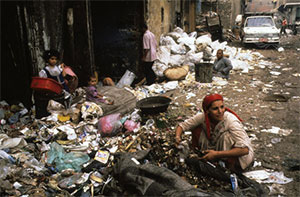 Romani people in Cairo, Egypt, forage through trash. Credit: UN Photo/Armineh Johannes
In 2015, the United Nations adopted the Sustainable Development Goals (SDGs) in an effort to promote “peace and prosperity for people and the planet.” To achieve that goal, it is essential to provide equal opportunities and access to basic services to all people. The 2025 UN SDG Report found that 35% of the 169 SDG targets are on track or making moderate progress, while 18% have reversed compared to the 2025 baseline. One in ten people still live in extreme poverty, one in eleven experience food insecurity, and over 1.1 billion people live in slums without access to clean water and sanitation. It is imperative to acknowledge the societal, technological, economic, and political issues that sustain poverty in countries around the world. Eradicating poverty will require significant frameworks in policy and governance on a national and international scale to ensure that all people will have equal access to basic services and economic opportunities by 2030. Furthermore, a dramatic reduction of United States foreign aid in 2025, including the termination of 83% of USAID programmes, threatens to erode years of fragile development gains.
Throughout the world, violent conflict and natural disasters also contribute to extreme poverty. The complete destruction of infrastructure and blockage of aid has significantly impoverished Palestine since October 7th. The destructive impact of Hurricane Maria in Puerto Rico left $91 billion in damage. An inadequate US government response also revealed significant and enduring questions within the issue of mitigating poverty: how do we rebuild infrastructure after its destruction? How do we restimulate economic development and bring in financial aid after disasters? Similar questions have been raised in the realm of regional cooperation, as devastating floods have wrecked hundreds of thousands of homes across multiple Southeast Asian nations in the past few years. Furthermore, the COVID-19 pandemic has greatly exacerbated the global poverty crisis, particularly in developing countries, setting back the United Nations goal of eradicating poverty by 2030.
IPS is committed to providing comprehensive features that focus on the persisting environmental, sociopolitical, and systemic issues that sustain poverty, and the steps taken worldwide towards poverty eradication.

The Week with IPS

NEXT STOP - SDGs
Tracking global progress towards a sustainable world
Tracking global progress towards a sustainable world

