Languages
Friday, November 27, 2026



News and Views from the Global South
Poverty & SDGs
G8 SUMMIT: Africa Wants Aid, Rich Nations Demand Reforms
Fresh money for the world's weakest economies will be a touchy topic when the world's economically most powerful nations meet next week in Scotland. While Africa hopes for increased development funds, some G8 nations, like Germany, first want to see more progress on reforms.WOMEN: 12 Colombian Nobel Peace Nominees All Too Familiar with War
"I'm 50 years old, I was born into war and I have lived in war all my life," said labour and women's rights activist Patricia Buriticá, a pioneer in incorporating a gender perspective in Colombia's trade union movement. She is one of 12 Colombian women nominated for this year's Nobel Peace Prize.ECONOMY: Developing Nations Shine in UN Growth Report
Despite an overall slump in the global economy, growth in poor countries continues to expand, a trend that many economists believe could prove helpful in implementing the international agenda on development.DEVELOPMENT: Plant a Tree Today, Save a Dollar Tomorrow
Putting money into projects that conserve the environment is a smart investment that could lift millions of people around the world out of poverty while giving governments healthy economic returns, a new study finds.DEVELOPMENT: Rich Nations Again Falter in Aid Pledges
A two-day high-level U.N. meeting on development financing concluded here on a predictable note: developing nations criticising industrial countries for reneging on their pledges to increase aid to help eradicate poverty.DEVELOPMENT: Strategies for Achieving Sustainable Cities
The mainstreaming of environmental planning and management as an integral part of public policies seems to be the only solution for a world where the population is becoming ever more concentrated in increasingly larger, poorer and more unmanageable cities.ENVIRONMENT-INDIA: Chinese Lake Threat Recedes, Leaves Flood of Questions
Threats of China's Parechu Lake bursting and deluging populations in India's northern Himachal Pradesh state this week were declared over, but the episode has left behind a flood of unanswered questions - starting with those about a regional approach to managing Himalayan water resources.THAILAND-U.S.: AIDS Drugs Take Centre-Stage at Trade Talks
After tiptoeing around the issue for months, Thailand's trade negotiators will have to finally reveal where they stand on the life-or-death question of producing cheap, generic anti-AIDS drugs.POLITICS-AFRICA: Bush Exaggerates Increase in U.S. Aid
U.S. President George W. Bush has been significantly exaggerating the amount of money his administration has provided in aid to sub-Saharan Africa, according to a new study released here Monday.ARGENTINA: Indigenous Villages on the Auction Block
The Argentine government has taken legal action to stop the imminent auction of a parcel of land in the northern province of Santiago del Estero that is home to 4,000 people, most of them of indigenous descent.TSUNAMI IMPACT: Lack of Water-Borne Disease a Silent Success
Away from the cameras and the headline-grabbing stories is a quiet miracle, of sorts, that has unfolded within the wasteland areas of Asia's tsunami-devastated countries: There was no massive outbreak of water-borne diseases amongst children as initially feared.POLITICS-UN: NGOs Hope First Date Wasn’t Just a One-Night Stand
Security, development and U.N. reform emerged as major themes over two days of civil society and private sector meetings with governments that concluded here Friday.POLITICS: U.N. Hosts Historic Session With Civil Society
For the first time ever, civil society has been invited to participate in interactive sessions of the U.N. General Assembly, but the guest list has irked some leading activists who wonder why they were not asked to attend.HEALTH-SOUTHERN AFRICA: AIDS Orphans – a Silent Tsunami
Twelve million and counting: that is the number of children who have lost one or both parents to AIDS in sub-Saharan Africa, according to the International Federation of Red Cross and Red Crescent Societies. This figure is expected to double by 2010.ENVIRONMENT-HAITI: A State Lost in the Trash
Uruguayan officers with the United Nations peacekeeping force in Haiti could not believe that the water pumped from 70 metres underground could be contaminated with colibacteria. But indeed it was - and once again they had to rely on their portable water filtration system.INDIA: Delhi Water Disputes Come to a Boil
Delayed monsoon rains and scorching summer temperatures have triggered water disputes in the Indian capital vicious enough to remind administrators that they urgently need to do a better job of managing existing resources of the wet stuff.G8 SUMMIT: The Injuries Need More Than Band Aid
The developing world needs long-term economic opportunities and not temporary relief, Commonwealth Secretary-General Don McKinnon told IPS in an interview Tuesday.CUBA: Food Aid for Victims of Worst Drought Since 1901
The World Food Programme (WFP) has launched an emergency food aid operation for 773,000 people affected by the ongoing drought in Cuba, WFP representative Rosa Inés Antolín told IPS.REFUGEES-KENYA: Contraceptives – Both Needed and Scorned
As the international community marks World Refugee Day, a Somali woman's tale of how she helped fellow refugees terminate pregnancies has highlighted the shortcomings of reproductive health care in refugee camps.ARGENTINA: Activists Fear Return of Spanish Fishing Vessels
Argentine groups fighting for sustainable fishing are denouncing the pressure from Spain for a new cooperation agreement, which they say could have lethal impacts on the South Atlantic fish stocks, already over-exploited by the Spanish fishing fleet in the 1990s.HEALTH: A Wind of Hope in Kenya’s Desert
Madonna's 1980s hit song 'Like a Virgin' blasts incongruously from a giant silver speaker in the corner of a bar deep inside Isiolo - a dusty town on the edge of Kenya's northern Kaisut desert, filled with tough nomads and their herds of emaciated animals.« Previous Page — Next Page »


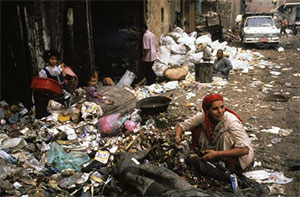 Romani people in Cairo, Egypt, forage through trash. Credit: UN Photo/Armineh Johannes
In 2015, the United Nations adopted the Sustainable Development Goals (SDGs) in an effort to promote “peace and prosperity for people and the planet.” To achieve that goal, it is essential to provide equal opportunities and access to basic services to all people. The 2025 UN SDG Report found that 35% of the 169 SDG targets are on track or making moderate progress, while 18% have reversed compared to the 2025 baseline. One in ten people still live in extreme poverty, one in eleven experience food insecurity, and over 1.1 billion people live in slums without access to clean water and sanitation. It is imperative to acknowledge the societal, technological, economic, and political issues that sustain poverty in countries around the world. Eradicating poverty will require significant frameworks in policy and governance on a national and international scale to ensure that all people will have equal access to basic services and economic opportunities by 2030. Furthermore, a dramatic reduction of United States foreign aid in 2025, including the termination of 83% of USAID programmes, threatens to erode years of fragile development gains.
Throughout the world, violent conflict and natural disasters also contribute to extreme poverty. The complete destruction of infrastructure and blockage of aid has significantly impoverished Palestine since October 7th. The destructive impact of Hurricane Maria in Puerto Rico left $91 billion in damage. An inadequate US government response also revealed significant and enduring questions within the issue of mitigating poverty: how do we rebuild infrastructure after its destruction? How do we restimulate economic development and bring in financial aid after disasters? Similar questions have been raised in the realm of regional cooperation, as devastating floods have wrecked hundreds of thousands of homes across multiple Southeast Asian nations in the past few years. Furthermore, the COVID-19 pandemic has greatly exacerbated the global poverty crisis, particularly in developing countries, setting back the United Nations goal of eradicating poverty by 2030.
IPS is committed to providing comprehensive features that focus on the persisting environmental, sociopolitical, and systemic issues that sustain poverty, and the steps taken worldwide towards poverty eradication.

The Week with IPS

NEXT STOP - SDGs
Tracking global progress towards a sustainable world

