Languages
Friday, November 6, 2026



News and Views from the Global South
Poverty & SDGs

Climate Summit Kicks Off, Caught Between Realism and Hope
Tens of thousands of delegates from state parties began working Monday Dec. 2 in the Spanish capital to pave the way to comply with the Paris Agreement on climate change, while at a parallel summit, representatives of civil society demanded that the international community go further.
Biofortified Food, a Business Boost for Smallholder Farmers
A start-up in Zimbabwe is producing high nutrition foods using biofortified crops in a bid to fight micronutrient deficiency. Vitamin A deficiency (VAD) leads to night blindness, illness and death from childhood infections. In Zimbabwe, 36 percent of children under five years of age suffer from Vitamin A deficiency, according to the World Health Organisation (WHO).
Care for Economic Development, Then Care for Food Nutrition, Food Researcher Tells Africa’s Politicians
More than 2 billion people in the world are suffering from malnutrition. This is the result of diets lacking essential micronutrients such as vitamins, iron and zinc, which are vital for the body to function, according to the Food and Agriculture Organization (FAO).
Did Sri Lanka’s Presidential Election Bring Back a Polarising Wartime Figure?
The Economist proclaimed recently that Gotabaya Rajapaksa, the man who, as secretary of defense, presided over this horrifying episode (the final phase of Sri Lanka’s terrorist inspired internal conflict), has just been elected president of Sri Lanka.
Four Ways to Prevent Deaths from Lassa Fever
Dr. Wouter, a Dutch doctor who helped perform surgeries and train colleagues in surgical skills in underserved areas of Sierra Leone died of Lassa Fever. He was infected as a result of performing a Caesarean section on an infected pregnant woman.
Catalysing Change for Gender Equality
Great strides have been taken to empower women and girls in the Asia-Pacific region since the Fourth World Conference on Women in Beijing adopted an ambitious global agenda to achieve gender equality twenty-five years ago. Gender parity has been achieved in primary education. Maternal mortality has been halved. Today, the region’s governments are committed to overcoming the persistent challenges of discrimination, gender-based violence and women’s unequal access to resources and decision-making.
I am Generation Equality: Child Marriage Survivor & Activist
-- I am Generation Equality because… I didn’t want other girls to go through the same struggles I experienced. I got married when I was 14 years old. I had no idea what marriage was.
Businesses Have Key Role in Safeguarding Human Rights
Unanimously endorsed by the UN Human Rights Council in 2011, the Guiding Principles on Business and Human Rights are the authoritative global reference point articulating the responsibilities of companies to respect and protect human rights.
Social Protection Necessary to Quickly End Poverty, Hunger
Historically, most social security systems have developed in the formal sector of rich economies. However, most of the poor and hungry in the world live in rural areas, surviving in the informal economy.
When African Women are Financially Included, an Entire Continent Wins
When Rwandan-born, Senegalese-raised entrepreneur and businesswoman Kristine Ngiriye was 18 she had a brilliant idea that she wanted to translate into a business. But when she went to her local bank for a loan they told her to rather get married, because “ a woman must be married instead of venturing into business”, Ngiriye tells IPS.
More Austerity for Developing Countries: It’s Bad News, and It’s Avoidable
After years of austerity, a number of Eurozone countries are now considering expansionary fiscal policies. And in the UK, government spending is set to return to levels last seen in the 1970s. But austerity abounds elsewhere in the world, including in some of the poorest countries.
A 650 Million Dollar Pledge Aimed at Eradicating Extreme Hunger by 2030
When a coalition of international donors pledged more than $650 million to provide assistance to over 300 million smallholder farmers in developing countries, the primary aim was to help increase agricultural and livestock production besieged by droughts, floods and other natural disasters triggered by climate change-- mostly in sub-Saharan Africa and South Asia.
80 Percent of Adolescents Do Less than 60 Minutes of Activity per Day, UN Health Agency Warns
An alarming lack of exercise among adolescents across the world risks seriously compromising their health into adulthood, the UN said on Thursday.
Sri Lanka’s Presidential Election Brings Back a Polarising Wartime Figure
On 16 November, Gotabaya Rajapaksa – who served as defence secretary during the final phase of Sri Lanka’s brutal civil war – won a decisive victory in Sri Lanka’s presidential election.
More Than just a Toilet: Fusing innovation & Partnerships for a Better World
Each year, World Toilet Day* raises awareness of the crucial role that sanitation plays in reducing disease and creating healthier communities. At Kohler, we’re committed to finding solutions for universal sanitation access by leveraging our design & innovation competencies and partnering with like-minded organizations to bring meaningful innovations to those communities most in need.
Winning the ‘No Food Loss’ Battle: The Case of Japan
Humankind since almost the time that there is recorded history has grappled with the question of ‘how many is too many?’ The response is expectedly complex as it varies across time and space. The pace of population growth was slow till about approximately 250 years or so. It is only since the middle of the eighteenth century that there has been a palpable acceleration in population growth.
As Donors Ramp up Polio Funding, Worries of Comeback Persist
Efforts to wipe polio off the face of the planet took a step forward this week, with a multibillion-dollar fundraiser in the Middle East helping eradication schemes tackle a virus that disproportionately kills and cripples children in poor countries.
Net Food Importer Turkey Grapples with Challenges of Food Self-sufficiency
Despite latest research showing Turkey lagging in overall food sustainability, progress in sustainable agriculture appears to be a bright spot in the country’s troubled agriculture industry.
Los Angeles Joins a Global Movement to Protect Human Right to Water
On November 6, Los Angeles became the first major city in the United States to earn the designation of “Blue Community” – a bold move that will keep water protected from privatization.
World’s Sewage Workers ‘Underpaid, Sidelined and Risking their Lives’
People who empty out sewage tanks and scrub down latrines doubtless perform a vital, thankless and even undesirable task. A new report, however, shows that doing such jobs could also cost workers their lives.
How can Taps, Toilets & Good Hygiene Help Ensure Sustainable & Resilient Agricultural Supply Chains?
Water underpins the global economy and agriculture is by far the world’s largest water consumer, accounting for 70% of freshwater withdrawals. Global water demands are projected to increase by 55% by 2050 and climate change will present further pressures on water accessibility.« Previous Page — Next Page »





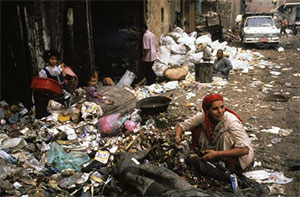 Romani people in Cairo, Egypt, forage through trash. Credit: UN Photo/Armineh Johannes
In 2015, the United Nations adopted the Sustainable Development Goals (SDGs) in an effort to promote “peace and prosperity for people and the planet.” To achieve that goal, it is essential to provide equal opportunities and access to basic services to all people. The 2025 UN SDG Report found that 35% of the 169 SDG targets are on track or making moderate progress, while 18% have reversed compared to the 2025 baseline. One in ten people still live in extreme poverty, one in eleven experience food insecurity, and over 1.1 billion people live in slums without access to clean water and sanitation. It is imperative to acknowledge the societal, technological, economic, and political issues that sustain poverty in countries around the world. Eradicating poverty will require significant frameworks in policy and governance on a national and international scale to ensure that all people will have equal access to basic services and economic opportunities by 2030. Furthermore, a dramatic reduction of United States foreign aid in 2025, including the termination of 83% of USAID programmes, threatens to erode years of fragile development gains.
Throughout the world, violent conflict and natural disasters also contribute to extreme poverty. The complete destruction of infrastructure and blockage of aid has significantly impoverished Palestine since October 7th. The destructive impact of Hurricane Maria in Puerto Rico left $91 billion in damage. An inadequate US government response also revealed significant and enduring questions within the issue of mitigating poverty: how do we rebuild infrastructure after its destruction? How do we restimulate economic development and bring in financial aid after disasters? Similar questions have been raised in the realm of regional cooperation, as devastating floods have wrecked hundreds of thousands of homes across multiple Southeast Asian nations in the past few years. Furthermore, the COVID-19 pandemic has greatly exacerbated the global poverty crisis, particularly in developing countries, setting back the United Nations goal of eradicating poverty by 2030.
IPS is committed to providing comprehensive features that focus on the persisting environmental, sociopolitical, and systemic issues that sustain poverty, and the steps taken worldwide towards poverty eradication.

The Week with IPS

NEXT STOP - SDGs
Tracking global progress towards a sustainable world
Tracking global progress towards a sustainable world

