Languages
Friday, October 9, 2026



News and Views from the Global South
Green Economy

Calls Mount for “Bold” Climate Deal in Paris
A diverse coalition of 24 leading British scientific institutions has issued a communique urging strong and immediate government action at the U.N. climate change conference set for Paris in December.
Caribbean Seeks Funding for Renewable Energy Mix
A leading geothermal expert warns that the small island states in the Caribbean face “a ticking time bomb” due to the effects of global warming and suggests a shift away from fossil fuels to renewable energy is the only way to defuse it.
2014 Another Record-Shattering Year for Climate
A new report by the U.S. National Oceanic and Atmospheric Administration (NOAA) Center for Weather and Climate has found that 2014 was the warmest year ever recorded, with Eastern North America the only major region in the world to experience below-average annual temperatures.
Opinion: What Will It Take to Bring a Second Green Revolution to India?
Long-term agricultural growth in India is slowing down. The lands that saw remarkable increases in productivity in the 1970s and 80s, thanks to the technology rolled out as part of the first “Green Revolution”, are not yielding the same results today.
Opinion: From New York to Addis Ababa, Financing for Development on Life-Support – Part Two
The key priorities of the Group of 77 developing countries (G77) remain somewhat aligned around a set of issues that have been present from the beginning of the FfD negotiations in New York.
Science and Technology a Game Changer for Post-2015 Development Agenda
A group of international scientists, designated as advisers to U.N. Secretary-General Ban Ki-moon, has conveyed a significantly timely message to him: science, technology and innovation (STI) can be "the game changer" for the U.N.’s future development efforts.Groups Slam Green Climate Fund Approval of Firms Tied to Dirty Energy
Civil society representatives attending the board meeting of the Green Climate Fund (GCF) in Songdo, South Korea expressed strong disappointment Thursday with the board's decision to accredit Deutsche Bank - one of the world’s largest financiers of coal - to receive and distribute GCF funds.
Opinion: ASEAN Must Unite Against Climate Change
The Association of Southeast Asian Nations (ASEAN) started as a cooperation bloc in 1968. Founded by five countries - Thailand, Singapore, Malaysia, Indonesia and the Philippines - ASEAN has since evolved into a regional force which is slowly changing the landscape in global politics.
Opinion: Scale Up Innovative Financing for Development
More than four decades ago, the richer members of the international community committed to deliver at least 0.7 percent of their respective national incomes as official development assistance.
Climate Commission Issues Blueprint for Low-Carbon Economy
Up to 96 percent of the emissions reductions needed by 2030 to keep global warming below a critical threshold of two degrees C could be achieved through a series of 10 steps, says a new report released by the Global Commission on the Economy and the Climate.
U.N. Swears by Hefty 100 Billion Dollar Target to Fight Climate Change
The most devastating impact of climate change – including rising sea levels, floods, cyclones and both droughts and heavy monsoons – will be felt mostly by the world’s poorest nations.
Sustainable Use of Biodiversity Could Fill Gap When Belo Monte Dam Is Finished
Some argue that the sustainable use of biodiversity is the best alternative for local development in the area surrounding the enormous Belo Monte hydroelectric dam, now that the construction project is entering its final phase on the Xingú River in Brazil’s Amazon jungle.A New Climate for Peace
U.N. officials, government leaders and civil society actors gathered Tuesday at the German House for a panel discussion on climate change as a “threat-multiplier”.
China Hailed as Leader for New Climate Plan
Environmental groups are praising China following the formal submission of Beijing’s highly-anticipated climate change strategy to the United Nations Tuesday.

U.N. Chief Seeks Equity in Paris Climate Change Pact
When the 193-member General Assembly hosted a high level meeting on climate change Monday, Secretary-General Ban Ki-moon warned that any proposed agreement at an upcoming international conference in Paris in December must uphold the principle of equity.
U.S. Supreme Court Deals Blow to Obama’s Emissions Cuts
In a setback to the Barack Obama administration's clean energy plans just five months ahead of a critical climate change summit in Paris this December, the U.S. Supreme Court on Monday blocked an initiative to limit emissions of mercury and other toxic pollutants from coal-fired power plants.
Rome March Celebrates Pope’s Call for Urgent Climate Action
People of faith, civil society groups, and communities affected by climate change marched together in Rome Sunday Jun. 28 to express gratitude to Pope Francis for the release of his Laudato Si encyclical on the environment, and call for bolder climate action by world leaders.
Grenada Rebuilds Barrier Reefs
The Eastern Caribbean nation of Grenada is following the example of its bigger neighbours Belize and Jamaica in taking action to restore coral reefs, which serve as frontline barriers against storm waves.
Views from the Caribbean ahead of COP21, the December 2015 Climate Change Summit in Paris – Building Resilience to Disaster: Mitigation
 Despite being a relatively small source of greenhouse gas emissions, the Caribbean region has been taking steps to introduce renewable energy sources like wind, solar and geothermal, which also reduce its dependence on expensive oil imports.

Opinion: Sub-Saharan Africa, Addis and Paris
After the turn of the century, growth in sub-Saharan Africa (SSA) picked up again after a quarter century of near stagnation for most, mainly due to increased world demand for minerals and other natural resources.
Opinion: Pope Francis’ Timely Call to Action on Climate Change
On June 18, Pope Francis issued Laudato Si, the first ever encyclical about ecology, which promises to be a highly influential document for years to come. The encyclical, which is the most authoritative teaching document a Pope can issue, delivered a strong message addressing the moral dimension of the severe ecological crisis we have caused with our “throwaway culture” and general disregard for our common home, the Earth.« Previous Page — Next Page »





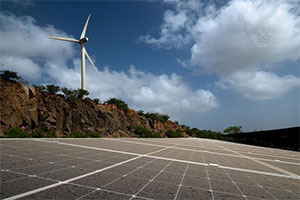 Renewable Energy in Cabo Verde. Credit: UN Photo/Mark Garten
A green economy is an economic model that aims to reduce environmental risks and build a sustainable future. Many of the UN SDGs seek to facilitate a green economy, such as ensuring access to affordable and reliable clean energy, building sustainable cities and communities, and implementing urgent action to combat climate change. Various key negotiations have strived to achieve a green economy, such as the Green New Deal and the Inflation Act of 2022. COP30, held in Belém, Brazil in 2025, agreed to mobilize $1.3 trillion annually for climate action and launched the Belém Mission to 1.5°C. However, the conference was not able to develop a fossil fuel reduction roadmap. Recent years have witnessed a sharp transformation in the geopolitical landscape of international sustainability cooperation. In March 2025, the United States stepped back from formal multilateral support for the SDGs, while China is on the rise as an international leader in renewable energy production. The actions of these global powers may shape shifting alliances on environmental governance. IPS is dedicated to sharing timely news on international developments in building a sustainable future.

The Week with IPS

NEXT STOP - SDGs
Tracking global progress towards a sustainable world
Tracking global progress towards a sustainable world
