Languages
Friday, November 13, 2026



News and Views from the Global South
Labour

Q&A: “Women Are the First to Cook and the Last to Eat”
Three hundred women from more than 30 countries converged in Canada last weekend for the Montreal International Women's Conference 2010 (MIWC), with the aim of building a global militant women's movement in the 21st century.US: Standing Up for Homeless Vets at Stand Downs
More than 400 homeless veterans from across northern California relaxed in comfort at the Alameda County Fairgrounds in Pleasanton.RIGHTS-JAPAN: Not All Working Women Are Equal
Fifty-one year old Miharu juggles two part-time jobs at a law firm and at a design company, but is barely able to make ends meet in one of the world’s richest economies.
ENVIRONMENT: Uruguay Tries to Solve Its Forestry Puzzle
"A Uruguayan consumes 40 kilos of paper per year, compared to 400 kilos consumed by someone in Finland. We produce wood pulp to feed foreign consumption," says sociologist María Selva Ortiz, representative of the environmental group Redes-Friends of the Earth Uruguay.U.N. Targets “Lost Generation”
Even as the U.N. launched the International Year of Youth last week, one of its agencies was warning of a "lost generation" of disillusioned young workers who are unable to find decent jobs.
SOUTHERN AFRICA: Women Traders “Blocked” From the “Big Business”
"Africans do not believe women can do big business," fumes Zambian trader Angelica Rumsey.DEVELOPMENT-NIGER: Selling Sand to Survive
It's a trade that requires no capital, only courage and endurance. A group of 200 women are making ends meet - sometimes even a bit more - by selling sand.Labour Rights Under Scrutiny in Bangladesh and Sri Lanka
The garment industry in Bangladesh and Sri Lanka has come under intense scrutiny amidst widespread accusations of large- scale labour exploitation.
MEXICO: Oil Workers at Sea Without a Safety Net
The oil spill in the Gulf of Mexico has reawakened concerns about labour conditions on Mexican drilling platforms.
TRADE-NEPAL: Carpet Industry Frayed at the Edges
It was an industry pioneer and had even proved itself successful in the export market. But these days Jawalakhel Handicraft Centre (JHC) is barely able to sustain itself on retail sales, and general manager Chimi Dorjee has been reduced to just recalling how things had been when the going was still good.MALAWI: A Cellphone, a Bicycle and Sound Agricultural Advice
It is 11 am and Mary Jusa seems unconcerned by the sun beating hard on her back. Humming a traditional tune, she carries on uprooting weeds in her maize field between two water canals.SOUTH-EAST ASIA: Jobless Youth Still Waiting for Better Times
Tanya Athikom’s search for a permanent job in the information technology sector has so far resulted in a string of disappointments. The Bangkok resident has thus been forced to accept short-term contracts in local and multinational companies here in the Thai capital.
MALAWI: Used Car Dealers Seeing Red Over New Green Tax
Small-scale importers of used cars in Malawi are crying foul over a government decision to introduce higher duties on second-hand passenger vehicles aged eight years and older.JAPAN: Foreign Caregivers’ Language Exam Triggers Debate
Wahyudin dreams of becoming a full-fledged caregiver, if not a certified nurse, in Japan. But the Indonesian worker must first pass the required Japanese-language national certification examination, which is far from easy.
BRAZIL: Environmental Impact Studies on Dams Count for Little in Amazon
"It's a fait accompli," acknowledges André Villas-Boas, head of the independent SocioEnvironmental Institute (ISA), resigned to the fact that the legal actions and protests have failed to block the construction of the Belo Monte hydroelectric dam in Brazil's Amazon jungle region.Haitians in DR Reap Far Less than They Sow
Luis Miguel, a soft-spoken and serious 21-year-old from Haiti's Artibonnite Valley, stands on a ridge overlooking the small farm in the Dominican Cibao where he works as the owner's overseer. He adopted his Dominican moniker in order to fit in.Commission Takes a Hard Look at Free-for-All Migration
At 35, Daniel James has his mind set on leaving Trinidad and Tobago "for greener pastures".LEBANON: Racism Legitimised by Law
Lebanon has a reputation for openness because of the relative freedom enjoyed by women in comparison to other Middle Eastern countries. But many women face rampant discrimination.Transport Workers Fear Job Losses from Climate Change Action
Transport workers are concerned that measures to mitigate climate change, like greenhouse gas emissions reduction, may put their jobs at risk, while experts are urging a transformation of the predominant transport model worldwide.ARGENTINA: The Gender Roots of Labour Inequality
Inequality and poverty in Argentina are explained to a large extent by a job market that discriminates against women, coupled with insufficient equal opportunity regulations and failure to enforce existing labour laws, experts on the issue told IPS.U.S.: Tough Laws Just One Peril for Day Labourers
Ovidio Perez's brother was planning to return to Guatemala because of a new Arizona law that made it a state crime to be an undocumented immigrant. He returned, but in a coffin.« Previous Page — Next Page »


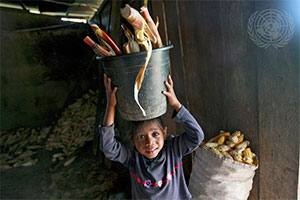 Timorese Girl with Fresh-Picked Corn. Credit: UN Photo/Martine Perret
A global common denominator is the need for a decent job. The economic realities of each country determine just how difficult it is to find one. Despite the labour movement's achievements, serious challenges persist: gender discrimination, child labour, worker migration, the digital divide and AI automation, evaporating pensions, unsafe workplaces, corporate pressure against union organising, negative impacts of trade agreements, and the precariousness of informal employment. The 2025 UN SDG Report identifies jobs and social protections as one of the six priority areas requiring urgent action, with progress either stalled or reversing in many developing nations.
In recent years, the fight to protect labour equality has taken on new dimensions with the rise of Environmental, Social and Governance standards. With the Social aspect aiming to promote equality and human rights, ESG principles have strengthened labour advocacy within corporate and governmental regulatory landscapes. In particular, ESG has become much more institutionalized in emerging economies such as Brazil and China. IPS follows the world’s workers as they confront these challenges - their setbacks and their successes.

The Week with IPS

NEXT STOP - SDGs
Tracking global progress towards a sustainable world
Tracking global progress towards a sustainable world
