Languages
Thursday, November 19, 2026



News and Views from the Global South
Economy & Trade

The Future for Financing Africa’s Renewable Energy
Lack of energy access presents a formidable challenge to Africa and lack of access to financing has been singled out as the biggest reason why over 620 million people living on the continent are stuck in energy poverty.
Zimbabwe’s Diaspora Could Help Revive Ailing Economy
At the dawn of the millennium, Sheila Mponda, 60, waved goodbye to her four children, who were leaving Zimbabwe for the United Kingdom in search of greener pastures. Mponda had just lost her husband and had been a housewife all her life.
An Inequality Beyond Wealth: Gaps in Women’s Health
While many often focus on wealth disparities, economic inequality is often a symptom and cause of other inequalities including women’s access to sexual and reproductive health.
To Eliminate Poverty, Better Understanding Needed
As the United Nations’ Second Decade for the Eradication of Poverty (2008-2017) comes to an end, more self-congratulation is likely. Claims of victory in the war against poverty will be backed by recently released poverty estimates from the World Bank, entrusted by the UN system to monitor poverty.
Argentina’s Biodiesel Plagued by Commercial and Environmental Challenges
The Argentine biodiesel industry, which in the last 10 years has become one of the most powerful in the world, has an uncertain future, faced with protectionist measures in the United States and Europe and doubts in the international scenario about the environmental impact of these fuels based on agricultural products.
Women: Major Drivers & Beneficiaries of Poverty Eradication
This year marks the 25th anniversary of the declaration of 17 October as the International Day for the Eradication of Poverty by the United Nations General Assembly. Under the theme “Answering the Call of October 17 to end poverty: A path toward peaceful and inclusive societies,” this year’s commemoration reminds us of the importance of equality, dignity, solidarity and equal voice in the fight to end poverty everywhere.
New Villages Bloom in the Shadow of a Mountain’s Wrath
Repeated volcanic eruptions of Mount Sinabung since 2010 have displaced thousands of people, leaving villages around the mountain deserted, with volcanic ash, lava and mud covering the soil, trees and empty houses.
International Day of Rural Women
On this International Day of Rural Women, the world celebrates women and girls in rural areas and the critical role they play in enhancing agricultural and rural development, improving food security and eradicating rural poverty.
Can the Kenyan Lion Kick High Enough to Be the South Korean Tiger of Africa?
In 1953 South Korea emerged from the ravages of a debilitating war, yet the total gross domestic product in nominal terms has surged 31,000 fold since 1953.
Hunger in Africa, Land of Plenty
Globally, 108 million people faced food crises in 2016, compared to about 80 million in 2015 – an increase of 35%, according to the 2017 Global Report on Food Crises. Another 123 million people were ‘stressed’, contributing to around 230 million such food insecure people in 2016, of whom 72% were in Africa.
Land Settlement Empowers: Bangladesh Sets an Example
History was made for 400 landless families in the remote char lands of Noakhali district. On 4th October, they all received land titles from the government for which they had waited for over two decades. In Bangladesh, as in other countries, the title is a permanent legal ownership document.
World Bank report shows signs of economic recovery in Middle East and North Africa
Despite a growth slowdown in 2017 at 2.1 percent, economic prospects in the Middle East and North Africa, MENA, region are projected to improve in 2018 and 2019 with growth exceeding 3 percent, according to the new World Bank MENA Economic Monitor, entitled "Refugee Crisis in MENA, Meeting the Development Challenge".
Strengthening Youth Potential and the Prospects for a Better Future
Investing in youth by developing their potential through education, job creation and instilling the values that advance the cause of humanity is the most daunting, yet promising challenge facing world leaders.
Transforming Agriculture in Africa
The African rural world is one I know well. I grew out of rural poverty myself and went to a rural school without electricity and lived in a village where we had to walk for kilometers to find water. We had to study after dark with candles or kerosene lanterns. By God’s grace, I made it out of poverty to where I am today. But for tens of millions of those in similar situations, especially in rural Africa, the outcomes are not like mine. For most, the potential has simply been wasted.
Biotechnology Part of the Solution to Africa’s Food Insecurity, Scientists Say
A growing number of African countries are increasingly becoming food insecure as delayed and insufficient rainfall, as well as crop damaging pests such as the ongoing outbreak of the fall armyworm, cause the most severe maize crisis in the last decade.
The IMF and Climate Change: Three Things Christine Lagarde Can Do to Cement Her Legacy on Climate
The International Monetary Fund (IMF) and climate change do not often appear in the same headline together. Indeed, environmental issues have been, at most, peripheral to the Fund's core functions. But now economists inside and outside the IMF are beginning to understand that climate change has significant implications for national and regional economies, and so it's worth reconsidering the Fund's role in addressing the climate challenge.
World Bank Must Stop Encouraging Harmful Tax Competition
One of the 11 areas that the World Bank’s Doing Business (DB) report includes in ranking a country’s business environment is paying taxes. The background study for DB 2017, Paying Taxes 2016 claims that its emphasis is “on efficient tax compliance and straightforward tax regimes”.
How to Eradicate Rural Poverty, End Urban Malnutrition – A New Approach
Population growth, increasing urbanisation, modern technologies, and climate change are transforming the world at a fast pace. But what direction are these transformations headed in? Are they benefitting the poor and the food insecure? And will the food systems of the future be able to feed and employ the millions of young people poised to enter labour markets in the decades to come?
Alternative Financing Strategies to Boost Small Businesses in Africa
A few years ago, more than half a century after the concept was first proposed, the government of Côte d’Ivoire completed construction of the Henri Konan Bédié Bridge, a span over the Ébrié Lagoon linking the north and south of Abidjan, the country’s main city. The project became a reality after the government received development bank and private capital financing.
Ghana Aims to Regain Top Spot in Cocoa Production
Ghana is home to the world’s favourite cocoa beans. They’re bigger in size, have a higher butter content and superior flavour – all qualities which make Ghana’s cocoa the world standard against which all cocoa is measured.
Why American Overseas Aid Should Focus on SDGs?
The average American believes the US spends a whopping third of its federal budget on foreign aid. Consequently, a majority of people think that too much is spent on foreign aid. That is one reason US President Donald J. Trump, who has campaigned on putting the needs of Americans first, has proposed deep cuts to foreign aid in his 2018 budget.« Previous Page — Next Page »


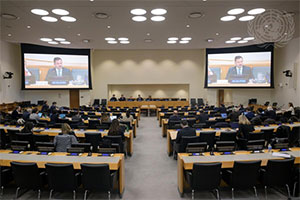 UN Commission on International Trade Law Holds Colloquium on Harmonizing Law in Age of Digital Trade and Finance. Credit: UN Photo/Manuel Elías
Trade has historically been a geopolitical tool that can both be used to propel development as well as entrench inequalities. In various nations in East Asia and Latin America, increased trade, as often seen in export booms, has allowed them to achieve influential standings within the global economy. On the other hand, many low-income countries in Sub-Saharan Africa, Asia, and Latin America struggle to maintain a robust trade performance, and oftentimes are subjugated to exploitative trade dynamics through intense extraction of their natural resources. In recent decades, international trade has reached a new era as emerging economies across the world are rising in economic preeminence. Stable international trade is crucial to world peace as global interconnectedness facilitates reliable diplomacy. Nevertheless, significant challenges are on the rise. Notably, a major wave of United States tariff escalations in January 2025 lifted US import taxes to their highest level since the 1930s, changing market dynamics and forcing renegotiations with global trading partners.These articles are aimed at informing readers about the complexities of trade and its varying effects on development, with a special focus on the consequences of the global economic crisis, the potential of fair trade and the gender implications of trade policies.
Updated by Yilan Batista and Shuli Wong August 2026

The Week with IPS

NEXT STOP - SDGs
Tracking global progress towards a sustainable world
Tracking global progress towards a sustainable world
