Languages
Tuesday, October 6, 2026



News and Views from the Global South
Trade & Investment

The United Nations Reforms-From Ideas to Actions
One of the highlight activities as the United Nations commemorates its 75th anniversary this year will be the launch of an “annual temperature check” on Sustainable Development Goals (SDGs), progress. With only ten years left to the final whistle for the Goals, this activity that will take place each September will provide a snapshot of what’s working, and where countries need more action.
2020 Is the Decade of Action & It Has to Be a Sprint
Happy New Year, Kenya. 2020 marks a decade of action towards the realization of the Sustainable Development Goals by 2030. Peace and development are inextricably linked, with each making the achievement of the other far more likely. This puts the conflict-prevention and development work of the UN at the heart of the agenda in East Africa, but in a multi-agency and programme environment, making meaningful progress is challenging.
Food Security Is Priority of Russian Sustainable Development Assistance
Food security holds a special place among Russia’s priorities in its efforts to achieve sustainable development globally. We believe that this task, which is reflected in Sustainable Development Goal 1, requires a comprehensive and multidimensional approach.
Billionaires’ Existential Threats to Humanity?
The social utility of billionaires’ existence has come under increased scrutiny, especially during the Democratic Party primaries for the 2020 US Presidential election. Leading newspapers, such as The New York Times, published opinion pieces arguing to abolish billionaires and reflecting on why billionaires engage in illegal insider trading.
Address Malnutrition, Not Just Food Security
Malnutrition remains a formidable challenge in most societies, with less than a tenth of countries in the world not experiencing at least one major malnutrition problem. In relatively more food secure countries, where almost everyone has enough to eat, and few live in fear of a sudden loss of access to food, micronutrient deficiencies and diet-related non-communicable diseases (NCDs) often still loom large.
Industrial Energy Efficiency is a Climate Solution
At a time when the world is battling unprecedented drought, bushfires, rising sea levels and water shortages, reducing energy use across industry is one powerful way to fight climate change in the immediate term.
Accelerating SDG Progress in Asia – Pacific
“The 2030 Agenda is coming to life”, declared the Secretary General at the opening of the first SDG Summit, a quadrennial event for the follow up and review of the 2030 Agenda for Sustainable Development. As leaders from Asia – Pacific took the floor, they highlighted country progress of SDG implementation and reaffirmed commitment to achieve the 2030 Agenda. Statements reflected different approaches across the region. Yet all converged on one priority: accelerated actions and transformative pathways.
Why Is Growth Slowing in China?
China’s gross domestic product (GDP) grew by 14%. Since then, its growth rate has declined by more than half to 6.6% in 2018. The five-year moving average growth rate is at its lowest since reforms began in 1978, although annual growth briefly fell lower during 1989, the year of the Tian An Men incident.
South-South Cooperation Offers Solutions to Urgent Climate Challenges
Climate change is the defining challenge of our time, and developing countries are recognized as hotspots for climatic risks. Through solidarity, peer-to-peer learning and collective self-reliance, developing countries are collaborating among themselves to address the threat.
Fostering Sustainable Urbanization and Rural-Urban Linkages
As urbanization continues apace, coupled with rapid population growth and rural to urban migration, the challenges for inclusive rural transformation continue, and the importance of fostering improved rural-urban linkages for better food systems becomes increasingly important.. According to the UN, by 2050 some 66% of the world’s population of 9 billion is expected to live in urban areas. Such rapid urbanization is increasingly shaping the rural space and rural livelihoods (through markets, demand for agricultural goods and labour, migration, and through the provision of services to rural areas). It is therefore critical for the increasing emphasis on urban development to take into account the importance of rural development.
Indigenous Knowledge, a Lesson for a Sustainable Food Future
Local knowledge systems rooted in traditional practices and culture passed down generations provide sustainable solutions to food and nutritional insecurity on the back of climate change, a conference heard this week.
Fixing the Business of Food
Milan is the city where Leonardo da Vinci painted his iconic Last Supper. Frozen in time is the moment Christ told his disciples there was a traitor among them. Visitors to the painting can examine the expressions on the faces of the disciples and look the food they might have eaten – the bread and wine, and of course the spilt salt. As one delegate to the 10th International Forum on Food and Nutrition noted, the diet did not seem varied or healthy.
Zimbabwe Food Crisis: Time to Act Is Now, Says UN Special Rapporteur
 Global food systems are ripe for transformation if people are to be nourished and the planet sustainable, says Hilal Elver, Special Rapporteur of the Right to Food of the United Nations Human Rights Council.

Tradition and Technology Take Centre Stage at BCFN Food Forum
A coffee producer will receive a cent and a half from a $2.50 cup of coffee. This one stark fact stood out as scientists, researchers, activists and grappled with solutions for change in food and nutrition practises, which would benefit the greater community.
Inequality and Its Many Discontents
Much recent unrest, such as the ‘yellow-vest’ protests in France and the US ‘Abolish the Super-Rich’ campaign, is not against inequality per se, but reflects perceptions of changing inequalities. Most citizens resent inequalities when it is not only unacceptably high, but also rising.
Biofortified Food, a Business Boost for Smallholder Farmers
A start-up in Zimbabwe is producing high nutrition foods using biofortified crops in a bid to fight micronutrient deficiency. Vitamin A deficiency (VAD) leads to night blindness, illness and death from childhood infections. In Zimbabwe, 36 percent of children under five years of age suffer from Vitamin A deficiency, according to the World Health Organisation (WHO).
Care for Economic Development, Then Care for Food Nutrition, Food Researcher Tells Africa’s Politicians
More than 2 billion people in the world are suffering from malnutrition. This is the result of diets lacking essential micronutrients such as vitamins, iron and zinc, which are vital for the body to function, according to the Food and Agriculture Organization (FAO).
Social Protection Necessary to Quickly End Poverty, Hunger
Historically, most social security systems have developed in the formal sector of rich economies. However, most of the poor and hungry in the world live in rural areas, surviving in the informal economy.
When African Women are Financially Included, an Entire Continent Wins
When Rwandan-born, Senegalese-raised entrepreneur and businesswoman Kristine Ngiriye was 18 she had a brilliant idea that she wanted to translate into a business. But when she went to her local bank for a loan they told her to rather get married, because “ a woman must be married instead of venturing into business”, Ngiriye tells IPS.
Winning the ‘No Food Loss’ Battle: The Case of Japan
Humankind since almost the time that there is recorded history has grappled with the question of ‘how many is too many?’ The response is expectedly complex as it varies across time and space. The pace of population growth was slow till about approximately 250 years or so. It is only since the middle of the eighteenth century that there has been a palpable acceleration in population growth.
Liberation, Not Liberalization, Responsible for China’s Economic Miracle
Any balanced assessment of the so-called Chinese economic miracle will recognize that it was extremely successful, not only during the reform period from 1979, but also since Liberation in 1949 despite the setbacks of the Great Leap Forward and the Cultural Revolution.« Previous Page — Next Page »





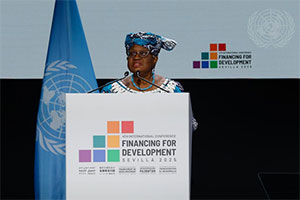 Opening of 4th International Conference on Financing for Development. Credit: UN Photo/Mariscal
International trade and investment are crucial elements of the world economy. While they can be powerful stimulators of development, they can also lead to global imbalances and dynamics of exploitation. In 2025, international trade entered a period of immense disruption, driven in part by a new wave of United States tariffs that reshaped global supply chains and investment flows. The increase in the US tariff rate, the highest since the 1930s, has forced bilateral renegotiations with global trading partners. Furthermore, the debt crisis in developing nations has accelerated while Official Development Assistance (ODA) has substantially dropped 7.3% in 2024.
In the 21st century, advancements in economic diversification in formerly colonized nations have propelled them into more central roles in the global economy. For example, both China and Mexico were able to develop their manufacturing sector and channel this development into booming export flows, thus advancing into the position of emerging economies. Foreign investment also plays an essential role in providing capital for developing countries, although they are oftentimes accompanied by social and environmental exploitation. For example, rising Chinese investments in natural resources in Latin America have often been met with tension as these investment projects fail to properly mitigate environmental risks and protect workers’ rights. In a more multifaceted vein, Sino-African relations have led to infrastructure development in Sub-Saharan Africa while also heightening the region’s economic dependency on China. IPS reports on global news in trade and investment, while shining a light on the nuanced nature of these endeavors.

The Week with IPS

NEXT STOP - SDGs
Tracking global progress towards a sustainable world
Tracking global progress towards a sustainable world
