Languages
Wednesday, October 21, 2026



News and Views from the Global South
Trade & Investment

Social Protection Necessary to Quickly End Poverty, Hunger
Historically, most social security systems have developed in the formal sector of rich economies. However, most of the poor and hungry in the world live in rural areas, surviving in the informal economy.
When African Women are Financially Included, an Entire Continent Wins
When Rwandan-born, Senegalese-raised entrepreneur and businesswoman Kristine Ngiriye was 18 she had a brilliant idea that she wanted to translate into a business. But when she went to her local bank for a loan they told her to rather get married, because “ a woman must be married instead of venturing into business”, Ngiriye tells IPS.
Winning the ‘No Food Loss’ Battle: The Case of Japan
Humankind since almost the time that there is recorded history has grappled with the question of ‘how many is too many?’ The response is expectedly complex as it varies across time and space. The pace of population growth was slow till about approximately 250 years or so. It is only since the middle of the eighteenth century that there has been a palpable acceleration in population growth.
Liberation, Not Liberalization, Responsible for China’s Economic Miracle
Any balanced assessment of the so-called Chinese economic miracle will recognize that it was extremely successful, not only during the reform period from 1979, but also since Liberation in 1949 despite the setbacks of the Great Leap Forward and the Cultural Revolution.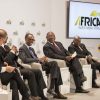
Africa is Better Placed Than Ever for Investment
 The Presidents Cyril Ramaphosa of South Africa, Paul Kagame of Rwanda, Nana Akufo-Addo of Ghana and Prime Minister Agostinho do Rosario of Mozambique engaged in a discussion titled, Invest in Africa's Space: Conversation with African Heads of State, moderated by Dr. Victor Oladokun, African Development Bank Group Director of External Relations and Communications, at the Africa Investment Forum, Johannesburg, 11 November 2019.
A New Deal for Sustainable Development
Almost nine decades ago, newly elected US President Franklin Roosevelt introduced the New Deal in 1933 in response to the Great Depression. The New Deal consisted of a number of mutually supportive initiatives, of which the most prominent were: a public works programme financed by budget deficits; a new social contract to improve living standards for all working families, including creation of the US social security system; and financial regulation to protect citizens’ assets and channel financial resources into productive investments.
Investment to Make Africa a World leader in Renewables
Africa, where close to half of its 1.2 billion people have access to electricity, is set to become a world leader in renewable energy. As global business and development leaders met in Johannesburg, South Africa, to attend the Africa Investment Forum (AIF), held Nov. 11 to 13, one of the key focuses of the deals being discussed was around sustainable, renewable energy.
Mo Money Mo Solutions – the African Development Bank’s Ready to Double Investment Across the Continent
Buses carrying cross-border traders and goods from Cotonou in Benin to Bamako in Mali have recently been using the Lomé route — travelling through the capital of Togo and then getting onto the Ouagadougou corridor on their way to the Malian capital.
Trade Liberalization for Development?
The International Monetary Fund (IMF), the World Bank and the World Trade Organization (WTO), all dominated by rich countries, have long promoted trade liberalization as a ‘win-win’ solution for “all people—rich and poor—and all countries—developed and developing countries”, arguing that “the gains are large enough to enable compensation to be provided to the losers”.
Going with the Wind: Transition to Clean Energy in Latin America & the Caribbean
The UN Climate Action Summit 2019, which took place in the days leading up to the 74th UN General Assembly, delivered new pathways and practical actions for governments and private sector to intensify climate action.African Development Bank Group’s Board of Governors to hold fifth extraordinary meeting in Abidjan
The Board of Governors of the African Development Bank will hold its fifth extraordinary meeting on Thursday, 31 October 2019, at the Sofitel Abidjan, Hotel Ivoire. During the meeting, the Bank’s shareholders will make signification decisions, and a major announcement is expected.
If India Stopped Growing, Would the IMF and World Bank Say So?
Leading economic indicators have slowed or reversed. Criticisms of official statistics are mounting. But the IMF and World Bank continue to forecast 6-percent growth by simple extrapolation.
UN Turns to Global Investors for Billions Needed for its 2030 Development Agenda
A Republican US Senator of a bygone era was once quoted as saying “a billion here, a billion there, and pretty soon you're talking about real money.”
Industrial Policy Still Relevant
Industrial policy refers to the promotion of new investments and technology by governments to encourage the growth and development of specific economic sectors. However, scepticism persists about the feasibility and desirability of using industrial policy, especially of the ability to ‘pick winners’, often accused of leading to ‘propping-up failing industries’.
Development Banks Needed to Finance Sustainable Development
Public or state development banking will be vital to achieving the Sustainable Development Goals, argues UNCTAD’s Trade and Development Report 2019 (TDR 2019). Ongoing World Bank led efforts seek to leverage private finance via shadow banking by using public money to guarantee handsome returns managed by giant investment houses. Such financialization introduce new costs and risks to financing investments for sustainable development, decent work and renewable energy.
African Development Bank and Three Regional Development Banks Launch Joint Report on Livable Cities
Rapid urbanization has provided most cities in the world with opportunities to provide more sustainable, vibrant, and prosperous centers for their citizens. But they must first address challenges such as inadequate infrastructure investments, pollution and congestion, and poor urban planning, according to a new report released today.
Africa’s Investment Drive Gathers Pace
Headwinds are blowing amid IMF warnings of a “synchronised slowdown” in global economic growth, yet Africa’s investment drive is still gathering pace, supported by intense international competition in development finance.
2019 Africa Investment Forum: African Development Bank and partners gear up for new heights
In just a few weeks, the second edition of the annual Africa Investment Forum will kick off in Johannesburg, South Africa, with development finance institutions determined to tackle the continent’s infrastructure investment challenges and advance Africa’s economic transformation agenda.
OECD Tax Reform Proposal Could Be Better
The OECD Secretariat published its proposed ‘unified approach’ to reform international tax rules to address tax challenges posed by digitalization on 9 October 2019. Under current rules, there is little chance of a company being taxed without its physical presence in the country concerned. But digitalization enables many businesses to remotely conduct economic activities affecting a national economy without a direct physical presence.
Global Climate Change Investment Heavily Tilted Towards Mitigation and Low on Adaptation
Good news: the graph depicting climate investments has been steadily increasing. Climbing from the 2012 figure of $360 billion in climate investments across the world to close to $600 billion currently.
Africa’s Mineral Wealth May Just have to Stay in the Ground to Protect a Changing Climate
As a result of climate change, resource extraction industries in Africa will be impacted by asset stranding, researchers say.« Previous Page — Next Page »





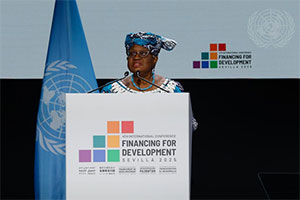 Opening of 4th International Conference on Financing for Development. Credit: UN Photo/Mariscal
International trade and investment are crucial elements of the world economy. While they can be powerful stimulators of development, they can also lead to global imbalances and dynamics of exploitation. In 2025, international trade entered a period of immense disruption, driven in part by a new wave of United States tariffs that reshaped global supply chains and investment flows. The increase in the US tariff rate, the highest since the 1930s, has forced bilateral renegotiations with global trading partners. Furthermore, the debt crisis in developing nations has accelerated while Official Development Assistance (ODA) has substantially dropped 7.3% in 2024.
In the 21st century, advancements in economic diversification in formerly colonized nations have propelled them into more central roles in the global economy. For example, both China and Mexico were able to develop their manufacturing sector and channel this development into booming export flows, thus advancing into the position of emerging economies. Foreign investment also plays an essential role in providing capital for developing countries, although they are oftentimes accompanied by social and environmental exploitation. For example, rising Chinese investments in natural resources in Latin America have often been met with tension as these investment projects fail to properly mitigate environmental risks and protect workers’ rights. In a more multifaceted vein, Sino-African relations have led to infrastructure development in Sub-Saharan Africa while also heightening the region’s economic dependency on China. IPS reports on global news in trade and investment, while shining a light on the nuanced nature of these endeavors.

The Week with IPS

NEXT STOP - SDGs
Tracking global progress towards a sustainable world
Tracking global progress towards a sustainable world
