
Thursday, October 1, 2026



News and Views from the Global South
Combating Desertification and Drought
ARGENTINA: Drought Threat Looms Again
The low humidity in Argentina's most agriculturally productive region has already caused a decline in grain yield - in particular corn and soybean - with ensuing losses for producers and the government.ARGENTINA: In Famatina, Water Is Worth Far More Than Gold
Thousands of people in the northwest Argentine province of La Rioja are mobilising to stop an open-cast gold mining project in the Nevados de Famatina, a snowy peak that is the semi-arid area's sole source of drinking water.Brown Revolution Brings New Hope
Picking spots for cattle to graze could reverse desertification and even do its bit to retard climate change, new experiments in Zimbabwe have shown. It’s what is coming to be called the Brown Revolution.
KENYA: Thirsty Eucalyptus Good for Absorbing Carbon
On a steep slope of land in Thangathi village in Central Province, Kenya, Peter Nyaga surveys his four-year-old eucalyptus woodlot. He calculates the value of every tree on his two-hectare piece of land at maturity in three years.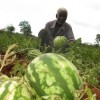
AFRICA: Watermelon Farming in a Drought
On a Sunday evening, a track loaded with 10 tonnes of watermelons leaves Geoffrey Ndung’u’s homestead in Kanyonga village in semi-arid Eastern Kenya. It travels past a village shopping centre were people have formed a queue to receive food aid because of a prolonged drought in the area.
Observing Deforestation from Space
Global climate change can now be observed from space. The United Nations Food and Agriculture Organisation (FAO) launched a new technology that can survey the world’s forests via satellites and provide a more accurate, global picture of common threats to the environment, such as deforestation, degradation or illegal logging.
CLIMATE CHANGE-AFRICA: Farming By Phone
Francis Mburu used to keep indigenous cattle in Entasopia village in the semi- arid Kajiado region, 160 kilometres southwest of Nairobi. However, increasing temperatures and frequent droughts in Kenya have made this difficult in recent years.
Forest-Dependent Communities Lobby for End of REDD+
Organisations working with indigenous peoples living in forests say the United Nations programme on Reducing Emissions from Deforestation and Forest Degradation in Developing Countries (REDD+) is just another way for big corporates to reap huge profits.
“God Wants Us to Live in a Garden, Not a Desert”
The European Union plan to save the Kyoto Protocol may meet its greatest obstacle in the developing world.CLIMATE CHANGE: Himalayan Nations Yet to Break the Ice
Chungda Sherpa, a former herder from eastern Nepal, has a warning tale ahead of the United Nations climate change conference in Durban.
AFRICA: Change the Donors Climate
When donor-funded horticultural projects failed in Kalacha village at the edge of the Chalbi Desert in North Eastern Province, Kenya, the local pastoralist community proposed their own idea, which turned out to be the solution to their problems.
Q&A: “Grabbing of Drylands is a Serious Concern”
Designated Drylands Ambassador, United Nations Convention for Combating Desertification (UNCCD), at its 10th Conference of the Parties (COP10) in South Korea in October, Dennis Garrity is mandated to raise awareness of land degradation.
Climate Change Could Unravel Development Progress
The United Nations unveiled its 22nd annual Human Development Report on Wednesday, with grave warnings that unless countries take action against climate change and implement sustainable solutions, progress in human development will be in serious jeopardy.
Hard Targets Needed to Halt Land Degradation Crisis
Every six seconds, a child dies of hunger-related causes. That disturbing reality seems as remote as the moon here in the ultra-modern Changwon Convention Centre, where delegates struggled to create effective ways to stem the ongoing decline of food-producing lands.
Civil Society Groups Call for Action to Curb Land Grabbing
Civil society organisations are calling on governments in developing countries to stop leasing and selling out land to transnational corporations because it leads to land degradation and food insecurity.
AFRICA: Gov’ts Fail to Invest in Hungriest, Poorest Regions
For millennia, people have coped with drought in the Horn of Africa, comprised mainly of drylands. Yet today, more than 13 million people there are starving because of political instability, poor government policies and failure to invest in the world's poorest people, say experts here in Changwon.
Q&A: ‘Soil is Key to Global Warming, Food Security’
Luc Gnacadja, in his second three-year term as executive secretary, United Nations Convention to Combat Desertification (UNCCD), is widely seen as delivering on his commitment to manage the world's drylands.
AFRICA: “The Man Who Stopped the Desert”
Yacouba Sawadogo, a peasant farmer from Burkina Faso, is known as the "man who stopped the desert." But when he first tried to save his arid land from desertification by planting the trees that have since grown into a 15-hectare forest, people in his village thought he was mad.
SOUTH KOREA: Drylands Meet Deserts Gender
Delegates to the United Nations Convention to Combat Desertification’s (UNCCD) meeting underway in this South Korean city are convinced that women, though affected most by desertification, hold the key to addressing hunger through land regeneration.
Looking to the Sahel for Lessons in Pushing Back Deserts
Nearly all our food comes from the Earth's limited food- producing lands, but those lands continue to be degraded, guaranteeing far higher food prices and less food in the future, experts warn.
SOUTH KOREA: Preventing Desertification Better Than Cure
"Humanity is the only desert-making species and we’ve been degrading usable land at one percent per year," says Luc Gnacadja, executive secretary of United Nations Convention to Combat Desertification (UNCCD).« Previous Page — Next Page »


Today, some two billion people depend on ecosystems in dryland areas, with 90 percent of them living in developing countries. But the pace of arable land degradation is accelerating – now estimated at 35 times the historical rate -- impacting biodiversity, availability of clean water and food security, as well as exposing vulnerable communities to the harsh impacts of climate change. As the only legally binding international agreement linking environment and development to sustainable land management, the United Nations Convention to Combat Desertification (UNCCD) works to improve the living conditions of people in the drylands. IPS looks at local solutions being implemented around the world, from restoring soil productivity and mitigating the effects of drought, to projects that empower communities to manage their dryland resources more effectively.

The Week with IPS

Tracking global progress towards a sustainable world
