Languages
Wednesday, September 30, 2026



News and Views from the Global South
Global Governance

Youth Lead Global Call to Support Hibakusha on UN Day Against Nuclear Test
Marking the United Nations’ International Day Against Nuclear Tests, young activists and experts gathered at the UN University in Tokyo for an event titled “The Role of Youth in Supporting Global Hibakusha.” The forum underscored how youth solidarity can amplify the voices of survivors of nuclear testing and bombings, known collectively as the “Global Hibakusha” — communities scarred by the use, production, and testing of nuclear weapons, from Hiroshima to the Marshall Islands — and strengthen global momentum toward nuclear abolition.
UN General Assembly Urged to Temporarily Move to Geneva to Circumvent US Visa Denials
When Yasser Arafat, leader of the Palestine Liberation Organization (PLO) was denied a US visa to visit New York to address the United Nations back in 1988-- under the Ronald Reagan administration-- the General Assembly defied the United States by temporarily moving the UN’s highest policy making body to Geneva– for the first time in UN history– providing a less-hostile political environment for the PLO leader.
E3, US Need a More Effective Diplomatic Strategy for Iran Post-Snapback
The decision early this week by the E3 (France, Germany, and the United Kingdom) to initiate the process to snap back UN sanctions on Iran that were modified as part of the 2015 nuclear deal must be paired with an effective diplomatic strategy that restarts talks between the United States and Iran.
UN Reforms Include “Painful Staff Reductions”—and Forcible Return to Home Countries
The 193-member General Assembly, the UN’s highest policy-making body, will make the ultimate decision on the proposed UN restructuring, which will include staff cutbacks, merging or eliminating of departments and relocating UN agencies from high-cost to low-cost locations.
Soka Gakkai President Issues Statement on Creating a World Without War to Mark 80 Years Since End of World War II
Minoru Harada, president of the Soka Gakkai Buddhist organization, has today issued a statement marking 80 years since the end of World War II, titled “Creating a Wave of Change Toward a Century Without War,” clarifying its ongoing commitment to peace.
From Endurance to Resilience: The Future of Development in Latin America & the Caribbean
The development trajectory of Latin America and the Caribbean is going through a period of unprecedented vulnerability and uncertainty. The significant achievements of past decades, as well as the possibility of continuing to make progress, are under threat from the impact of growing geopolitical tensions, unresolved structural challenges, and an increase in crises of various kinds—environmental, political, health, technological, and social.
President Trump: You Must Stop Netanyahu’s Second Genocide in Gaza
President Trump, you are the only leader who can stop Netanyahu from committing another genocide in Gaza. The whole world is watching. Do not allow yourself to become an accessory to the murder of thousands of innocent Palestinian women and children and the utter destruction of what’s left of Gaza
A New Non-Alignment for the Global South
The Global South had little voice, let alone influence, in shaping the economically ‘neoliberal’ and politically ‘neoconservative’ globalisation leading to contemporary geopolitical economic conflicts. Pacifist non-aligned cooperation for sustainable development offers the best way forward.
IPC Officially Declares Famine; More than Half a Million Starving in Gaza
The Integrated Food Security Phase Classification (IPC) has officially declared that there is famine in Gaza. The world’s biggest food monitoring system raised its classification to Phase 5, the highest level on its food insecurity scale.
Who Should Lead the UN Development Programme?
In June this year, UNDP bade farewell to Achim Steiner. The ninth Administrator in UNDP’s history had completed a second four-year term in office.
Sexual Exploitation & Abuse at UN Reveals “Significant Underreporting”
A system-wide UN survey of sexual exploitation and abuse (SEA), described as “grave violations of human rights”, has revealed that in 2024, there were 675 allegations reported. A UN message to staffers last week says this is “widely believed” to be “significant underreporting” because the real numbers may be much higher.
Accountability on Trial: UN’s Unabated SEA Crisis Erodes Trust in World Body’s Leadership
After taking oath of office in December 2016 as Secretary-General, Mr. Antonio Guterres described the eradication of sexual offenses by UN peacekeeping and all other UN personnel as the first item on his reform agenda.
Can the UN Trusteeship Council be an Important Part of the Solution in the Middle East?
Many feel desperation and anger that the genocide of the Palestinians is not being stopped. How can the US, Germany and others continue to pour funds and weapons into Israel despite decisions in the UN's highest bodies indicating complicity in accordance with the Convention against Genocide?
UN Staff Federation Remembers with Sorrow the Many who have Fallen in the Line of Duty
On this World Humanitarian Day, the members of CCISUA Staff Federation honour colleagues who dedicate their lives to protecting people in crisis, and we remember with sorrow the many who have fallen in the line of duty.
Will the US Blacklist Bar Political Leaders & Delegates from UN’s 80th Anniversary Summit?
When the 193-member General Assembly commemorates the UN’s 80th anniversary during a high-level meeting in mid-September, how many political leaders and delegates will be barred from entering the United States --despite the 1947 US-UN Host Country Agreement?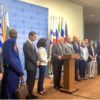
World Leaders Take a Stand as Outrage Against Israel Increases
The world is becoming increasingly outraged at Israel for its actions in the ongoing war against Hamas, particularly amid the recent killings of Palestinian journalists and Israel’s announcement of its plan to seize complete military control of the Gaza Strip.
Peacebuilding: The Missing Peace in COP30 Climate Ambition
Peacebuilding, conflict prevention, and crime prevention are no longer niche security concerns—they are global imperatives for sustainable climate action. From the migration crisis in Venezuela to the deforestation-driven conflicts in the Amazon, to organised crime in Central America, the ripple effects of instability and environmental degradation are felt far beyond national borders. In 2025, nearly 80% of countries experiencing risks to peace remain off-track to meet the Sustainable Development Goals (SDGs). Addressing these challenges isn’t just about safeguarding peace, stability and development. It’s also about ensuring sustainable climate action.
The Death of EU Values in Gaza
The EU likes to think of itself as a normative power — a community of values, committed to upholding international law, promoting peace, protecting civilians and building a rules-based global order. These are not just lofty ideals; they are enshrined in EU treaties, declarations and Council conclusions.
Fiji’s Truth and Reconciliation Commission Aims To Restore Trust and Peace After Decades of Political Crises
Fiji, a nation located west of Tonga in the central Pacific, is renowned for its natural beauty and beach resorts. But for 38 years it has endured a political rollercoaster of instability with four armed coups that overturned democratically elected governments and eroded human rights.
How the UN Can Prevent AI from Automating Discrimination
Artificial Intelligence (AI) is reshaping the world at a speed we've never seen before. From helping doctors detect diseases faster to customizing education for every student, AI holds the promise of solving many real-world problems. But along with its benefits, AI carries a serious risk: discrimination.
Four Ways Asia Can Strengthen Regional Health Security Before the Next Pandemic
In an interconnected world when infections can circle the globe in hours, cooperation in preparing for pandemics is essential. The COVID-19 pandemic highlighted just how vulnerable countries are when surveillance is fragmented, laboratory networks are underfunded and underequipped, and vaccines are not dispersed equitably.« Previous Page — Next Page »


The Week with IPS

NEXT STOP - SDGs
Tracking global progress towards a sustainable world
Tracking global progress towards a sustainable world
