Languages
Saturday, November 21, 2026



News and Views from the Global South
Headlines

Rain and Ruin
Undoubtedly, there were others who suffered more. Even before the rains beat down on Karachi this year, taking a few and then a few more and finally over 20 lives, hundreds others had died in neighbouring countries. The citizens of Karachi died as they do every year in an increasingly destructive monsoon season: a child drowned in an underground tank, two men were electrocuted while riding a motorcycle, another in his home. The run-up to Eid meant that there was livestock everywhere, tied up in markets and outside homes. The waste from these animals mixed with stagnant water — the deadly mix of offal, excrement and raw sewage in standing water — may well raise the number of dead. They will not be included in the official death count for this year’s rains.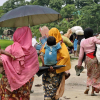
Where Is Our Rohingya Policy?
What we have today in the Rakhine State of Myanmar is a regime of ethnic cleansing. This latest round of pogrom of the Rohingyas is the result of the international community's abject lack of action. Not only has the persecution of the Rohingyas not stopped, there has been a renewed vigour in the activity of the state agencies of Myanmar to ensure that the State of Rakhine is emptied of the Rohingyas.
We Can Value Humanitarians Even if President Trump Does Not
As we watch disasters unfold – the flooding in Houston, Texas as well as the floods in India, Bangladesh, and Nepal that have killed over 1,200 people – we are grateful for the many humanitarians who risk their lives to help others.
Scaling up Development Finance
The Business and Sustainable Development Commission has estimated that achievement of Agenda 2030 for the Sustainable Development Goals will require US$2-3 trillion of additional investments annually compared to current world income of around US$115 trillion. This is a conservative estimate; annual investments of up to US$2 trillion yearly will be needed to have a chance of keeping temperature rise below 1.5°C.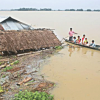
Combating Climate Change Impacts
Jamil is living on the bank of the Brahmaputra, a fisherman, carrying out his ancestral fishing business over the years. As a breadwinning person in the family, he has to feed several mouths. Moreover, Jamil is deeply rooted in his land. Jamil is in dismay, thinking that his business is no longer like back then when he used to travel to the bottom of Brahmaputra with his father by troller to catch fish. Jamil has a favourite flash back. They came back with baskets filled with fishes, and his father nodding his head told the tale of the daunted local sailor whose heroism melted Jamil's heart, and he wanted to play with the jewel blue stream of the Brahmaputra like this sailor. However, after reaching home, their happiness flourished more to join dining as they found the delicious fish curries on the table. Life changes its colour. Recurrent floods and booming industrial growth are grabbing up the lands and shirking his fishing business. However, this time the flood is devastating than they ever have experience. Their lands swamped up, and people started starving. Surprisingly, although relief workers supplied flood, still they spent time with empty bellies because they had no cooking arrangement. Jamil and his people are gripped by fear and uncertainty. They do not want to lose the sacred connection with their land and people. It would be a scary ride for them if their land would become uninhabitable and they would be forced to live in another place.
Ethiopia’s Internally Displaced Overlooked Amid Refugee Crises
Grasping its limp leg, a woman drags the carcass of one of her few remaining black-headed sheep away from her family’s domed shelter fashioned out of sticks and fabric that stands alone amid the desiccated scrubland a few kilometers from the town of Dolo Odo in the southeast of Ethiopia near the border with Somalia.
Cambodia no Longer Compliant with the Global Deal
Swedish Prime Minister Stefan Löfven made a special effort to reach this global agreement between countries, unions and businesses. The bearing idea is that by initiating dialogue in society, salaries can be raised, business profits improved and political stability strengthened.
What Charities and Relief organizations do to alleviate poverty in the Arab region
Extreme poverty remains one of the world’s biggest challenges. According to the United Nations, 767 million people live in extreme poverty around the world. Although world society has managed to lift nearly 1 billion people out of extreme poverty – in 1999 it was estimated that 1.7 billion were affected by extreme poverty – the unprecedented rise of conflict and of violence in the Arab region has worsened the socioeconomic situation of vulnerable population segments in many countries. On 22 February 2017, the Under-Secretary-General for Humanitarian Affairs and Emergency Relief Coordinator of the United Nations –Stephen O’Brien – stated to the United Nations Security Council that 67% of the population in Syria is living under conditions considered as extreme poverty. In another Arab country affected by war and conflict – Yemen – the World Bank estimates that poverty affects 62% of the population, whereas the World Bank’s estimates this number to be at approximately 22% for Iraq or even as high as 40% in territories controlled by DAESH. Inevitably, conflict and violence have worsened the situation in the Arab region.
Europe, New Border of Africa’s ‘Great Desert’ – The Sahara
 With the highest temperatures on record and unprecedented heat waves hitting Europe this year, Africa’s ‘Great Desert’, the Sahara, is set continue its relentless march on the Southern European countries until it occupies more than 30 per cent of Spain just three decades from now.

Robots: A Solution to Declining and Aging Populations?
Are humanoid robots or androids a solution to declining and aging populations? Given the prospects of demographic decline and population aging coupled with growing opposition to immigration, countries are increasingly turning to and investing in advanced robotics and androids to address shrinking workforces and rising numbers of elderly.
Small Entrepreneurs Emerge as Backbone of Bangladesh’s Rural Economy
She was born in the early 1950’s to an ultra-poor family in Kundihar, a remote village of Banaripara of Barisal division in Bangladesh. She was a beautiful baby and her father named her ‘Shahndah Rani’ which means ‘Queen of Evenings’. But in reality her life was far from that of a queen.
Towards a Resource Efficient and Pollution Free Asia-Pacific
Senior government officials from across Asia and the Pacific will meet in Bangkok this week for the first-ever Asia-Pacific Ministerial Summit on the Environment. The high-level meeting is co-convened by the United Nations Economic and Social Commission for Asia and the Pacific (UN ESCAP) and UN Environment and is a unique opportunity for the region’s environment leaders to discuss how they can work together towards a resource efficient and pollution-free Asia-Pacific.
Climate-Smart Agriculture Urgently Needed in Africa
Africa contributes only 4 per cent of global greenhouse gas emissions, while six of the 10 most affected countries by climate change are in Africa, warns a major agricultural research for development partnership, while stressing the urgent need to scale up climate-smart agriculture, improve forestry and transform the productivity of water use.
Latin America Calls for Free Movement of Persons in Global Compact on Migration
Latin America and the Caribbean called for the free movement of persons to be included in the Global Compact on Migration, which will be negotiated within the United Nations in 2018, in the first meeting held by any of the world’s regions to decide on the position to be adopted on the future agreement.Indian Ocean Not Another South China Sea, Please
There was a hive of activity this week in Colombo with a variety of international think tanks, strategists, analysts and senior military officers, Foreign Ministers and Ministers exchanging views and taking up positions – the focus being on the Indian Ocean and its surroundings.
The Difference Between Trafficking in Persons and Smuggling of Migrants
Trafficking in persons (TiP) and smuggling of migrants (SoM) directly affect ACP (African, Caribbean and the Pacific Group of States) countries and their European Union counterparts.Fighting Could Spread to ARMM – Duterte
President Rodrigo Duterte is unlikely to lift martial law in Mindanao before the end of 2017 because of a possible spillover of violence brought about by the fighting in Marawi City to the Muslim autonomous region.
More Than 18,000 Rohingya Flee as Violence Renews
A surge in deadly violence in Myanmar has forced over 18,000 Rohingya Muslims to flee in less than one week, a migration agency said.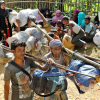
Misframed Facts, Prejudiced Responses
Rohingyas of northern Arakan are facing yet another round of armed atrocities. Not only are they at the receiving end of indiscriminate use of bullets, bayonets and firing from helicopter gunships; their homes, hearths, livestock, crops and businesses are being consumed by bellowing fire deliberately lit by the Burmese security forces and their Rakhine cohorts. Satellite images validate witness accounts and provide correlation with some reported incidents where residences have allegedly been deliberately torched. The carnage follows a series of coordinated attacks by ethnic Rohingya militants on August 25, 2017 against 25 security posts.
US Pressure Keeps Palestinians Blacklisted at UN
When Secretary-General Antonio Guterres proposed the appointment of former Palestinian Authority Prime Minister Salam Fayyad as UN’s Special Representative in Libya back in February, the proposal was shot down by US Ambassador Nikki Haley, purely because he was a Palestinian.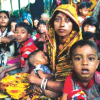
Exodus of Refugees Turns Fatal
Law enforcers rescued 19 bodies of Rohingya people, who had been fleeing violence in Myanmar, from the Bay of Bengal after the ill-equipped boats carrying them capsized yesterday.« Previous Page — Next Page »


