Languages
Thursday, October 1, 2026



News and Views from the Global South
Aid

Pacific Islanders Turn to Local Economies to Drive Post-pandemic Recovery
While Pacific Island countries have, so far, been spared a catastrophic spread of COVID-19, their economies have been devastated by the effects of border closures, internal lockdowns and the demise of international tourism and trade. With the global pandemic far from over, Pacific Islanders are looking to their local and regional economies to drive resilience and recovery.
IP, Vaccine Imperialism Cause Death and Suffering, Delay Recovery
Vaccine developers’ refusal to share publicly funded vaccine research findings is stalling broader, affordable vaccinations which would more rapidly contain COVID-19 contagion. The pandemic had infected at least 109 million people worldwide, causing over 2.4 million deaths as of mid-February.
Give us Access to Tigray to Find Missing Refugees — NRC Pleas
The Norwegian Refugee Council (NRC) has called for unimpeded access to all parts of Ethiopia’s Tigray Region, to locate an estimated 20,000 unaccounted for refugees and assess damage to its Hitsaats Camp which was looted and set alight in early January.
To Prevent Another Civil War South Sudan Must Create a New, Unique Political System
The threat of a full-blown civil war in South Sudan remains unless the country’s leaders can broaden power sharing, warns a new report by the International Crisis Group (ICG) released almost year into the country’s formation of a government of national unity.
Why it’s Crucial Not to Limit the Youth’s Access and Use of Family Planning
With the COVID-19 pandemic negatively affecting access to Adolescent and Youth Sexual and Reproductive Health (AYSRH) services, it’s imperative governments employ community-based initiatives and peer educators to ensure these services are still available to them.
Internationally COVID-19 Extracted a Heavy Toll on Older People
Internationally COVID-19 extracted a heavy toll on older people – raising concerns in the Asia Pacific region where more than half of the world’s ageing population live.
How COVID-19 Adds to the Challenges of Leprosy-affected People
Lilibeth Evarestus of Lagos, Nigeria doesn’t like the concept of handouts — she is against the idea of thinking of leprosy-affected people as weak. Yet, for several months now, Evarastus – a human rights lawyer and founder of community welfare organisation, Purple Hope Foundation – has been spending a lot of time on the road, distributing food items and hygiene products among the leprosy-affected people in her community.
Lebanon: How to Build Back Better after Political and Economic Crisis
Lebanon must “shield and preserve” the skills, knowledge, and experience of its people in order to move forward with its development, according to Christophe Abi-Nassif, the Lebanon programme director for the Middle East Institute (MEI).
“Saving Journalism: A Vision for the Post-Covid World”
In the midst of the COVID-19 pandemic, journalists everywhere are feeling the consequences; job cuts, layoffs and closures have swept the world.
We are Facing a Climate Emergency, Warns UN Chief
We begin this year with a heightened awareness of the importance of resilience. The COVID-19 pandemic has reminded us that we cannot afford to ignore known risks.
International Partnership Helps Mongolia Counter Climate Change
Climate warming is believed to have taken place at some of the fastest rates in the world in Mongolia, raising the country's average temperatures by 2.24°C between 1940 and 2015, with the last decade being the warmest of the past 76 years.
Q&A: Why we Must Invest in Educating Children in Crisis-Hit Burkina Faso
Education Cannot Wait (ECW) - the first global fund dedicated to education in emergencies and protracted crises – was on the ground in Burkina Faso last week with its Director, Yasmine Sherif, to launch a new multi-year programme that aims to provide an education to over 800,000 children and adolescents in crisis-affected areas.
Afghanistan Threatened With Rising Violence Once Again
When the Doha talks were launched in September, the Afghan people's hopes for an end of war and violence were high. So far, many have been disappointed as the negotiations have not done much to improve the security situation.
COVID-19 Pandemic Shapes the Future World People Want
The peoples of the world are unanimous - access to basic services such as universal healthcare must become a priority going forward. So too should global solidarity, helping those hardest hit by the COVID-19 pandemic and addressing the climate change emergency.
If Covid-19 is Primarily a ‘First World’ Virus, Why is the Global South in Lockdown?
The currently available Covid-19 vaccines have been authorized for ‘emergency use ‘in Europe and North America. This is due to an apparent spike in Covid-19 flu cases in the northern hemisphere as winter advances. Highly advertised vaccines are being produced and rolled out at ‘warped speed’ by powerful pharmaceutical and bio-technology companies headquartered in Euro-America although their efficacy including how long their immunity lasts is not clear.
Ten Defining Moments for Women in 2020
While 2020 will be remembered most for the way COVID-19 changed our lives in nearly every way and in every part of the world, we made some strides for women’s rights and gender equality.
2020: A Yet More Devastating Year Closes With At Least Some Signs Of Hope
Despite its grim record of multiple natural disasters and a deepening climate crisis, one could be forgiven for looking back on 2019 with a degree of nostalgia. There is no disguising the extent of the calamity wrought this year by COVID-19, yet as we approach the end of 2020 we may also draw strength from positive developments emerging.
The Impact of COVID-19 on Child Marriage and Other Gender-Based Violence
I recently visited rural areas of Bangladesh amid the COVID-19 pandemic and returned to Dhaka with a new understanding of the impact that COVID-19 is having on child marriage, a harmful practice that is a global challenge. The fundamental shift that I saw was that child marriage, which has typically been encouraged by struggling parents, is now being encouraged by struggling girls. This worrisome trend underscores a new burden of the pandemic on the poor.
Afghanistan’s Historic Year: Peace Talks, Security Transition but Higher Levels of Violence
While Afghanistan ends a historic year, filled with the hope for peace as the government and Taliban sat down for almost three months of consecutive peace talks for the first time in 19 years, it was also a year filled with violence with provisional statistics by the United Nations showing casualties for this year being higher than 2019.
Sid Chatterjee Epitomizes the New Leadership Model of UN Resident Coordinators Worldwide
Siddharth Chatterjee, who has served with the United Nations for over 20 years, has been appointed as the new Resident Coordinator in China, the world’s second largest economy after the United States.
Getting Children in Lebanon Back to School Amongst Multiple Crises
Education and health care were high on the agenda when the United Nations vowed to work toward a better future by setting 17 Sustainable Development Goals (SDGs) to be met by 2030.« Previous Page — Next Page »


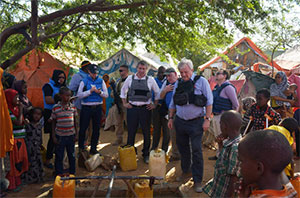 UN Emergency Relief Coordinator Visits Somalia. Credit: UN Photo/Tobin Jones
In recent years, conflicts have broken out across the world with no sign of slowing down or stopping. In times like this, millions of people globally are in dire need of humanitarian aid. Famine, warfare, natural disasters, and economic decline plague a host of nations, including Palestine, Sudan, Chad, Lebanon, and Haiti, to name a few. Humanitarian aid provides millions of people with critical services including healthcare, food, clean drinking water, psychosocial support, housing, and access to education. UN agencies such as the UNDP, UNICEF, the World Food Programme (WFP), UNHCR, UNRWA, and UNEP work with the UN Office for the Coordination of Humanitarian Aid (OCHA) and local organizations to come up with the best possible strategies to support affected communities. At the same time, humanitarian aid and those working on the frontlines are consistently threatened by both actors directly involved in conflict as well as those who are meant to contribute to the international humanitarian regime at large. The near-collapse of United States international aid structures in 2025, including the termination of 83% of USAID’s 6,300 global initiatives, has left millions of people without access to vital humanitarian assistance. 98 million people in 2025, only 65% of people targeted for humanitarian assistance, received the help they needed. In contrast, 123 million people received some form of humanitarian assistance in 2024, and OCHA’s 2026 Global Humanitarian Overview estimates that 239 million people are in need of assistance in 2026. IPS is well-positioned to discuss current initiatives to provide aid and relief through in-depth reporting and opinion content.

The Week with IPS

NEXT STOP - SDGs
Tracking global progress towards a sustainable world
Tracking global progress towards a sustainable world
