Languages
Saturday, October 17, 2026



News and Views from the Global South
Aid

Overly Bureaucratic Procedures and Long Waits Cuts off Support to 22 Million Yemenis
As Yemen’s people struggle to survive amid what has been described as the world’s worst humanitarian crisis, the stranglehold by both government coalition forces and rebels over the country’s main ports of entry and distribution is cutting off a lifeline of support to 22 million people.
West Africa Moves Ahead with Renewable Energy Despite Unpredictable Challenges
The West African nation of Guinea may be a signatory of the Paris Agreement, a global undertaking by countries around the world to reduce climate change, but as it tries to provide electricity to some three quarters of its 12 million people who are without, the commitment is proving a struggle.
Savagery of Rapes of Minors
Rapes of minors surged from 16 per day in 2001 to 46 per day in 2016. As if this was not horrendous enough, their savagery adds to it. In 2016, 43.3% of the total female rape victims were minors. Around 13% of the minor female victims were of age 11 and below. The deceased victim in the Kathua rape case from a nomadic Muslim community was barely eight years old. Her crumpled body was found in a blood-smeared dress in January, 2018. A group of Hindu men lured her into a forest, kidnapped her, drugged her, locked her in a Hindu temple, gang-raped her and then strangled her.
Three Countries Protect Half the World’s New Refugees
Turkey, Bangladesh and Uganda alone received over half of all new refugees last year. Never before has the world registered a larger number of people displaced by war and persecution.
2.5 Million Migrants Smuggled Worldwide, Many Via Social Media
At least 2.5 million migrants were smuggled worldwide in 2016, generating an income for smugglers which ranged between $5.5 billion and $7.0 billion, according to a newly published report “2018 Global Study On Smuggling Of Migrants” by the Vienna-based UN Office on Drugs and Crime (UNODC)
Trump is Here to Stay and Change the World
Donald John Trump, 45th and current president of the United States, has been seen in many illustrious circles as an anomaly that cannot last. Well, it is time to look at reality. If we put on the glasses of people who have seen their level of income reduced and are afraid of the future, Trump is here to stay, and he is a result and not a cause.
Fertility Struggles More Open – and Shared on Social Media
Fertility health is an incredibly personal – and often vulnerable – topic. Fertility, infertility, and fertility preservation have gained increased public interest over the past few years. Infertility is formally defined as the inability to achieve pregnancy after one year of unprotected intercourse.
Now is Not the Time to Give up on the People of DRC
After more than 20 years of brutal conflict, few might believe that things could get worse in the Democratic Republic of Congo (DRC). And yet they most dishearteningly are. In the last year, we have witnessed a continuous escalation of violence that has spread to half of the country, endangering millions. Some 2 million children suffer from acute hunger, and the DRC is home to the largest number of displaced people in Africa.
Europe, Sharing the Love?
Even if arrivals of migrants into Italy by sea have decreased between 2017 and 2018 so far, recent events in the Mediterranean rim have strongly drawn attention to the migration issue and a fierce debate is now underway among European countries.
Sahel in the Throes of a Major Humanitarian Crisis
I am increasingly concerned by the situation in the Sahel. In Burkina Faso, Chad, Mali, Mauritania, Niger and Senegal, nearly 6 million people are struggling to meet their daily food needs. Severe malnutrition threatens the lives of 1.6 million children. These are levels unseen since the crisis of 2012, and the most critical months are still ahead.
Stop Neglecting African Conflicts
Conflicts have uprooted millions across several African nations and we must not forget them, said a human rights group. Norwegian Refugee Council’s (NRC) timely message was published through their annual list of the worlds most neglected displacement crises.
Universities & Their Duty to Help Refugees
A global network of universities is helping to create positive change for the experiences of refugees and migrant families. On June 7, scholars and students travelled to the United Nations HQ in New York to share how they are supporting refugees – and how small actions can make a big difference.
Kenya Can End the Moral Indignity of Child Labour
On 12 June every year is the World Day Against Child Labour. In the world's poorest countries, around one in four children are engaged in work that is potentially harmful to their health.
When a Grass Towers over the Trees
As governments scramble for corrective options to the worsening land degradation set to cost the global economy a whopping 23 trillion dollars within the next 30 years, a humble grass species, the bamboo, is emerging as the unlikely hero.
World Wakes up to Climate Migration
This year is set to be an important milestone in the arduous journey of climate migrants. The global community is now beginning to fathom the challenges of people displaced by events such as floods, storms and sea level rise that are partly fuelled by climate change.
Great Green Wall Brings Hope, Greener Pastures to Africa’s Sahel
Hope, smiles and new vitality seem to be returning slowly but surely in various parts of the Sahel region, where the mighty Sahara Desert has all but ‘eaten’ and degraded huge parts of landscapes, destroying livelihoods and subjecting many communities to extreme poverty.
Experts Urge Lawmakers to Focus on Food-Migration Nexus
Lawmakers at the highest levels urgently need a “revolution in thinking” to tackle the twin problem of sustainable food production and migration. Starting with an inaugural event in Brussels, then travelling on to New York and Milan, an international team of experts led by the Barilla Center for Food and Nutrition (BCFN) is urging far-reaching reforms in agricultural and migration policy on an international scale.
Human Rights Must Be on the Table During U.S.-North Korea Talks
Human rights issues must be included in next week’s United States-North Korea summit in order to create a “sustainable agreement”, said a UN expert.
Afghan Electorate: Basic Needs Must be met Before Political Progress can be Ensured
After four decades of perpetual conflict, Afghanistan rolls into two consecutive election years – parliamentary this year, presidential the next. But the country and its people are going through even tougher times than usual with continued displacement and a looming hunger crisis.
“A Map and Plan”: When Greener Pastures End in a Blazing Desert
“Sometimes when I’m alone, I still get flashes of the grisly images I saw in the desert. I feared I was going to die out there. The people transporting us were ready to get rid of any of us where necessary,” Njoya Danialo recalled as he narrated the ordeal he endured traveling through the Sahara in search of greener pastures.
US Administration Wants to Control Immigration by Slashing Aid: Here’s What They Need to Know
The US is going to use aid to shape migration. That’s at least how the president’s remarks seem to have laid it out on Wednesday, when he announced his White House is “working on a plan to deduct a lot of aid” from countries whose nationals arrive at the US border. “[W]e may not just give them aid at all.”« Previous Page — Next Page »





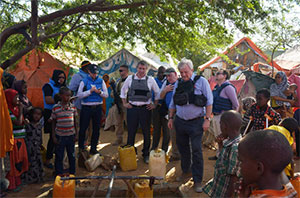 UN Emergency Relief Coordinator Visits Somalia. Credit: UN Photo/Tobin Jones
In recent years, conflicts have broken out across the world with no sign of slowing down or stopping. In times like this, millions of people globally are in dire need of humanitarian aid. Famine, warfare, natural disasters, and economic decline plague a host of nations, including Palestine, Sudan, Chad, Lebanon, and Haiti, to name a few. Humanitarian aid provides millions of people with critical services including healthcare, food, clean drinking water, psychosocial support, housing, and access to education. UN agencies such as the UNDP, UNICEF, the World Food Programme (WFP), UNHCR, UNRWA, and UNEP work with the UN Office for the Coordination of Humanitarian Aid (OCHA) and local organizations to come up with the best possible strategies to support affected communities. At the same time, humanitarian aid and those working on the frontlines are consistently threatened by both actors directly involved in conflict as well as those who are meant to contribute to the international humanitarian regime at large. The near-collapse of United States international aid structures in 2025, including the termination of 83% of USAID’s 6,300 global initiatives, has left millions of people without access to vital humanitarian assistance. 98 million people in 2025, only 65% of people targeted for humanitarian assistance, received the help they needed. In contrast, 123 million people received some form of humanitarian assistance in 2024, and OCHA’s 2026 Global Humanitarian Overview estimates that 239 million people are in need of assistance in 2026. IPS is well-positioned to discuss current initiatives to provide aid and relief through in-depth reporting and opinion content.

The Week with IPS

NEXT STOP - SDGs
Tracking global progress towards a sustainable world
Tracking global progress towards a sustainable world
