
Saturday, October 17, 2026



News and Views from the Global South
Climate Change
Global Shipping Reforms Cast Shadow Over Tanzania’s Fishing Communities
At dawn, as the sun rises across the Indian Ocean, Venance Shayo perches on the edge of his boat, hauling in a net. The sea gently ripples under the breeze and the sound of revving engines.
Using Better Data to Break the Cycle of Permanent Crisis
We are stuck in response mode. But what good is an ambulance without a hospital? Climate shocks are intensifying. Conflict is at record levels. Economies are fragile. Humanitarian appeals grow larger each year, while donor countries prioritise domestic and security concerns. One emergency follows another. Recovery slips further out of reach.
Bridging Knowledge Systems: How Pacific Communities Are Reclaiming Climate Solutions Through Nature
Climate change is no longer a distant threat. Across the Pacific, it is a daily reality reshaping coastlines, livelihoods, and the delicate balance between people and the environment. But in a region long defined by resilience, solutions are not being invented from scratch. They are being remembered, strengthened, and scaled.
Explainer: How the GEF Funds Global Environmental Action
The Global Environment Facility, widely known as the GEF, plays a central role in financing environmental protection across the world. It supports developing countries in tackling climate change, biodiversity loss, land degradation, pollution, and threats to ecosystems.
Shipping Industry Seeks Certainty as Experts Back Strong Net-Zero Framework
As global shipping braces for another round of high-stakes negotiations, a volatile mix of rising fuel costs, geopolitical tensions and deep political divisions is testing the fragile consensus around a proposed Net-Zero Framework (NZF) aimed at decarbonising one of the world’s most polluting industries.
From Flooded to Future Ready: Why Asia Pacific Cities must Become ‘Sponges’
As the Pacific recovers from a severe cyclone season and Asia braces for the monsoon, flood readiness has become a defining test of sustainable urban development.
Informal Settlements Grapple With Climate Extremes in Pacific Islands
A rising cycle of poverty and extreme weather threatens many towns and cities, especially those situated on coastlines, in the Pacific Islands. Urban centres in the Pacific have grown at an unprecedented rate this century, rapidly straining national resources for urban planning. But governments are now making progress on improving people’s lives in the informal settlements that dominate the urban sprawl in some of the region’s largest cities.
“Humanity at the Edge of Its Own Humanity”
We live in a century of extraordinary achievement. Humanity has split the atom, mapped the genome, and sent astronauts to the Moon, with plans now underway to reach Mars. Our knowledge has expanded, our tools have become more powerful, and our capacity to shape the world around us exceeds anything previous generations could have imagined. We communicate instantaneously across continents, diagnose diseases earlier, monitor climate patterns in real time, and design artificial intelligences that can aid in everything from medicine to climate modelling.
From Dialogue to Delivery: The Pacific’s Climate Mobility Moment
Rising seas, intensifying storms, saltwater intrusion and shifting coastlines are the lived realities of Pacific communities today. Families are making difficult decisions about whether to stay, adapt or move. Some communities have already relocated. Others are preparing for that possibility. Many are determined to stay for as long as possible on lands that hold ancestral meaning and identity.
WHO: Migrants and Refugees Face Rising Health Risks as Global Systems Fall Short
Global human migration is at record-high levels, as the World Health Organization (WHO) estimates that roughly 1 in 8 people—about one billion individuals—are on the move. Many of these migrants and refugees face harsh living conditions and heightened challenges, such as poverty, insecurity, and limited access to basic services. With the number of international migrants having doubled since 1990, new findings from WHO call for expanding health systems to meet the growing scale of needs.
Caribbean Leaders and Civil Society Prepare for Global Push on Fossil Fuel Phase-Out
As the world edges closer to breaching key climate thresholds, Caribbean policymakers, scientists and civil society leaders gathered in Saint Lucia this month to coordinate the region’s position ahead of a landmark global meeting on transitioning away from fossil fuels.
EXCLUSIVE: Water Laureate Kaveh Madani on Arrest, Exile and Fight for Science
Professor Kaveh Madani of Iran has been named the 2026 Stockholm Water Prize laureate. The award will be formally presented by King Carl XVI Gustaf of Sweden in August during World Water Week in Stockholm.
As East Africa’s Migratory Fish Vanish, a Food Security Crisis Surfaces
By the time the auction begins at Nangurukuru fish market in Tanzania’s southern Lindi region, the crisis is already visible. Wooden canoes that once returned from the Rufiji River with heavy catches now bring only a fraction of what they used to. Traders scan for the long-whiskered catfish that once defined the market but find none.
“At Africa’s First Our Ocean Conference, a Test of Global Will on High Seas Protection and Deep-Sea Mining”
When the 11th Our Ocean Conference opens in Mombasa and Kilifi, Kenya, from June 16-18, 2026, it will mark the first time this influential meeting has been held on African soil. For coastal and island nations across the continent and the wider Indian Ocean – and for the Global South more broadly – the stakes could not be higher: the promises and commitments made there will help decide whether the ocean becomes a source of justice and resilience, or deepens existing inequalities.
World Heating Faster Than Expected, Scientists Sound Alarm in latest UN Report
The global climate system continued its alarming trajectory in 2025, with multiple indicators reaching record or near-record extremes, underscoring the accelerating pace of climate change and its cascading impacts on ecosystems and human societies, according to the latest State of the Global Climate 2025 report released by the World Metereological Organisation (WMO).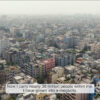
My Name is Dhaka
 My Name is Dhaka is a one-minute experimental film portraying Dhaka as a living, breathing entity with a 400-year history. Through a reflective voice, the city recounts its transformations, crises, and resilience. It captures contrasts between pollution and celebration, hardship and hope, revealing a megacity shaped by climate change, migration, and human survival.

Geospatial Innovations Addressing Critical Water Data Gaps in Asia
Across Asia, new initiatives are showing how satellite Earth observation data and AI-powered technologies can turn fragmented water-related data into actionable insights for managers and policymakers in line ministries and local governments.
Where Water Doesn’t Flow, Equality Doesn’t Grow – Challenging Global Patriarchy this World Water Day
The 2026 campaign on World Water Day’s focuses on Water and Gender – ‘where water flows, equality grows’ . While substantial progress has been achieved across a range of gender indicators spanning education, health and public participation, the situation around WASH (water, sanitation and hygiene) is still marked by deep inequalities with women and girls disproportionately affected – and this reflects the persistence of global patriarchy.
80 Percent of Rural Households Without Direct Water Access – World Water Report
A new United Nations report has warned that global water inequality remains one of the most pressing development challenges of the decade, with billions still lacking safe drinking water and sanitation – while women and girls continue to bear the heaviest burden of water insecurity.

Oil Shocks, Political Upheaval and the One Solution Governments Keep Ignoring
Once again, global oil prices are spiking, driven by the Israeli-US war against Iran. With Iran retaliating by attacking infrastructure and transport hubs and blocking the Strait of Hormuz, through which one-fifth of the world’s oil passes, oil supplies from the region are being choked, pushing up prices. The cost of a barrel of Brent crude – the international benchmark for oil prices – stood at US$73 before the conflict but has surged beyond US$100 since. It could go higher still as war continues.
Housing as Climate Resilience in Asia-Pacific Cities
Access to adequate housing is a foundation of resilient cities. Safe and affordable homes provide stability, allow residents to access essential services, and enhance the capacity for communities to withstand and recover from shocks. Yet housing is often treated as a downstream outcome of urban development or disaster recovery rather than as a strategic investment in resilience.« Previous Page — Next Page »





As unsustainable human consumption and production systems are driving changes in average temperatures and weather patterns, "abnormal" is increasingly becoming the norm. So far, a lack of financing has been standing in the way of a comprehensive global plan for climate adaptation, and a global financial crisis has contributed to an increasing reliance on public-private partnerships. Our Climate Change page provides you with the latest news about international and local efforts to address what's frequently been called "the challenge of our time", the forces behind the climate change and the impact it has on the world's most vulnerable populations. Along the way, we bring you stories on growing citizen awareness, new scientific data, and emerging climate policies towards sustainable development.

The Week with IPS

Tracking global progress towards a sustainable world

