Languages
Thursday, November 19, 2026



News and Views from the Global South
Development & Aid

We Must Make It Happen – Together!
“As we enter 2021, education must be at the core of pandemic response and recovery efforts,” says António Gutteres, Secretary-General of the United Nations, in his interview with Education Cannot Wait (ECW) for this monthly issue, reminding us that “upholding our pledge to leave no one behind starts with education.”
To Prevent Another Civil War South Sudan Must Create a New, Unique Political System
The threat of a full-blown civil war in South Sudan remains unless the country’s leaders can broaden power sharing, warns a new report by the International Crisis Group (ICG) released almost year into the country’s formation of a government of national unity.
Forgotten Conflicts 2021: When Will the Crisis in the Central African Republic End?
Last October, an ICRC medical team helped a woman deliver a baby boy in the bush on their way to a health center we support in Grévaï, a small town in the north-central region of CAR. On her way to the market, by foot, the woman went into labour and only by chance did not have to go through it alone, surviving along with her baby.
The West vs the Global South: You Have the Numbers. We Have the Money
When the 134-member Group of 77, the largest single coalition of developing countries, was trying to strike a hard bargain in its negotiations with Western nations years ago, one of its envoys famously declared: “You have the numbers. We have the money.”
Intellectual Property Cause of Death, Genocide
Refusal to temporarily suspend several World Trade Organization (WTO) intellectual property (IP) provisions to enable much faster and broader progress in addressing the COVID-19 pandemic should be grounds for International Criminal Court prosecution for genocide.
The Struggle to End Female Genital Mutilation: A Dark Secret No More
Survivors of female genital mutilation or cutting (FGM/C), are determined to share their stories to end this practice – even though they face ostracisation by their communities. Masooma Ranalvi, an FGM/C survivor and founder of ‘WeSpeakOut’, an organisation committed to eliminating FGM/C or khafd/khafz/khatna explains that FGM/C is practised by various communities in India but is prominently practised among the Dawoodi Bohras.
Education Cannot Wait Interviews United Nations Secretary-General António Guterres
Education Cannot Wait’s interview with the Secretary-General of the United Nations, António Guterres, focused on the crucial role of education in the lives of crisis-affected children and youth, follows below. ECW: Why is education a priority in emergencies and protracted crises? António Guterres: The COVID-19 pandemic has upended societies and created the largest-ever disruption of education systems, affecting more than 1.5 billion students. While remote solutions were rolled out, 1 in 3 children missed out on such opportunities, exposing and exacerbating inequalities and vulnerabilities, especially for those in crisis situations. In such circumstances, education protects girls and boys from sexual violence and exploitation, trafficking, early pregnancy and child marriage, forced recruitment into armed groups and child labour. It also ensures that they continue learning, offering them hope for the future. As we enter 2021, education must be at the core of pandemic response and recovery efforts. Without resolute political commitment by global leaders, as well as additional resources for Education Cannot Wait, and its UN and civil society partners, millions of girls and boys may never return to school. Investing in the education of these vulnerable children and youth is an investment in peace, prosperity and resilience for generations to come – and a priority for the United Nations.[related_articles]
Q&A: Documenting COVID-19 Effect on Youth Sexual and Reproductive Health
With the COVID-19 pandemic adding complex layers of challenges to the issue of sexual and reproductive health for the youth, governments should prioritise documenting these effects for data collection purposes, Dr. Simon Binezero Mambo co-founder and team leader of the Youth Alliance for Reproductive Health in the Democratic Republic of the Congo, told IPS in an interview.

El Aromo Solar Project Sets Precedent for Renewable Energy in Ecuador
In December 2020, the “El Aromo” solar energy project was approved in coastal Manabí province, Ecuador. Operated by the Spanish company Solarpack, the project is expected to transform national solar output. El Aromo will occupy 2.9km2 of land that was previously cleared to build a multi-billion dollar oil refinery, plans that have since been abandoned. While El Aromo holds symbolic significance, it remains uncertain whether the project will mark a significant step toward more environmentally sustainable energy development in Ecuador.
Why it’s Crucial Not to Limit the Youth’s Access and Use of Family Planning
With the COVID-19 pandemic negatively affecting access to Adolescent and Youth Sexual and Reproductive Health (AYSRH) services, it’s imperative governments employ community-based initiatives and peer educators to ensure these services are still available to them.
Revoke Patents, Defeat the Pandemic & Deliver Global Justice
As the pandemic spills into its second year, the WHO tracker lists eight Covid-19 vaccines already in public use. Several others are awaiting regulatory approval. This is unprecedented in vaccine history and with effective international coordination, it presents the global community with a real chance for both pandemic and economic recovery in 2021.
Water Graves: Nightmare for Mexican Fishermen
All of Erizo's nightmares are the same. Since his return from the ocean - almost unrecognizable - every bad dream is identical. A wave punches his little boat and throws him into the deep sea where everything is so dark that he can't even see his own hands.
Nepal Struggles to Preserve Its Indigenous Languages as Those Speaking Them Dwindle
At last count Nepal had 129 spoken languages, but even as new ones are identified, others are becoming extinct. At least 24 of the languages and dialects spoken in Nepal are ‘endangered’, and the next ones on the verge of disappearing are Dura, Kusunda, and Tillung, each of which have only one speaker left.
Road to Hell Paved with Good Intentions
Access to COVID-19 vaccines for many developing countries and most of their people will have to wait as the powerful and better off secure earlier access regardless of need or urgency. More profits, by manufacturing scarcity, will surely cause even more loss of both lives and livelihoods.
Caught in Tangled Web of Vaccine Nationalism
“Oh what a tangled web we weave When first we practice to deceive”. Walter Scott’s lines, already over two centuries old, nicely sum up how pursuit of national advantage and private gain have undermined the public interest and the common good.
Sri Lanka’s Deteriorating Human Rights Situation Raises Multiple Alarms
A decade has passed since the end of Sri Lanka’s civil war between the government and the LTTE, where at least 100,000 people were killed in the over three-decade long conflict. Families of victims of enforced disappearances continue to seek justice, the government is yet to end impunity and put accountability for crimes under international law and human rights violation and abuses in its transitional justice process.
A Grey Cloud Over Lebanon: Mental Health Burdens
Humankind is no stranger to the destabilizing events of 2020. The state of the global economy and the outbreak of the COVID-19 pandemic hit the headlines. In this ever escalating global crisis, Lebanon, has been facing what can only be described as unimaginable hardships. For the past year the country has seen challenges which have resulted in an utter state of hopelessness and rapid deterioration in mental health of many of its citizens.
Internationally COVID-19 Extracted a Heavy Toll on Older People
Internationally COVID-19 extracted a heavy toll on older people – raising concerns in the Asia Pacific region where more than half of the world’s ageing population live.
How COVID-19 Adds to the Challenges of Leprosy-affected People
Lilibeth Evarestus of Lagos, Nigeria doesn’t like the concept of handouts — she is against the idea of thinking of leprosy-affected people as weak. Yet, for several months now, Evarastus – a human rights lawyer and founder of community welfare organisation, Purple Hope Foundation – has been spending a lot of time on the road, distributing food items and hygiene products among the leprosy-affected people in her community.
Lebanon: How to Build Back Better after Political and Economic Crisis
Lebanon must “shield and preserve” the skills, knowledge, and experience of its people in order to move forward with its development, according to Christophe Abi-Nassif, the Lebanon programme director for the Middle East Institute (MEI).
Elections in Africa go on Amid COVID-19
Central African Republic and in Niger held their presidential and parliamentary elections on 27 December 2020 to round up a challenging year where despite fears of disruption from the COVID-19 pandemic, most countries in Africa managed to stick to their scheduled elections.« Previous Page — Next Page »


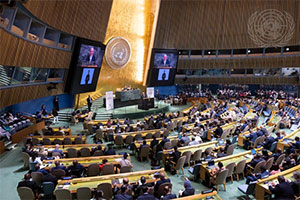 2026 High-level Political Forum on Sustainable Development. Credit: UN Photo/Eskinder Debebe
In 2015, the United Nations and its Member States adopted the Sustainable Development Goals (SDGs) in an effort to make the world a more sustainable and peaceful place for future generations. Progress on the 17 SDGs has been uneven, and inequality persists across the globe. 10 years after adoption, the 2025 UN SDGs Report revealed that only 35% of the SDG targets are on track, with more than half moving too slowly, and 18% moving backwards from the 2015 baseline. Poverty remains one of the world’s most pressing issues, with hunger, violence, and inequality impeding the opportunities for all people to achieve success. In September 2024, the United Nations Summit of the Future introduced a new goal: to eradicate global poverty by 2030, ensure universal rights to basic services, and increase the overall standard of living in terms of industrialization, economic well-being, citizen health, and literacy. Furthermore, recent shifts in United States foreign aid policy – notably, major budget cuts to USAID and the termination of thousands of development programmes– have severely threatened vital lifelines of financial aid to impoverished communities around the world. Additionally, the United States’ withdrawal from the Paris Climate Agreement has undercut international efforts at sustainable development. With the upcoming 2030 deadline, the UN Secretary-General has called for urgent multilateralism across six priority areas: food systems, energy, digital connectivity, education, jobs and social protection, and climate and biodiversity. IPS sheds light on marginalized communities that struggle on a daily basis to survive and have their stories heard and respected.
Updated by Yilan Batista and Shuli Wong August 2026

The Week with IPS

NEXT STOP - SDGs
Tracking global progress towards a sustainable world
Tracking global progress towards a sustainable world
