Languages
Sunday, November 15, 2026



News and Views from the Global South
Editors' Choice

Civilians Paid a Very High Price for Raqqa’s Devastating “Liberation” by US-led Forces
Driving around in Raqqa, it was easy to believe what a senior US military official said – that more artillery shells were launched into the Syrian city than anywhere else since the Viet Nam war.
‘Don’t Try to Be a Superwoman’: An Interview With Michelle Bachelet
Michelle Bachelet ended her second term as president of Chile on March 11, 2018. Her first term, from 2006 to 2010, was marked by an ambitious social and economic agenda advancing women’s rights and better health care. Her cabinet of ministers, for example, was composed of an equal number of men and women, as she vowed to do during her campaign.
Plastic Tsunamis Threaten Coast in Latin America
Although Latin America produces just five percent of the world's plastic, it imports billions of tons annually for the use of all kinds of products, some of which end up in the sea as garbage.
Latin America Begins to Discover Electric Mobility
With 80 percent of the population living in urban areas and a vehicle fleet that is growing at the fastest rate in the world, Latin America has the conditions to begin the transition to electric mobility - but public policies are not, at least for now, up to the task.
Why Israel Dropped Out of the Security Council Race: Not Enough Votes
From the start, it was a closely watched contest pitting Germany, Belgium and Israel against one another for their regional bloc’s two seats in the next term on the United Nations Security Council. Israel has never held a seat on the Council, and as it celebrates its 70-year membership in the UN in 2018, the country was aiming high for the June 8 election.
Chile Debates Whether Citizens Should Profit from Generating Energy
Chile has become a model country for its advances in non-conventional energy, and is now debating whether citizens who individually or as a group generate electricity can profit from the sale of the surplus from their self-consumption - a factor that will be decisive when it comes to encouraging their contribution to the energy supply.
Pompeo’s Iran Speech a Prelude to War?
The United States Secretary of State Mike Pompeo’s speech this past Monday targeting Iran may have created a new benchmark for hypocritical, arrogant, and entitled demands by the United States on foreign governments.
Digital Revolution Holds Bright Promises for Africa
Internet penetration is creeping up in Africa, bringing the prospect of digital dividends to a continent long marked by digital divides.
Energy Cooperatives, Fogged Mirrors for Latin America
“It made me angry that a company from outside the region was making money from renewable energy and I wondered why people weren't getting involved," says Petra Gruner-Bauer, president of the German co-operative SolixEnergie.
A Natural Climate Change Adaptation Laboratory in Brazil
The small pulp mill that uses native fruits that were previously discarded is a synthesis of the multiple objectives of the Adapta Sertão project, a programme created to build resilience to climate change in Brazil's most vulnerable region.
Indigenous Peoples Recover Native Languages in Mexico
Ángel Santiago is a Mexican teenager who speaks one of the variations of the Zapotec language that exists in the state of Oaxaca, in the southwest of Mexico. Standing next to the presidential candidate who is the favorite for the July elections, he calls for an educational curriculum that "respects our culture and our languages."
Will Climate Change Cause More Migrants than Wars?
Climate change is one of the main drivers of migration and will be increasingly so. It will even have a more significant role in the displacement of people than armed conflicts, which today cause major refugee crises.
Chile, an Oasis for Haitians that Has Begun to Run Dry
A wave of Haitian migrants has arrived in Chile in recent years, changing the face of low-income neighbourhoods. But this oasis has begun to dry up, thanks to measures adopted by decree by the new government against the first massive immigration of people of African descent in this South American country.
Fighting Inequality in Asia and the Pacific
Inequality is increasing in Asia and the Pacific. Our region’s remarkable economic success story belies a widening gap between rich and poor. A gap that’s trapping people in poverty and, if not tackled urgently, could thwart our ambition to achieve sustainable development. This is the central challenge heads of state and government will be considering this week at the Economic and Social Commission for Asia and the Pacific (ESCAP). A strengthened regional approach to more sustainable, inclusive growth must be this Commission’s outcome.
Child Slavery Refuses to Disappear in Latin America
Child labour has been substantially reduced in Latin America, but 5.7 million children below the legal minimum age are still working and a large proportion of them work in precarious, high-risk conditions or are unpaid, which constitute new forms of slave labour.
Optimal Use of Water Works Miracles in Brazil’s Semi-Arid Region
Cattle ranching has been severely affected by drought in Brazi's Northeast region, but it has not only survived but has made a comeback in the Jacuípe river basin thanks to an optimal use of water.
From the Syrian War to Argentina – Or How to Start a New Life
Fares al Badwan moved to Buenos Aires alone, from Syria, in 2011. He was 17 years old then and the armed conflict in his country had just broken out. Since then he has managed to bring over his whole family and today he cannot imagine living outside of Argentina. "I like the people here. No one makes you feel like a foreigner," he said.
Time to Get Serious About Peace & Development
Four months ago UN Secretary-General Antonio Guterres issued a “red alert”, noting that instead of progressing towards greater peace, the world had moved in reverse towards deepening conflicts and new dangers: “Global anxieties about nuclear weapons are the highest since the Cold War.
Central Americans Demand to be Consulted About Mining Projects
Rosa Dávila is busy cooking ears of corn, to be eaten by the men and women who have set up a checkpoint on the side of the road to block the passage of supplies sent to a mining company that operates in the area.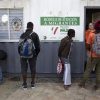
Mexico’s Solidarity Towards Haitians Only Goes So Far
In the airport of this Mexican city, on the border with the United States, customs agents warn that they will carry out a "random" inspection. But it's not so random. The only people who are stopped and checked have dark skin and kinky hair, and virtually do not speak a word of Spanish.
Occupational Safety Improves in Latin America, Except Among Young People
Despite progress achieved in occupational safety in Latin America, the rates of work-related accidents and diseases are still worrying, especially among young people, more vulnerable in a context of labour flexibility and unemployment.« Previous Page — Next Page »


The Week with IPS

NEXT STOP - SDGs
Tracking global progress towards a sustainable world
Tracking global progress towards a sustainable world
