Languages
Friday, September 25, 2026



News and Views from the Global South
Education

Education Cannot Wait Investments Change Lives for Children, Including At-Risk Girls, Children with Disabilities and Teachers in South Sudan
Ayom Wol sits under a tree in South Sudan in the scorching midday sun. He is a newly-trained teacher, preparing for tomorrow’s lessons. His school principal says he has to prepare while at school because there is no electricity at home.
As a Humanitarian Crisis Engulfs Afghanistan, Education Cannot Wait Makes Urgent Appeal for Access to Quality Learning for All Children
After leading a landmark, first-ever all-women mission to Afghanistan last week, Yasmine Sherif, Director of Education Cannot Wait, the United Nations global fund for education in emergencies and protracted crises, says that schools must reopen for all children and that girls, in particular, must be able to return to secondary school classrooms.
Education Cannot Wait Calls For Urgent Funding To Fulfill The Right To Education Of All Children And Youth In Afghanistan
Immediately following the first all-women UN mission to Afghanistan since takeover by the de facto authorities, Yasmine Sherif, Director of Education Cannot Wait - the United Nations global fund for education in emergencies and protracted crises - appealed to donors to significantly increase financial support for a robust collective humanitarian-development nexus response. This includes urgent scaled up funding to UN agencies and NGO partners delivering life-saving education to vulnerable children and adolescents on the ground.
Education Cannot Wait Urges Urgent Action for World’s Biggest Humanitarian Crisis in Afghanistan
Education Cannot Wait Director Yasmine Sherif urged the world to support their efforts to provide education to children living in Afghanistan – in what she called the “biggest humanitarian crisis” on earth.
Egypt Must End State Oppression of Women and Girls
The fate of Egyptian women and girls delicately hangs in the balance as the country continues to have one of the worst records in the world for gender equality. With oppression often state-sanctioned, Egyptian women face a daily struggle against sexual harassment and other violations of their basic human rights, including institutionalised violence.
Bringing Quality Education to Syria’s Most Vulnerable, Crisis-Impacted Children – Their Education Cannot Wait
In war-torn Syria, the support of Education Cannot Wait (ECW) – the United Nations global fund for education in emergencies and protracted crises – is bringing positive, life-changing educational opportunities tailored to children like 11-year-old Ali.
Inclusive Education to Break the Cycles of Poverty
In September 2021, children in the northern hemisphere returned to school after the summer break. For some, the end of the holidays signaled a return to normalcy and to the joys of learning after facing months of school closures due to the Covid-19 pandemic. For the majority of children in the Global South, however, the return to reality looked grimmer.
Winning the Human Race, Together
“Now is the time for a stronger, more networked and inclusive multilateral system anchored in the United Nations,” said UN Secretary-General António Guterres in his latest report “Our Common Agenda.” Indeed, there is a fork in the road: we can either choose to breakdown or to breakthrough.
Education Cannot Wait Interviews the LEGO Foundation’s New CEO Anne-Birgitte Albrectsen
Anne-Birgitte Albrectsen is the CEO of The LEGO Foundation. Ms. Albrectsen has spent almost 30 years in fields of international development, human rights and diplomacy, most recently holding the position of Global CEO at Plan International since September 2015.
China and the UN at 50- What We Can Achieve Together
China was one of the architects of the United Nations and was the first signatory of the UN Charter in San Francisco in 1945. But it was only in October 1971, with the Chinese delegation led by Mr. Qiao Guanhua, that China’s representation at the UN resumed. Since that time, the UN has had the great privilege of witnessing and supporting China in achieving one of the greatest periods of socio-economic progress in world history.
When Girls Have Access to Technologies, A True Digital Revolution Will Be In Sight
This year’s International Day of the Girl theme, Digital Generation, Our Generation, celebrates the potential of digital technologies while calling for the inclusion of all girls in accessing technology. The digital revolution will not be realized if girls without access to digital solutions are left behind. For years, advocates of technology for development have been repeating the mantra that technology is not a panacea. Yet in racing to connect, catch up, and create greater access, we ignore at our own peril the inconsistent or non-existent household- and community-level access girls have to technologies. While digital solutions are available and evolving all the time, they should be accompanied by hybrid methods which include new ways to use analog technologies, so that existing local resources are reimagined and redistributed in ways that support more girls learning.
Will Taliban Honour UN Treaties Signed by Afghanistan Over the Last 20 Years?
When the Islamic Emirate of Afghanistan receives the political blessings of the 193-member General Assembly-- and eventually inherits its seat at the United Nations-- it will have to ultimately prove its credentials as a member of good standing by adhering to the UN Charter and the Universal Declaration of Human Rights (UDHR) – as all member states do.
New Education Cannot Wait Annual Results Report Highlights Multiplying Education Challenges for Children & Adolescents Living in Emergencies & Protracted Crises amid Covid-19
On this World Teachers’ Day, Education Cannot Wait (ECW), the United Nations global fund for education in emergencies and protracted crises, announced it has reached more than 4.6 million children and adolescents (48% of whom are girls) with quality education in more than 30 of the worst humanitarian crises around the world.
Afghan Women – The Emerging Narrative and Why it is Wrong
The USA and its allies have repeatedly stated that promoting women’s rights was one of the key reasons they were in Afghanistan. The US military top brass, in a letter to marines stated that they were in Afghanistan “for the liberty of young Afghan girls, women, boys, and men who want the same individual freedoms we enjoy as Americans”.
Education Cannot Wait Annual Results Reveals the Devastating Impact of COVID-19 on Learning for Children in Emergencies and Protracted Crises
The COVID-19 pandemic has changed the face of education globally, but for children in emergencies and protracted crises, its blow has been particularly devastating.
Making Online Health News Reliable, Accessible
Telemedicine and health-related information have experienced a massive uptake since the COVID-19 pandemic began last year. While online health services are seen as a panacea for many ills, disinformation and fake news reports have tarnished their credibility.
The Plight of Haiti
I assume channel surfing and internet browsing contribute to a decrease in people’s attention span. I am not familiar with any scientific proof, though while working as a teacher I found that some students may be exhausted when five minutes of a lesson has passed and begin fingering on their smartphones. They might also complain if a text is longer than half a page, while finding it almost impossible to read a book.
Donors Come Together with US$138.1 Million in New Funding for Education Cannot Wait During Un General Assembly to Leave No Child Behind
– On the sidelines of this year’s United Nations General Assembly, public, private and philanthropic donors announced a total of US$138.1 million in new contributions to Education Cannot Wait (ECW).
COVID-19 Recovery Requires Justice Beyond Rhetoric
Policy responses to the COVID-19 pandemic and resulting economic crisis have exacerbated rather than reduced global inequalities. On the one hand, the net wealth of billionaires has risen to record levels since the outbreak of the pandemic (increasing by more than US$ 5 trillion to US$ 13.1 trillion from 2020 to 2021), on the other hand, the number of people living in extreme poverty has also increased massively (by approx. 100 million to 732 million in 2020).
We Stay and Deliver until the Light Shines
Kabul 1990. I land in the capital of Afghanistan for my very first mission with the United Nations. Controlled by the government, Kabul was surrounded by the Mujahedeen. As a young female professional, living and working across the country, I felt protected by the Afghans, whether walking in the bustling cities or meeting with the Mujahedeen in the rural countryside. Afghanistan had already been at war for over ten years and we all worked with the hope that the fighting would come to an end soon.
The Covid-19 Youth Employment Crisis in Asia & the Pacific
A pre-pandemic report published by the International Labor Organization, ILO, the Global Employment Trends for Youth 2020, offered a sober analysis on the job market prospects for youth.« Previous Page — Next Page »


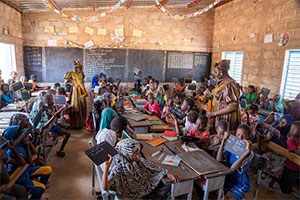 Two teachers work in a classroom in Forces Vives School in Dori, Burkina Faso. Credit: UNICEF/UNI978361
Safe and uninterrupted education is a fundamental right for all children. Education is paramount to global development, as it has been proven that investing in education – especially for girls and children – contributes significantly to economic growth and prosperity. Although more than 1 billion children go to school, many are subjected to conditions that are not conducive to a proper learning environment, including makeshift facilities, a lack of supplies, violence in classrooms, inadequate sanitation, untrained instructors, and widespread school closures. Since 2015, there have been immense gains in education with an increase of 109 million children in school. However, as of 2023, 272 million children are still out of school.
High poverty levels in developing countries also impede children’s access to a proper education. For example, from the early to mid 2000s, Sub-Saharan African nations witnessed a dramatic decline in trained teachers due to inadequate funding in the education sector. Furthermore, major cuts to United States international aid threaten an estimated 23 million additional children's access to education, as USAID‑funded school programmes across Africa and Asia face closure.
Various other factors contribute to the decline of education, notably hunger, which has increased as conflict and climate change interfere with global food production and dissemination. Meanwhile, certain social and cultural practices also impede children’s access to education, with gender inequality, discrimination, child labour, and child marriages preventing millions of children from attending school. Economic conditions such as the inaccessibility of higher education also affect disenfranchised communities across the world. In extreme situations, such as warfare where educational facilities are destroyed in their totality, notably in Gaza and Sudan, entire generations of children might grow up without access to education. Rebuilding educational infrastructure is a long and arduous process, especially when violence persists across generations, and this significantly stunts the development of societal prosperity and stability.
IPS is dedicated to telling the shocking truths about worldwide education through impassioned opinion pieces and comprehensive articles, highlighting global issues that impede worldwide education and the courses of action being taken by organizations such as UNICEF and Education Cannot Wait.

The Week with IPS

NEXT STOP - SDGs
Tracking global progress towards a sustainable world
Tracking global progress towards a sustainable world
