Languages
Monday, October 26, 2026



News and Views from the Global South
Energy

Renewable Energies in Latin America Weather Low Oil Prices
Traditionally, falling oil prices have discouraged development of renewable energy sources, but clean energy is making steady progress in Latin America, according to regional experts.
Opinion: A Legally-Binding Treaty to Prohibit Nuclear Weapons
Five years after the adoption of the NPT (Nuclear Non-Proliferation Treaty) Action Plan in 2010, compliance with commitments related to nuclear disarmament lags far behind those related to non-proliferation or the peaceful uses of nuclear energy.
In India, an Indoor Health Crisis
For years, Kehmli Devi, a middle-aged woman from the village of Chachadeth in India’s northern Himalayan state of Uttarakhand, has prepared her family’s meals on a wood-burning stove.Prominent Lawyer Defending the Poor Gunned Down in Mozambique
As billions pour into Mozambique from foreign investors scooping up fields of coal and natural gas, the signs of newfound wealth are impossible to miss.
Tech-Savvy Women Farmers Find Success with SIM Cards
Jawadi Vimalamma, 36, looks admiringly at her cell phone. It’s a simple device that can only be used to send or receive a call or a text message. Yet to the farmer from the village of Janampet, located 150 km away from Hyderabad, capital of the southern Indian state of Telangana, it symbolises a wealth of knowledge that changed her life.Namibian President Wins $5 Million African Leadership Prize
Outgoing Namibian President Hifikepunye Pohamba was Monday named winner of the Ibrahim Prize for Achievement in African Leadership, believed to be the most lucrative individual award in the world.

Syrian Conflict Has Underlying Links to Climate Change, Says Study
Was the four-year-old military conflict in Syria, which has claimed the lives of over 200,000 people, mostly civilians, triggered at least in part by climate change?
Bamboo – An Answer to Deforestation or Not in Africa?
Deforestation is haunting the African continent as industrial growth paves over public commons and puts more hectares into private hands.
Opinion: The Middle East and Perpetual War
There is a currently popular idea in Washington, D.C. that the United States ought to be doing more to quash the recently born Islamic States of Iraq and Syria (ISIS), because if we don’t, they will send terrorists to plague our lives.
Opinion: Water and the World We Want
We have entered a watershed year, a moment critical for humanity.
Mega-Cities, Mortality and Migration
As the international community marks the 70th anniversary of the founding of the United Nations, one question worthy of some reflection is: Is world population better or worse off demographically since the establishment of the U.N.?
Falling Oil Prices Won’t Derail St. Lucia’s Push for Clean Energy
At Plas Kassav, a roadside outlet in Canaries, a rural community in western St. Lucia, a busload of visitors from other Caribbean countries, along with tourists from North America and Europe, sample the 12 flavours of freshly baked cassava bread on sale.
Argentina Moves Towards Marriage of Convenience with China
The government of Argentina is building a marriage of convenience with China, which some see as uneven and others see as an indispensable alliance for a new level of insertion in the global economy.
Biogas Eases Women’s Household Burden in Rural Cuba
On the blue flame of her biogas stove, it takes half as long for rural doctor Arianna Toledo to heat bath water and cook dinner as it did four years ago, when she still used electric power or firewood.
Everything You Wanted to Know About Climate Change
So much information about climate change now abounds that it is hard to differentiate fact from fiction. Scientific reports appear alongside conspiracy theories, data is interspersed with drastic predictions about the future, and everywhere one turns, the bad news just seems to be getting worse.
Getting Bang for the Buck on New Development Goals
Right now, the United Nations is negotiating one of the world’s potentially most powerful policy documents. It can influence trillions of dollars, pull hundreds of millions out of poverty and hunger, reduce violence and improve education — essentially make the world a better place. But much depends on this being done well.
Warming, Wildfires and Worries
World leaders from government, finance, business, science and civil society are attempting to negotiate a legally binding and universal agreement on climate change at the upcoming 21st United Nations Climate Change Conference being convened in Paris in December.
U.N. Climate Talks Advance Link Between Gender and Climate Change
A week of climate negotiations in Geneva, Switzerland Feb. 8-13 are setting the stage for what promises to be a busy year. In order to reach an agreement in Paris by December, negotiators will have to climb a mountain of contentious issues which continue to overshadow the talks.
Money Pipeline Flowing Between U.S. Congress and Big Oil
With battle lines sharpening over the stalled Keystone XL pipeline, a new analysis details the intense industry lobbying of both houses of the U.S. Congress since 2013 – to the tune of 58.8 million dollars by five refinery companies alone.
U.N. Touts 2015 as Milestone Year for World Body
The United Nations, in a sustained political hype, is touting 2015 as a likely breakthrough year for several key issues on its agenda - primarily development financing, climate change, sustainable development, disaster risk-reduction and nuclear non-proliferation.
OPINION: People Power, the Solution to Climate Inaction
Nothing is more important to farmers like me than the weather. It affects the growth and quality of our crops and livestock, and has a major impact on global food supply.« Previous Page — Next Page »





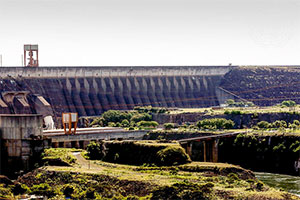 UN Power Plant, Paraguay. Credit: UN Photo/Evan Schneider
Energy has posed a great challenge for economies around the world. As global energy consumption skyrockets throughout the years, so does the need for sustainable solutions. The Sustainable Development Goals are essential in providing people with access to safe, affordable, and sustainable energy sources that minimize harm on the planet. Progress towards these goals opens the door for an advancement in modernization for communities on a global level and allows for a potential mitigation of tensions between nations.
The UN’s Summit of the Future in 2024 offered new initiatives that are being taken to achieve these goals, including a decreased reliance on fossil fuels, a switch to renewable energy sources, and improved climate financing.
IPS is well positioned to provide relevant, insightful, and compelling analysis of recent updates and measures being taken around the world to achieve a cleaner future.

The Week with IPS

NEXT STOP - SDGs
Tracking global progress towards a sustainable world
Tracking global progress towards a sustainable world
