
Monday, November 23, 2026



News and Views from the Global South
Environment

EUROPE: Cranes Overstay Their Welcome as Weather Grows Warmer
Migrating flocks of cranes flying overhead are normally a harbinger of spring and autumn in Europe. But due to rising temperatures, the birds are sticking around increasingly longer in the fall before heading south.
SOUTH AFRICA: Climate Change Affecting Fisherwomen’s Livelihoods
Having observed changes in the sea and the life cycles of the rock lobsters that their livelihoods depend on, a group of fisherwomen from the Western Cape, South Africa are calling on government to adjust fishing seasons to adapt to what they claim are climate change-related alterations.
Forging Bond Will Be Test for Co-ops and Occupy Movement
Canadian cooperatives may grow as the global Occupy movement raises the profile of their business model through boosting interest in credit unions over traditional banks, but uncertainty remains about the degree to which the two camps will join forces from here on.
The Green Climate Fund
 The Green Climate Fund is meant to help developing countries with 100 billion dollars a year by 2020 to adapt to the effects of climate change. The creation of the GCF was approved during the COP16 in Cancun. Civil society and some developing nations noted that governments have made trillions of dollars available for the bank and financial sector and that the world's military budget is more than 10 times what is needed for the GFC. Up until now, countries have not been able to agree on a single mechanism to draw public funds.

Durban Platform
After two weeks and an additional 29 hours of intense and even bitter negotiations, the 193 nations participating in the United Nations climate talks agreed to a complex and technical set of documents called the "Durban Platform." The biggest development reached at dawn Sunday is an agreement to negotiate a new global treaty to reduce emissions by 2015. 
Global emissions from burning fossil fuels
Documents under negotiation in Durban, South Africa acknowledge the science-based emissions reduction target of 25 to 40 percent by 2020. Those reductions and that timeline are what is needed to stay below two degrees Celsius. The draft text says this would be the target to be agreed on at COP 18. The science shows that global emissions need to fall to 44 Gt by 2020 and continue to decline by two percent per year.
CLIMATE CHANGE-BRAZIL: Contradictory Goals in Agriculture
Brazil aims to meet its climate change targets in agriculture by stimulating techniques that have been proven to reduce greenhouse gas emissions – but which may increase the use of toxic agrochemicals, activists say.
MEXICO: Saving Native Seeds to Protect Food Heritage
When Guadalupe Ortiz planted gardens in Mexico, she was struck by the importance of saving and preserving the seeds, and decided to do something about the problem of seed supply.
Indigenous Peoples Call for REDD Moratorium
A new coalition of indigenous peoples and local communities called for a moratorium on Reducing Emissions from Deforestation and Forest Degradation (REDD) programs, a key part of the negotiations for a new international climate treaty that took place over the last two weeks in South Africa.
Cranes Overstaying Their Welcome as Weather Grows Warmer
As a result of warmer autumn temperatures, cranes are remaining in Germany longer than usual, causing damage to crops and sparking conflicts between farmers and environmentalists.Ecobreves – HONDURAS: Landslide Risk Areas to be Stabilized
The city government of Tegucigalpa will allocate 12 million dollars to the stabilization of areas prone to landslides in the neighborhoods of El Berrinche and El Reparto.Ecobreves – BRAZIL: Record Increase in Transgenic Crops
The land area planted with genetically modified seeds in Brazil has increased 20.9 percent over the last year, reaching 31.8 million hectares, according to a study by the consulting firm Céleres.Ecobreves – ARGENTINA: Fundraising Drive for the Creation of a National Park
A campaign was launched at the beginning of December in Buenos Aires to raise the funds needed to expropriate a private landholding in northeastern Argentina and turn it into a national park.Ecobreves – MEXICO: Growing Opposition to Urban Freeway
Non-governmental organizations have called on the left-leaning government of Mexico City to halt construction of the Supervía freeway in the southeast of the capital, after a court revoked the environmental permit for the project.
KENYA: Thirsty Eucalyptus Good for Absorbing Carbon
On a steep slope of land in Thangathi village in Central Province, Kenya, Peter Nyaga surveys his four-year-old eucalyptus woodlot. He calculates the value of every tree on his two-hectare piece of land at maturity in three years.
ISRAEL: Togetherness Takes Wings
Hasn't anyone dreamt once of taking refuge under the shelter of a bird's wings, coiled up in its feathers, catching a bird's eye view of what looks from above like paradise?
Agreement for New Global Treaty To Reduce Emissions
The world is increasingly committed to dangerous levels of global warming with yet another failure by nations of the world to agree to needed reductions in carbon emissions here in Durban. However, as the 17th Conference of Parties ended early Sunday morning, members did agree to talk about a new global treaty to reduce emissions.INDIA: Seeking Aid For Low Carbon Growth
After pushing for financing adaptation at the just-concluded United Nations climate talks at Durban, India is hitting every button for aid in executing its low-carbon growth plans.
JAMAICA: Waking Up to Urgency of a National Climate Policy
As increasingly extreme and erratic weather driven by the earth's changing climate exacts a heavy toll on Jamaica's population, economy and infrastructure, a consensus has emerged among scientists and policy makers here that adaptation measures must include hazard mitigation.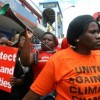
Draft Climate Deal Dubbed a “Death Sentence for Africa”
No one is happy late Friday at the very contentious U.N. climate talks that went into extra time on Saturday. As the lights flicker on a rainy night here, the partial power failure echoes the failure of the multilateral process, according to civil society and some countries.
Q&A: “By 2020 it Will be Too Late”
Despite the high risk, it remains difficult to convince politicians to take immediate action to prevent further climate change and make available the necessary funds to do so. Scientists have warned repeatedly of the effects of climate change - if governments do not act fast, they will cause an irreversible catastrophe.« Previous Page — Next Page »


Through our global network of local writers, we are continuing our award-winning coverage of global and local environmental challenges, with a focus on the people for whom the ecosphere matters in a direct way: rural dwellers who have little means to protect themselves against adverse conditions; communities that need to switch to sustainable development in order to survive; poor women and children, who are the most vulnerable in natural disasters. Sponsored by the United Nations Environment Program (UNEP), the United Nations Development Program (UNDP) and The World Bank (WB), IPS also maintains the award-winning Tierramérica, a specialised information service on environment and development.

The Week with IPS

Tracking global progress towards a sustainable world


