Languages
Saturday, November 14, 2026



News and Views from the Global South
Gender

Rise of Teenage Pregnancy Deters Development Goals
A few years ago, someone shared a video with me that deeply impacted me. It was called "The Girl Effect". In three minutes, the video demonstrates the fate of millions of girls and teenagers around the world.
Production Diversity, Diet Diversity and Nutrition in Sub -Saharan Africa
Lack of diet diversity is viewed as the major cause of micronutrient malnutrition in Sub-Saharan Africa. Imbalanced diets resulting from consumption of mainly high carbohydrate based-diets also contribute to productivity losses and reduced educational attainment and income. Consequently, micronutrient malnutrition is currently the most critical for food and nutritional security problem as most diets are often deficient in essential vitamins and minerals. In Tanzania, for example, most rural and urban households consume mainly staples as their main food, which are high in carbohydrates, but low in micronutrients and vitamins. Staple food items increase energy availability but do not improve nutritional outcomes if not consumed together with micro-nutrient rich foods.
Water, Water Everywhere, Costs More Than You Might Think
Without reliable access to water, human beings cannot survive. Yet 3 out of 10 people do not have a safely managed water supply, and 6 out of 10 lack safely managed sanitation. Over 2 billion people drank water that was fecally contaminated in 2015, and the World Bank estimates that the annual cost of poor sanitation is in excess of $260 billion annually.
No Health Protection for Migrant-Women Healthcare Givers
While the media may be attracted by images of migrants drowning or sold as slaves, another flagrant but lesser-known drama is that of care workers, who are overwhelmingly women, often migrants, and who make a very large contribution to global public health, but are exposed to great health risks themselves with little or no protection, let alone basic labour rights.
Rohingyas: Lurching from Crisis to Crisis
Ferdous Begum was cleaning her child after he had defecated in the open, using leaves she collected from a nearby tree at Bangladesh’s Teknaf Nature Park. The settlement is packed with Rohingya refugees who fled military persecution in Myanmar since August.
“We Need to Be Strong” – Award Spotlights Courageous Journalists
As press freedom becomes increasingly limited, journalists are frequently finding themselves in more dangerous predicaments than ever before.
SLIDESHOW: Tales of the 21st Century – Rohingyas Without a State
 The world has witnessed innumerable images of the long walk to 'freedom' of Rohingya women, children and men. Some trudged for endless hours and days, many carrying elderly parents and babies in baskets, with the women suffering the unimaginable trauma having been victims of rape, torture and harassment.

Rohingya Refugees Endure Lingering Trauma
Twelve-year-old Rubina still struggles with the horrors she witnessed in her homeland in Myanmar before fleeing to neighbouring Bangladesh three months ago.
A Responsibility to Prevent Genocide
Almost 70 years since the Genocide Convention was adopted, the international community still faces a continued and growing risk of genocide.
For Freedom from Poverty, Universal Health Coverage Is a Must
Today is 12 December 2017 is an auspicious day, as it marks Kenya’s independence from colonial rule in 1963. Today is also Universal Health Coverage Day. It is the anniversary of the first unanimous United Nations resolution calling for countries to provide affordable, quality health care to every person, everywhere.
Pakistan Gets Its First One-Stop Shop for Women Fighting Violence
Sliced noses, broken ribs, fractured fingers, slashed arms, bruised and bloodied faces with teeth missing and eyes swollen... Sana Jawed, 30, has been witnessing these brutalities for over a decade.
“Banging on the Door” – Women Fight for a Voice and Space in Civil Society
The space for civil society organizations is shrinking around the world, with particular impacts on women activists and human rights defenders who face additional barriers due to their gender or sexual orientation.
No One Country Can Do It Alone — Towards a Migration Compact
International commitment and cooperation is critical to reap the benefits and overcome the challenges of migration, stressed a leading official at the conclusion of a UN meeting.
Rohingya Refugees: The Woes of Women (Part Two)
Under pouring rain, hundreds of young and expectant mothers stand in line. With her bare feet and the bottom of her dress covered in mud, Rashida is one of them, clutching her emaciated infant. She lost her husband on the treacherous trek from Myanmar to Bangladesh, and with nowhere to go and her resources exhausted, rain-drenched and standing in this long, muddy line for food and medicine for her child is her only hope.
Despite Progress, Gay & Abortion Rights Face Threats in Latin America
Cancun, Mexico, of white sand beaches and spring break-style nightlife, was, this past June, the unusual backdrop for a regional gathering on human rights and democracy.
Rohingya Refugees: The Woes of Women – Part One
Afia* lines up her bucket every morning in the refugee camp for water delivery from humanitarian relief workers. On one particularly sweltering day, she kept four water pitchers in a row with gaps between them, hoping to insert another empty container in the space when the water arrived.
Rohingya Exodus Is a “Major Global Humanitarian Emergency”
In less than four months, over 600,000 Rohingya refugees have fled brutal persecution in Myanmar to seek safety across the border in Bangladesh. They are now crowded into camps across a stretch of 30 kms in Cox's Bazar, a southeastern coastal region of the small South Asian nation.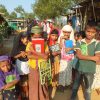
Rohingya Refugees Face Fresh Ordeal in Crowded Camps
Mariam Akhtar, 23, is desperately searching for her young daughter two weeks after arriving from Myanmar in Cox’s Bazar, a southeastern coastal district in Bangladesh.
New Safety Handbook by IAWRT
Hopefully female journalists have read it by now “What if…? Safety Handbook for Women Journalists”. The handbook, written by renowned safety trainer Abeer Saady, an Egyptian, and published by The International Association for Women in Radio and Televison (IAWRT), provides hands on tips on what to do when caught in a crossfire , when stopped at checkpoints, arrested during coverage, or kidnapped and held hostage.
Free-will Marriage
`Chief Minister Sindh, Murad Ali Shah ... said: `This is a metropolitan city, not a tribal area where jirgas are held. I would not allow such kind of barbarianism here [sic]`.
Empowering Women Improves Communities, Ensures Success for Generations
At an event held on October 29 at the International Fund for Agricultural Development (IFAD) Gender Awards 2017, five countries were honored for impressive achievements in gender equality and women’s empowerment despite harsh conditions and numerous daunting situational and societal obstacles. The five countries are Bangladesh, Mozambique, Colombia, Morocco, and Mauritania. The IFAD supported projects in these countries have ambitious goals for a more egalitarian future. To date these projects have successfully provided women with decision-making opportunities, skill training, and increased autonomy through the development of their own livelihoods.« Previous Page — Next Page »


Women make up half the world's population, but don't nearly share half of the world's wealth, well-being and opportunity. Two-thirds of the world poor are women, disproportionally exposing women to precarious living conditions, disease and unmitigated natural disasters. The media, meanwhile, remains a male-dominated sector in much of the world, contributing to women's voices lacking a crucial amplifier to put their concerns on political agendas and unleash the development potential of their ingenuity. Rather than then stereotypical victims of local and global forces, women are also organizer, innovators, conservators and community builders. These are some of their stories.

The Week with IPS

NEXT STOP - SDGs
Tracking global progress towards a sustainable world
Tracking global progress towards a sustainable world
