Languages
Tuesday, November 17, 2026



News and Views from the Global South
Humanitarian Emergencies

Millions of Women and Children for Sale for Sex, Slavery, Organs…
It is happening now. Millions of humans are forced to flee armed conflicts, climate change, inequalities, and extreme poverty. They fall easy prey to traffickers lurking anyone who can be subjected to sexual exploitation, forced labour and even sell their skin and organs.
Migrants – The Increasingly Expensive Deadly Voyages
 They borrow huge amounts of money. They sell all their modest properties. They suffer brutalities on the hands of their own countries “security” forces to prevent them from fleeing wars, droughts, floods, lack of food, extreme poverty.

UN Appoints Experts to DRC’s Kasai to Probe Harrowing Rights Abuses
The UN High Commissioner for Human Rights, Zeid Ra’ad Al Hussein, appointed a team of three international experts yesterday to collect information and raise awareness about grave atrocities in the ongoing conflict in the remote Kasai region of the Democratic Republic of Congo (DRC).
Yemen Records 400,000 Cholera Cases
The directors of the UN Children’s Fund (UNICEF), World Food Programme (WFP) and World Health Organization (WHO) released a joint statement today shedding light on a deadly cholera epidemic engulfing war-torn Yemen.
Nigeria’s Ticking Time Bomb
In the dusty arid town of Dikwa, tens of thousands of Nigerians queue for hours in sweltering 40-degree heat for water. Fatuma is one of 100,000 people displaced in the Borno State town, the epicentre of Nigeria’s conflict. She sifts through remnants of food aid seeds, drying them out to prepare them to eat. Food is a scarcity here. Fatuma used to live on three meals a day. Today she is happy if aid agencies can provide her with a single meal.
Alcoholism Cannot Explain Russian Mortality Spike
The steep upsurge in mortality and sudden fall in life expectancy in Russia in the early 1990s were the highest ever registered anywhere in recorded human history in the absence of catastrophes, such as wars, plague or famine. The shock economic reforms in the former Soviet economies after 1991 precipitated this unprecedented increase in mortality, shortening life expectancy, especially among middle-aged males.
Parliamentarians Study Nexus of Youth, Refugees and Development
Held for the first time in the Arab world, an annual meeting of Asian and Arab Parliamentarians examined how regional conflicts hinder the development of effective policies to achieve sustainable development, particularly as they generate large numbers of refugees, internally displaced persons and migrants.
No Justice, No Peace for Yemeni Children
Human rights groups are urging the UN Secretary-General to include the Saudi-led Coalition (SLC) in a child rights’ “shame list” after documenting grave violations against children.
Pope Francis Donates to FAO for Drought, Conflict-Stricken East Africa
As an unprecedented gesture, Pope Francis has donated 25,000 euro to the UN Food and Agriculture Organisation's efforts supporting people facing food insecurity and famine in East Africa.
Educating Children One Radio Wave at a Time
Nigeria’s conflict has displaced more than a million children, leaving them without access to education. However, an innovative radio program aims to transform this bleak scenario.
East Africa’s Poor Rains: Hunger Worsened, Crops Scorched, Livestock Dead
Poor rains across East Africa have worsened hunger and left crops scorched, pastures dry and thousands of livestock dead, the United Nations food and agriculture agency has warned in a new alert.
Extreme Weather Wiping Out Hard-Won GDP Gains in Hours
With Antigua and Barbuda joining St. Kitts and Nevis as the two eastern Caribbean nations to attain middle-income country status, a senior diplomat has identified climate change as a major factor preventing other nations in the grouping from taking the same step forward.
Death Toll Rises in the Mediterranean Sea as EU Turns Its Back
The failure of European Union (EU) to buckle up safety for migrants and refugees reaching its shore has been condemned by Amnesty International in a report today.
“Long March to Justice”: Appointed Judge to Investigate Syrian War Crimes
A former French judge has been appointed as the head of an independent team tasked with investigating war crimes in Syria.
Progress on World Hunger Has Reversed
World hunger has increased, reversing years of progress, said a UN specialised agency. During its biennial conference held in Rome, Italy from 3-8 July, the Food and Agriculture Organisation (FAO) noted that the world is facing it’s worst food crisis since World War II.
Is the United States Preparing for a War in Syria?
Although US policies during the past few months have been quite puzzling and unpredictable, the events of the past few days have been truly bewildering and alarming. On Monday 26th June, the White House released a statement saying that the United States had “identified potential preparations for another chemical attack by the Assad regime…” It went on to say: “If, however, Mr. Assad conducts another mass murder attack using chemical weapons, he and his military will pay a heavy price.”
Civilian Casualties Rise in Raqqa as Fighting Intensifies
As US-backed Syrian rebels plow ahead in the fight to take back Raqqa from the Islamic State in Iraq and the Levant (ISIL) in Syria, the stake of civilian lives, who number as many as 100,000 in the city, has raised concerns among top UN officials.
Did Arab Coalition Threaten to Pull Out of UN in Protest?
When Saudi Arabia – which has been spearheading a coalition of Arab states in a devastating war against Yemen since 2015 – was accused of bombing civilians, and particularly children caught up in the conflict, the government in Riyadh threatened to cut off humanitarian funding to the world body.
UN Response Teams Underfunded as Costs Hit Staggering $23.5 Billion
UN response teams that help the most vulnerable people in the world are still largely underfunded, a new status report has revealed. The funding available to the teams is no match for the record number of people—141 million—who need assistance today.
No Wall for Ethiopia, Rather an Open Door—Even for Its Enemy
It’s one thing to read about the exodus of souls flowing out of Eritrea, it’s quite another to look into the tired eyes, surrounded by dust and grime, of a 14-year-old Eritrean girl who’s just arrived on the Ethiopian side of the shared border.
Sexual Violence Fuels Vicious Recruitment Cycle in Congolese Militia
In the Democratic Republic of Congo (DRC), the active recruitment of young girls by armed militias has produced disastrous effects—facing social stigma when they’re freed, many girls find their way back to these violent groups and rejoin them.« Previous Page — Next Page »


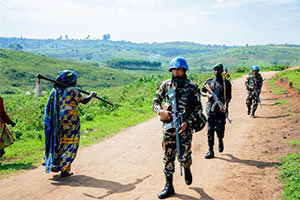 MONUSCO Peacekeepers and FARDC Soldiers Patrol Fataki Area. Credit: UN Photo/Jorkim Jotham Pituwa
Conflict, human rights violations, natural disasters, and famine have been at the forefront of concerns for humanitarian organizations. The escalation of humanitarian crises has led to over 239 million people in need of humanitarian assistance at the start of 2026, as estimated by OCHA’s Global Humanitarian Overview. The 2025 humanitarian appeal received only $12 billion, the lowest funding in over a decade, which has left 24 million fewer people reached in comparison to 2024. Conflict has remained the primary driver of crisis.
Humanitarian emergencies massively impact progress towards the Sustainable Development Goals (SDGs), adversely affecting economic development, inequality, education, planetary well-being, and poverty. Millions of people are faced with reduced access to essential services, including shelter, food, healthcare, and access to clean drinking water. UN Organizations such as UNHCR and the United Nations Children’s Fund (UNICEF) are committed to providing direct relief to affected communities when state governments cannot.
The United Nations 2024 Summit of the Future discussed measures that will be taken to reduce global inequality and promote peacekeeping efforts around the world. The recent UN Climate Change Conference (COP30) in Belém, Brazil, agreed to mobilize $1.3 trillion annually for climate action by 2035, operationalize the loss and damage fund, and triple adaptation finance. However, a fossil fuel transition commitment was not secured, despite climate change and the greenhouse effect being major contributors to humanitarian crises worldwide.
Countries across the world have also rallied to end humanitarian crises, as witnessed in conflicts such as Palestine and Ukraine. IPS is committed to providing relevant and in-depth reports of humanitarian emergencies around the world and their implications.

The Week with IPS

NEXT STOP - SDGs
Tracking global progress towards a sustainable world
Tracking global progress towards a sustainable world