Languages
Monday, November 16, 2026



News and Views from the Global South
Labour
LABOUR: World Leaders, ILO Call For Urgent Reforms
A crisis summit organised by the International Labour Organisation (ILO) to halt millions of job losses across the world due to the global economic slowdown ended Wednesday with a ringing call by its host to act now and put "the workers first before anything else."EGYPT: Workers Reeling Under Financial Crisis
The global financial crisis has forced Egyptian companies to lay off thousands of workers, and provided cover for firms to evade their legal and financial obligations to their workers, labour rights groups warn.LABOUR: ILO Urges Action on Financial Speculation
World leaders, employers and trade unionists, meeting here at a crisis summit on employment, welcomed a new ‘Global Jobs Pact’, but warned that any delay in its implementation would worsen the problems created by financial speculation.
U.S.: Unions and Migrant Workers Coalesce from Coast to Coast
Up the Pacific Coast from California to Washington, through the heartland in Texas and Illinois, and over to the Atlantic Seaboard in New Jersey and New York, local trade unions and mainly immigrant workers centres are experimenting with new modes of cooperation.
Q&A: “Helping the Most Vulnerable Benefits All Workers”
After decades at sea, organised labour has limped into port. Last fall, they helped to elect a sympathetic U.S. president and Congress. Now trade unions are gearing up to push for a major overhaul of labour law. They are also welding an alliance with immigrant and human rights groups to win comprehensive immigration reform.LABOUR: Colombia Still Undisputed Leader in Trade Unionist Murders
Colombia has long been the world leader in murders of trade unionists – a dubious distinction that it seems in no danger of losing, according to a new report by the International Trade Union Confederation (ITUC).RIGHTS-COLOMBIA: Trafficking Victims’ Ordeal Never Over
A mixture of rage, impotence and terror is evident behind the sadness in María’s* eyes. It’s been five months since she escaped from her captors in the United States, where she was taken under a false job contract, and she still can’t shake off her fear.URUGUAY: ‘Just Like a Daughter’ – Until You Exert Your Rights
"If you protest or stand up for your rights, they start playing little psychological games with you. You immediately go from being the darling of the household, ‘just like a daughter,’ to being treated rudely, and sometimes they even accuse you of stealing."
LABOUR-US: Unions Embrace Street Corner Solidarity
For Pablo Alvarado, the genesis occurred back in 1999 when janitors in Los Angeles were on strike. Some of the cleaning companies came to the corners and workers' centres where day labourers gathered and tried to hire workers to cross the janitors' picket lines, he recounted to IPS.CHILE: Goodbye to the Gender Wage Gap?
Gabriela, 32, is delighted with Chile’s new law establishing equal wages for men and women doing the same work. But the discrimination she has experienced in the workplace makes her wary of premature optimism.
MIGRATION-US: Grassroots Labourers Plough Common Ground
The hiring hall for Hod Carriers and General Labourers Local 242 is in the basement of the Seattle Labour Temple, a two-story tan-brick building of early-20th century vintage. You walk down a flight of well-worn red-tile stairs and through the double doors.
COLOMBIA: The Farmers Who Abandoned Coca for Cocoa
Chocaguán Amazónico, a small peasant-run alternative crop company that emerged in the midst of Colombia's cocaine boom and civil war, will celebrate its 15th birthday in September.
INDIA: Computers Bring Jobs to Rural Women
What strikes a visitor entering the Source for Change business processing centre (BPO) in rural Rajasthan, a deeply conservative state where women are veiled and child marriage still rampant, is the near absence of men in the building.
LATIN AMERICA: Remittance Drop Will Hurt Poor
The fall in migrant remittances to Latin America caused by the global financial crisis is posing a threat to middle and lower-income households, especially in countries where cash transfers represent a large proportion of GDP.
Q&A: Korea’s Tourism Industry Turns Crisis into Opportunity
The global financial crisis, which has had a devastating impact on trade, finance and industry, is threatening to unleash its destructive power on one of the vibrant economic lifelines in the Asia-Pacific region: tourism.EUROPE: Traffickers Still Looking East
Eastern Europe has been a major source of trafficking for sexual labour since the fall of communism. Now, other forms of exploitation are catching up.BRAZIL: Murder, Death Threats Amid Environmental Protests
Environmentalists and human rights activists in Brazil are demanding clarification of the murder of Paulo Santos Souza, a fisherman and trade unionist who was fighting irregularities in the construction of a gas pipeline for Petrobras.
MIGRATION-BOLIVIA: Women’s Remittances Come at High Cost
The income earned by Bolivian women migrants in Spain, which enables them to support the families they left behind and build a nest egg, comes at a high price: low wages, long hours, no benefits and few or no days off.PHILIPPINES: Fish Farming to Reduce Protein Deficiency in Uplands
Like most upland dwellers in the Philippines, the Higaonon indigenous people in the southern town of Sumilao are living in extreme poverty. There are no jobs available and members of the tribe barely scrap by on subsistence farming, mainly root crops.VENEZUELA: Shootings of Unionists Continue Unabated
Two shots to the head, fired from a van, put a sudden end to the life of Argenis Vásquez, the organising secretary of the Toyota assembly plant workers' union in the city of Cumaná, 400 kilometres east of the Venezuelan capital, as he was leaving his home at 09:00 local time.RIGHTS: Few Govts Serious About Human Trafficking, U.N. Finds
The U.N. General Assembly discussed ways of taking stronger collective action to end human trafficking on Wednesday, with delegates debating the need for and form of a "global plan of action" to end this form of modern slavery.« Previous Page — Next Page »


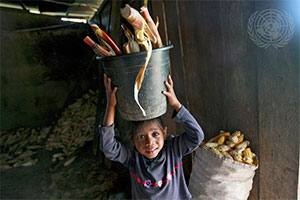 Timorese Girl with Fresh-Picked Corn. Credit: UN Photo/Martine Perret
A global common denominator is the need for a decent job. The economic realities of each country determine just how difficult it is to find one. Despite the labour movement's achievements, serious challenges persist: gender discrimination, child labour, worker migration, the digital divide and AI automation, evaporating pensions, unsafe workplaces, corporate pressure against union organising, negative impacts of trade agreements, and the precariousness of informal employment. The 2025 UN SDG Report identifies jobs and social protections as one of the six priority areas requiring urgent action, with progress either stalled or reversing in many developing nations.
In recent years, the fight to protect labour equality has taken on new dimensions with the rise of Environmental, Social and Governance standards. With the Social aspect aiming to promote equality and human rights, ESG principles have strengthened labour advocacy within corporate and governmental regulatory landscapes. In particular, ESG has become much more institutionalized in emerging economies such as Brazil and China. IPS follows the world’s workers as they confront these challenges - their setbacks and their successes.

The Week with IPS

NEXT STOP - SDGs
Tracking global progress towards a sustainable world
Tracking global progress towards a sustainable world
