Languages
Thursday, November 19, 2026



News and Views from the Global South
Labour
INDIA: Mammoth Social Security Scheme Flounders
Nearly two months after India launched 'the world's biggest social security scheme', doubts are creeping up on the workability of a programme to provide work for 25 million unemployed rural people.ECONOMY-THAILAND: Court Ruling Hits Privatisation Plans
Fresh from a landmark court victory that stopped the privatisation of the country's state-owned power utility, Saree Ongsamwong is setting her sights on stalling privatisation of other state enterprises that the government wants traded on the Thai stock exchange.CHINA: Rural Unrest Rooted in Land Rights Issue
"The core question of China's farmers is land, and China's reform began with rural villages", Chinese Premier Wen Jiabao told legislators at the annual meeting of the National People's Congress, this month.HEALTH: Brain Drain Hits Poor Countries Hard
Kenya is just one of many developing countries worried about the growing loss of healthcare workers, who mainly migrate to industrialised nations, said Dr. Francis Kimani of Kenya.LABOUR: U.S. Unions Back Ousted Mexican Leader
Support is growing in the United States for a "formidable advocate" of workers' rights in Mexico who was forced out of his job as union leader by the Mexican government just over a month ago.ECONOMY: Uruguay’s Gain is Finland’s Loss
The paper mill was the cradle of the little Finnish town Kuusankoski more than a hundred years ago. Now it could become its grave after paper-making giant UPM announced it is downsizing local operations.POLITICS: U.N. Reform Plan Is U.S.-Driven, Staff Charges
The 5,000-strong U.N. Staff Union, which passed a vote of "no confidence" in Secretary-General Kofi Annan last month, has implicitly declared that his much-publicised plan to restructure the world body is driven primarily by a single country: the United States.LABOUR-LATIN AMERICA: Social Security Is for the Few
The free-market economic reforms implemented in Latin America in the 1990s and the increase in public spending seen in the past five years have failed to improve social security in the region, where 60 percent of the population still lacks coverage, noted the Economic Commission for Latin America and the Caribbean (ECLAC).POLITICS-US: Battle Royal Brews Over Immigration Reform
So passionate are the views of legislators and advocacy groups representing all points on the political spectrum that Congress-watchers are expressing serious doubts that this year will see any meaningful progress toward comprehensive immigration reform in the United States.POPULATION-CHINA: Baby Boom or Bust
Fixated on maintaining the country's high-powered economic growth, Chinese policy makers have been soliciting opinions from economists about how to avoid future labour shortages by relaxing and even scrapping the rigid 'one-child' policy.JAPAN: No Home Away From Home for Refugees
Despite spending more than half his life in Japan, Min Maung Nyo, a Burmese national who first arrived in 1989 to study agriculture and never went back after the military junta took over, says he longs to return some day.TRADE: Poorest Nations Hit Hardest by WTO Agenda, Study Finds
Developing nations are likely to end up being net losers under the current global trade agenda because they do not have the agricultural or industrial capability to compete with the United States, Japan, Europe or even China, the expected winners, a new study says.POLITICS: U.S. Under Fire for Labour Rights Abuses
The United States, a self-styled promoter of human rights and global democracy, has come under heavy fire for "serious violations" of labour rights in its own backyard.CHINA: Rural Spending, Safety Valve for Hot Economy
Against the backdrop of rising trade tensions between China and the outside world, Beijing's new drive to boost rural spending and close the wealth gap between the booming cities and its neglected countryside is being promoted as a safety valve for trade tensions with developed and developing countries.ARGENTINA: From High Unemployment to Shortage of Skilled Labour
After 37 months of sustained economic growth, Argentina's unemployment rate has plummeted from 23 to 10 percent. But any further reduction will be difficult to achieve, because of a lack of skilled workers to meet growing demand.PAKISTAN: Free at Last, From Generations of Bonded Labour
Just 22, Jai Kumar, a teacher, knows what he wants for his students at the informal school for 'freed' bonded labour near this southern Pakistani city. ''I'm going to make sure that none of them ever end up working at the young age I was forced to. Each one of them will enroll in the government school once I'm through with them,'' he asserts.MIGRATION-BRITAIN: Doors Open for Brains and Money
Under a new policy Britain will open its normal immigration channels only to those with money and extraordinary skills.POLITICS: Staff Union Votes “No Confidence” in U.N. Chief
For the first time in the 60-year history of the world body, the U.N. staff union has declared it has "no confidence in the secretary-general and his senior management team".UAE: Hiccups as Nationals Replace Expatriate Workers
A policy of replacing expatriate workers with nationals in key jobs is now well underway with the United Arab Emirates government compelling all major companies to hire only citizens as public relations officers (PROs) or cease business.MALAYSIA: Vigilante Attack on Indian Workers Under Probe
In a rare move, the Malaysian Human Rights Commission (MHRC) has begun investigations into the assault by armed vigilantes on a group of Indian migrant workers as they were protesting in front of their country's diplomatic mission here.ARTS-HAITI: Young Photographers Lift their Masks
For a moment, it could have been lower Manhattan. Edgy photos hung on bright white walls inside an old brick warehouse. Men and women from around the globe stood captivated by black-and-white images of monsters and people.« Previous Page — Next Page »


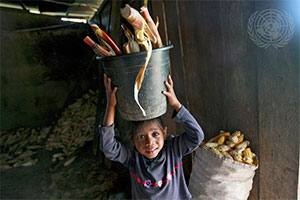 Timorese Girl with Fresh-Picked Corn. Credit: UN Photo/Martine Perret
A global common denominator is the need for a decent job. The economic realities of each country determine just how difficult it is to find one. Despite the labour movement's achievements, serious challenges persist: gender discrimination, child labour, worker migration, the digital divide and AI automation, evaporating pensions, unsafe workplaces, corporate pressure against union organising, negative impacts of trade agreements, and the precariousness of informal employment. The 2025 UN SDG Report identifies jobs and social protections as one of the six priority areas requiring urgent action, with progress either stalled or reversing in many developing nations.
In recent years, the fight to protect labour equality has taken on new dimensions with the rise of Environmental, Social and Governance standards. With the Social aspect aiming to promote equality and human rights, ESG principles have strengthened labour advocacy within corporate and governmental regulatory landscapes. In particular, ESG has become much more institutionalized in emerging economies such as Brazil and China. IPS follows the world’s workers as they confront these challenges - their setbacks and their successes.

The Week with IPS

NEXT STOP - SDGs
Tracking global progress towards a sustainable world
Tracking global progress towards a sustainable world
