Languages
Monday, November 16, 2026



News and Views from the Global South
Natural Resources

Setting Goals to Protect Half the Planet
The high seas, crucial regions of the world's oceans that are beyond national jurisdiction, account for 45 percent of the planet, but are today under severe threat from overfishing and pollution.
Defining Green Economy May Stymie Rio Summit
The thematic battle at the U.N. Conference on Sustainable Development (UNCSD) in Brazil next week will be primarily around the new concept of a "green economy" - and how best to define it.
Biggest Economies Still Lagging on Renewables
On the eve of the Rio+20 Summit in Brazil, the U.S.-based Natural Resources Defense Council (NRDC) released a report Monday ranking the world's biggest countries on their use of renewable energy.
Rio+20: Transforming Political Platitudes into Economic Realities
When world leaders endorse the final plan of action, titled "The Future We Want, at the Rio+20 summit in Brazil next week, a lingering question may remain unanswered: how best can the United Nations transform political platitudes into economic realities?
Q&A: “Today’s Food System Is Failing Small Farmers”
With heads of state from more than 120 nations and tens of thousands of civil society and international development experts gathering for the U.N. Summit on Sustainable Development next week, it is accepted wisdom that rethinking agriculture is one of most critical issues facing this and future generations.
Will Water Dry Up at Summit on Sustainable Development?
The headline in a New York newspaper last March captured the essence of a future potential threat to political stability the world over: "U.S. Report Sees Tensions Over Water."
Dam Threatens Turkey’s Past and Future
Hasankeyf, a small village in southeastern Turkey, has been under threat for 15 years. Home to approximately 3,000 people, the site is one of the oldest continuously inhabited human settlements, with an archaeological record going back at least 9,500 years.
Germany’s Energy Revolution Hits Potholes
When the German government decided last year to phase out nuclear energy by 2022, following the catastrophe at the Fukushima power plant in Japan, it was clear that the process would require extraordinary effort, not only in further developing alternative energy sources, especially renewables, but also in upgrading the country-wide electricity grid.
How Would You Measure Success at the Rio Summit?
When the heavily hyped three-day U.N. Conference on Sustainable Development (UNCSD) comes to a close in Rio de Janeiro Jun. 22, what would be the yardstick to measure its successes and failures?
Establishing Environmental Flows in the Zambezi
When Jose Chiburre was a boy growing up in Mozambique, he would often challenge his friends to a swim across the Incomati River. That was in the 1970s, when the river was 300 metres wide in the dry season: today, the race would be over before it begins.New World Bank Environment Strategy Boosts Private Sector Role
The World Bank this week released its new environment strategy for the next decade, 2012 through 2022, saying the policy framework was crafted in response to "calls from governments and the private sector for new approaches to development in light of unprecedented environmental challenges".
Calls for an African Green Revolution, Only Smarter
To deal with looming food crises in the coming decades, Africa needs a Green Revolution on par with what took place in Asia during the 1960s and 1970s, according to experts in Washington.
RIO+20: A Stalemated U.N. in Do-or-Die Session on Action Plan
After weeklong negotiations, a meeting of the Preparatory Committee (PrepCom) to finalise a plan of action titled "The Future We Want" for next week's Rio+20 summit has failed to reach agreement - and deferred a decision to a final three-day session in Brazil.
24 Policies to End the Earth Emergency
Ecologically ignorant policies are largely responsible for the interlinked crises that are unraveling the planet's life support system.
Expo 2012 Shadows Rio+20 on Sustainable Oceans
When the U.N. Conference on Sustainable Development (UNCSD) takes place in Brazil next week, it will be closely shadowed by another event thousands of kilometres away in the South Korean coastal town of Yeosu: Expo 2012.
U.S.: Law of the Sea Treaty Ratification Faces Unsettled Waters
Given the wide range of its supporters – everyone from the U.S. Chamber of Commerce and the Joint Chiefs of Staff of the U.S. Armed Forces to Greenpeace – one would think that Senate ratification of the 1982 Law of the Sea Treaty (LOST) would be a slam dunk.
Samoan Breadfruit Makes a Splash in the Caribbean
Can a single species of tree significantly reduce hunger, unemployment and deforestation in the tropics? Researchers and scientists behind a surge in breadfruit activity think so.
RIO+20: Earth Summit Negotiated the Size of the Zero
Amidst much political fanfare, the 1992 Earth Summit in Rio de Janeiro concluded with the adoption of the Rio Declaration on Environment and Development and the landmark Agenda 21 blueprint for a sustainable future in the 21st century.
For Dominica, Adaptation Best Option to Combat Climate Change
It has been dubbed the "Nature Isle" of the Caribbean, its craggy and dense rain forests, usually covered with fog, bearing testament to how cool temperatures can be here.
Human Activity and Climate Change Threaten Tourism in Jamaica
Experts here fear that that the impact of climate change on Jamaica's fragile ecosystems will worsen the ravages of human activity and destroy the country's tourism industry.
Politics Heats Up Around Arctic Thaw
The best way to protect the Arctic is for all nations with an interest in the region to participate in its governance - including non-Arctic nations like China, Brazil, and Singapore - suggests a new report.« Previous Page — Next Page »


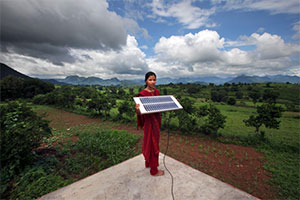 Bringing clean energy to rural India. Credit: Abbie Trayler-Smith / Panos Pictures / Department for International Development
Large reserves of oil, gas and minerals in developing countries generate opulent revenues. They could be used to stimulate economic growth and reduce poverty, but often result in environmental destruction and conflict, benefiting large companies and corrupt governments. Furthermore, competition over natural resources often manifests through geopolitical conflict. For example, before the US-Iraq war, Iraq’s domestic oil industry was nationalized. With US aggression came weakened Iraqi institutions and foreign intervention, thus eventually leading to the privatization of Iraqi oil, leaving the industry now largely dominated by Western companies. As another example, China’s rising investments within the lithium sector in South America are increasing the US-China rivalry across the Western Hemisphere. Notably, Bolivia has the largest reserves of lithium in the world, and the nation’s state-owned lithium extraction firm recently signed a contract with China’s CBC Consortium, while rejecting the entry of Western firms into the nation. In Bolivia’s case, rising Chinese investment in the nation’s lithium sector also raises concerns about environmental sustainability and the sociopolitical rights of Indigenous communities. More broadly, Sub-Saharan Africa holds nearly 30% of global reserves of critical minerals required for low-carbon technologies. Despite this, the region attracts less than 10% of global exploration investment, depicting a critical barrier to both the clean energy transitions and Sub-Saharan Africa’s economic development. Furthermore, resource wealth continues to fuel conflict like Sudan’s civil war, which has led to 9.1 million internally displaced people and is intensely connected to competition over gold, water, and agricultural land. IPS covers news about major oil, gas, and mining projects, their effects on the environment and local communities, and the ideas and actions of the interest groups involved.

The Week with IPS

NEXT STOP - SDGs
Tracking global progress towards a sustainable world
Tracking global progress towards a sustainable world
