Languages
Friday, October 2, 2026



News and Views from the Global South
Trade & Investment

Seven Challenges for US Nominee for World Bank President
All incoming World Bank presidents bring a public record of their views about the bank and about development more generally. David Malpass, who is on track to become the bank’s next president, has not been shy in criticizing the role and management of the institution he now plans to lead.
Innovative Sustainable Business: A Three Trillion-Dollar Opportunity that UN Environment Wants People to Develop
In the East African region, communities around the continent’s largest water body, Lake Victoria, regard the water hyacinth as a great menace that clogs the lake and hampers their fishing activities. But in Lagos, Nigeria, some groups of women have learned how to convert the invasive weed into a resource, providing them with the raw material needed to make handicrafts.
Promoting Privatization
Privatization has been central to the ‘neo-liberal’ counter-revolution from the 1970s against government economic interventions associated with Roosevelt and Keynes as well as post-colonial state-led economic development. Many developing countries were forced to accept privatization policies as a condition for credit or loan support from the World Bank and other international financial institutions, especially after the fiscal and debt crises of the early 1980s. Other countries voluntarily embraced privatization, often on the pretext of fiscal and debt constraints, in their efforts to mimic new Anglo-American criteria of economic progress.
Ignorance-Inspired Brexit Imperial Nostalgia
As the possible implications of Britain’s self-imposed ‘no-deal’ exit from the European Union loom larger, a new round of imperial nostalgia has come alive. After turning its back on the Commonwealth since the Thatcherite 1980s, some British Conservative Party leaders are seeking to revive colonial connections in increasingly desperate efforts to avoid self-inflicted marginalization following divorce from its European Union neighbours across the Channel.
Doing Business with Nature
As the environment continues to degrade and natural resources deplete at unprecedented rates, spelling disastrous consequences for societies, a new tool aims to bring financial institutions into the fight to protect nature.
Reverse Engineering for SDGs
When young people from small towns and villages seek higher education they have to usually migrate to big cities leaving their local communities behind. On completion of their degree from the Universities, they generally prefer staying in cities, in search of a good job and a successful career. Though this is a standard practice, it is also a case of lost opportunities, especially for students who pursue higher education in agriculture. Here is why.
Agribusiness Is the Problem, Not the Solution
For two centuries, all too many discussions about hunger and resource scarcity has been haunted by the ghost of Parson Thomas Malthus. Malthus warned that rising populations would exhaust resources, especially those needed for food production. Exponential population growth would outstrip food output.
What, After Buenos Aires Conference on South-South Cooperation?
Initially, in its BAPA+40 follow-up, the Group of 77 should address – in its own circle and in a comprehensive manner – the challenges and opportunities facing South-South cooperation.
Bringing #MeToo to the Fashion Industry
The global #MeToo movement has put a spotlight on sexual harassment and violence in various industries including the film and music industries. Is it now time for the fashion industry to address these issues within their supply chains, one organisation says.
Economic Crisis Can Trigger World War
Economic recovery efforts since the 2008-2009 global financial crisis have mainly depended on unconventional monetary policies. As fears rise of yet another international financial crisis, there are growing concerns about the increased possibility of large-scale military conflict.
Farmers Secure Land and Food Thanks to ‘Eyes in the Skies’
Six years ago while wondering how best to use her engineering skills, Tanzanian ICT entrepreneur Rose Funja decided to enter an innovation competition. Years later she has turned a digital idea into a viable business that helps smallholder farmers across the East African nation access credit.
Blue Economy: The New Frontier for Africa’s Growth & How Japan Can Help
1. Why Blue Economy in Africa? What potentials does Africa have? The blue economy in Africa is neglected, ignored or underexploited, but it can offer a range of African solutions to African economic problems. More than one-quarter of Africa’s population lives within 100km of the coast and derive their livelihoods there. According to the International Energy Agency (IEA), by 2020, the annual economic value of energy activities related to maritime affairs will reach EUR 2.5bn.1 Out of the 54 African countries, 34 are coastal countries and over 90% of African exports and imports are transported by sea. The territorial waters under African jurisdiction cover a surface area of 13 million km², with a continental shelf of some 6.5 million km² comprising exclusive economic zones (EEZ). The continent covers 17% of the world’s surface water resources. The strategic dimension of the blue economy is an indisputable reality for African countries. It is for this reason that it has been included in the African Union’s Agenda 2063 and that a practical handbook on the blue economy was prepared by the United Nations Economic Commission for Africa in March 2016.
Time, Gentlemen, Please—Next President of the World Bank
It is time for an open, fair, merit-based process to appoint the next President of the World Bank. And I’ll explain below why I think the Europeans may, at last, break the cartel that has prevented this.
Financial Globalization, North-South Wealth Distribution and Resource Transfers
At a time when the world economy is seen poised for yet another financial turmoil, there is a widespread recognition that emerging economies (EMEs) are particularly vulnerable because of their deepened integration into the global financial system. What is less appreciated is the implication of financial globalization and integration for external wealth distribution between emerging and advanced economies and resource transfers from the former to the latter.
Ethiopia Juggles Refugees and Shoppers Coming from Eritrea Amid New Peace
 The sudden peace between Ethiopia and Eritrea, and the opening of their previously closed and dangerous border, sent shockwaves of hope and optimism throughout the two countries. But a new issue has arisen: whether Eritreans coming into Ethiopia should still be classed as refugees.

Beware Proposed E-commerce Rules
In Davos in late January, several powerful governments and their allies announced their intention to launch new negotiations on e-commerce. Unusually, the intention is to launch the plurilateral negotiations in the World Trade Organization (WTO), an ostensibly multilateral organization, setting problematic precedents for the future of multilateral negotiations.
Ethics for artificial intelligence
Owing to our varied circumstances and experiences, there are contradictory tendencies to either exaggerate or underestimate the power and importance of artificial intelligence (AI) in contemporary society.
Making Tourism More Responsible
Long before Joy Daniels became the manager of a travel company she was cleaning rooms at a guesthouse. But after joining a Fair Trade-certified business, a place that valued its staff, in a few years she was soon promoted to manager.
Hospital PPPs Undermine Healthcare
Despite all the evidence to the contrary, and substantial opposition from community groups, public-private partnerships (PPPs) are still being promoted to deliver sustainable development. Public-private hospital partnerships are supposed to ensure that the private sector will offer much needed efficiency in healthcare provision.
Asia’s Landlocked
Structural economic transformation and the expansion of international trade are among the most pressing issues to be addressed, if Asia’s landlocked developing countries (LLDCs) are to overcome the development challenges related to their geographical locations.
A New Spectre is Haunting Europe
After Theresa May’s defeat in the British parliament it is clear that a new spectre is haunting Europe. It is no longer the spectre of communism, which opens Marx’s Manifesto of 1848; it is the spectre of the failure of neoliberal globalisation, which reigned uncontested following the fall of the Berlin Wall, until the financial crisis of 2009.« Previous Page — Next Page »


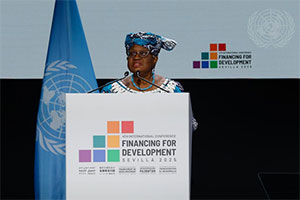 Opening of 4th International Conference on Financing for Development. Credit: UN Photo/Mariscal
International trade and investment are crucial elements of the world economy. While they can be powerful stimulators of development, they can also lead to global imbalances and dynamics of exploitation. In 2025, international trade entered a period of immense disruption, driven in part by a new wave of United States tariffs that reshaped global supply chains and investment flows. The increase in the US tariff rate, the highest since the 1930s, has forced bilateral renegotiations with global trading partners. Furthermore, the debt crisis in developing nations has accelerated while Official Development Assistance (ODA) has substantially dropped 7.3% in 2024.
In the 21st century, advancements in economic diversification in formerly colonized nations have propelled them into more central roles in the global economy. For example, both China and Mexico were able to develop their manufacturing sector and channel this development into booming export flows, thus advancing into the position of emerging economies. Foreign investment also plays an essential role in providing capital for developing countries, although they are oftentimes accompanied by social and environmental exploitation. For example, rising Chinese investments in natural resources in Latin America have often been met with tension as these investment projects fail to properly mitigate environmental risks and protect workers’ rights. In a more multifaceted vein, Sino-African relations have led to infrastructure development in Sub-Saharan Africa while also heightening the region’s economic dependency on China. IPS reports on global news in trade and investment, while shining a light on the nuanced nature of these endeavors.

The Week with IPS

NEXT STOP - SDGs
Tracking global progress towards a sustainable world
Tracking global progress towards a sustainable world
