Languages
Tuesday, October 6, 2026



News and Views from the Global South
Middle East & North Africa
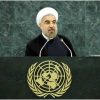
Vibrant Civil Society Essential for Sustainable Development in Iran
2019 has not been a good year for Iranian human rights activists. At a time where civic space had completely closed, many watched in disbelief as the regime mounted even more restrictions on civil society. Over recent months, many activists have been arrested, like Noushin Javari (a photographer), Marzieh Amiri (a journalist), and Javad Lal Mohammadi (teacher).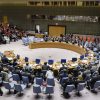
Aid Groups Warn of Humanitarian Crisis from Turkey’s Assault on Syria
Aid groups operating in northeastern Syria have been raising the alarm about civilian casualties and an impending humanitarian crisis this week, as Turkey began a military assault on the turbulent region’s Kurdish militants.
Constitutional Committee Breakthrough Offers ‘Sign of Hope’ for Long-suffering Syrians
There is a “sign of hope for the long-suffering Syrian people” as a Syrian-led, Syrian-owned, credible and inclusive Constitutional Committee is set to start deliberations next month, the United Nations Special Envoy for the country told the Security Council on Monday.
Watchdog Pushes U.S. to Publish ‘Duty to Warn’ Khashoggi Files
A media watchdog has asked United States intelligence agencies to reveal whether they knew about an assassination plot against Jamal Khashoggi and failed to warn the Saudi journalist he was in mortal danger.
Advice to US: When You’re Going to a Gunfight, Bring all Your Friends with Guns
Jim Mattis a former United States Defense Secretary in the Trump administration quotes a Marine Corps dictum in a recently released book titled “Call Sign Chaos: Learning to Lead”.
NYC Library Ditches Controversial Saudi Royal MBS’ Event
A New York library appeared to bow to pressure this week when it canceled an event that was being co-hosted by Saudi Arabia’s crown prince Mohammad bin Salman, who is accused of a range of human rights abuses.
Petition and Critics of Khashoggi Killing Heap Pressure on U.N.-Saudi Event
The United Nations faces growing public opposition to an event it is co-hosting with a Saudi Arabian charity only days before the anniversary of the murder of journalist Jamal Khashoggi.
U.N. Criticised for Link-up with Saudi Prince MBS
The United Nations is under growing pressure to scrap an event it is co-hosting with the private foundation of Saudi Arabia’s crown prince Mohammad bin Salman, who has been linked to the killing of journalist Jamal Khashoggi.
The Syrian Tragedy
As I often do, I recently discussed the Syrian Civil War with a friend of Lebanese origin. He is far from supporting the Syrian regime, which occupied his country of origin between 1989-2008. My friend assumes the Syrian government was behind the assassination of Lebanon´s prime minister Bachir Gemayel, who in 1982 together with 26 others were blown to pieces by a bomb planted at the headquarters of the Lebanese Forces. He also suspects Syria was behind the death of former prime minister Rafik Harari, who in 2005 was killed in a car bomb explosion. However, this does not make my friend an admirer of Israel or the U.S., which together with Russia, Turkey, Iran, and Saudi Arabia meddle in Syria´s bloody internal strife. It is an almost impossible task to disentangle the mess of warring fractions guided by corrupt politicians, religious fanatics, liberal politicians, bandits, Mafiosi and/or foreign commercial and strategical stakeholders.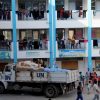
UN Aid Boss Promises “Punishment” for Misconduct in Yemen and Palestine
A senior United Nations official has promised a thorough investigation into allegations of misconduct in field operations in Yemen and the occupied Palestinian territories, saying that those responsible would be punished.
Russia and Syria in the Spotlight for Latest Idlib Medic Deaths
Medical aid groups have again blasted Russian and Syrian government forces this week for an ever-growing death toll among doctors, paramedics and other health workers in military strikes in northwestern Syria.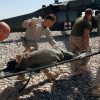
Rules of War Widely Flouted, 70 years on: Red Cross
World governments are not doing enough to stop armed groups from committing mass rape, torture and other war crimes, the head of the Red Cross aid group head Peter Maurer said on Tuesday.
Five Million Palestinians Deserve Better!
An old adage passed on by veteran U.N. staff to younger recruits is, “Do nothing whenever possible. It’s safer.” For a junior officer that might indeed be career-enhancing.
Mediating Peace in a Complex World
“It is all about orchestration”, was Martin Griffiths’, the UN Special Envoy for Yemen, response to the question of what mediation in Yemen looks like today.
U.S. Sanctions Imperil Aid to Iran’s Flood Victims
Two major humanitarian groups have warned that United States sanctions on Iran are stopping cash flows for vital humanitarian work in the country, adding another complication to the growing rift between Washington and Tehran.
Migration and Human Solidarity
The migrant and refugee crisis has become a serious test for the unity of Europe as a political project. The inflow of destitute migrants and refugees has tested Europe’s political unity to an unprecedented extent. With a long-term solution to the migrant and refugee crisis nowhere in sight, the adverse impact of the current situation has the potential to unfold further and to give rise to a broader crisis with long-term implications, affecting Europe and the MENA region alike.
U.N.’s Islamic State Probe Unit Kicks into Gear
A United Nations-backed probe into atrocities committed by the so-called Islamic State (IS) group in Iraq has frequently been criticised for making slow progress during its first two years of operations. Lately, that could be changing.
U.S.-backed Kurds to Halt Child Soldier use in Syria
The United States-backed Syrian Democratic Forces (SDF) have struck a deal with the United Nations to stop using child soldiers across swathes of eastern Syria under their control and to release all youngsters from their ranks, the U.N. announced Monday.
US & Iranian Actions Put Nuclear Deal in Jeopardy
Iran’s announcement that it may soon breach the 300-kilogram limit on low-enriched uranium set by the 2015 nuclear deal is an expected but troubling response to the Trump administration’s reckless and ill-conceived pressure campaign to kill the 2015 nuclear agreement, known as the Joint Comprehensive Plan of Action (JCPOA).
Beyond Saudi Arabia: The World Is Failing Journalists
Saudi journalist Jamal Khashoggi was deliberately killed at the hands of state actors and journalists around the world are increasingly seeing the same fate, said a United Nations expert.
‘Born A Refugee, I Dream of a Place Called Home’
I am a refugee, born to a refugee family. I was granted that status on the day I came into this world. I was not aware of what had happened before then. I did not fight any battle, I did not threaten anyone. I did not even choose my own race or ethnicity. I just came to this world to find myself a displaced person.« Previous Page — Next Page »





The Week with IPS

NEXT STOP - SDGs
Tracking global progress towards a sustainable world
Tracking global progress towards a sustainable world
