Languages
Tuesday, October 20, 2026



News and Views from the Global South
UNESCO
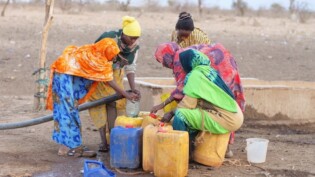
80 Percent of Rural Households Without Direct Water Access – World Water Report
A new United Nations report has warned that global water inequality remains one of the most pressing development challenges of the decade, with billions still lacking safe drinking water and sanitation – while women and girls continue to bear the heaviest burden of water insecurity.

Frontline of a Planetary Emergency: Africa Demands Climate Justice and Action
The room at the Swiss Inn Nexus Hotel in Bole was silent but tense as Sunita Narain, one of the world’s most influential environmental voices, fixed her gaze on rows of African journalists, scientists, and policymakers. Her tone was gentle, but the words cut deep.
Iconic World Heritage Sites Threatened by Water Risks as Climate Change Marches On
From Zimbabwe's 'The Smoke that thunders,' Victoria Falls, to the awe-inspiring Pyramids in Egypt and the romantic Taj Mahal in India, these iconic sites are facing a growing threat - water risk.
UN Pushes for 10,000 Ships To Track Ocean Changes
A groundbreaking initiative to revolutionize global ocean observation is being launched this week at the UN Ocean Conference side event, aiming to enlist 10,000 commercial ships to collect and transmit vital ocean and weather data by 2035.
UNOC3: Bringing Ocean Education and Science to the Global Agenda
A greater understanding and appreciation of the world’s oceans is needed to protect them. As the global community prepares to convene for the ocean conference, they must also prepare to invest in scientific efforts and education that will bolster their joint efforts.
U.S. White House Executive Order Raises Concerns for Its Support to the UN
A new executive order from the United States White House calls for withdrawing support from major UN entities and a review of all international intergovernmental organizations which the United States is a member of. The U.S.’s orders against the UN Palestine Refugee Agency also do not bode well for ongoing ceasefire negotiations in Gaza.
Once Scattered by Colonialism, Today United in Urgent Pursuit of Climate Justice
The Seychelles consider the ongoing public hearings at the International Court of Justice (ICJ) both timely and critical “for the people of the small island developing state in the middle of the Indian Ocean,” Flavien Joubert, Minister for Agriculture, Climate Change and Environment of the Seychelles, told the court today.
Lead for Learning: Decisive Leadership Urgently Needed To Improve Education Globally
Global education is facing a critical moment amid severe setbacks. Millions of children are out of school, learning levels are falling, and millions are leaving school without the skills they need. New out-of-school figures reveal that global progress in reducing the number of out-of-school children has been just 1 percent since 2015, leaving 251 million behind.
Can Scientific Freedom Deliver Development for Africa?
Scientific research has led to social and economic gains worldwide, but the scientists who make it happen face significant challenges.
Investing in Teachers, School Leaders Key in Keeping Girls in School UN-African Union Study Finds
Investing in teachers and school leaders in Africa is the most important factor in promoting educational opportunities for girls, keeping them in school and ending child marriage, ultimately reducing gender inequality through education.
Made in Africa: Africa’s Fashion Redefining Narratives About the Continent
It is a new dawn as Africa’s high fashion industry enters an era defined and driven by young African fashion designers. As they take to the global stage, the young creatives are showcasing the continent in all its majesty through unique weaving techniques and patterns that combine their rich African heritage with contemporary styles.
Under Fire, Journalism Explores Self-Preservation
With widespread attacks on professional journalists and the rise of a fake-news industry, media experts agree that journalism is increasingly under fire. But how can the press fight back and ensure its survival?
ICT Signals the Cradle of Radio’s Rebirth
Over the last few decades, radio has played an important role in the realm of development. It has enabled the distribution of information on new policies, technology, products, and ideas with the potential of stimulating growth and development, largely in rural Africa.
Radio: the Original Social Media
With less than half the world’s population online, radio continues to be world’s most widely accessible source of news and information.
Faith Leaders Issue Global “Call to Conscience” on Climate
“We received a garden as our home, and we must not turn it into a wilderness for our children.”
Science and Technology a Game Changer for Post-2015 Development Agenda
A group of international scientists, designated as advisers to U.N. Secretary-General Ban Ki-moon, has conveyed a significantly timely message to him: science, technology and innovation (STI) can be "the game changer" for the U.N.’s future development efforts.
Q&A: “Climate Change is About Much More Than Temperature”
The cost of inaction is high when it comes to climate change and, so far, countries’ commitments to reduce greenhouse gas (GHG) emissions are not enough, says Michel Jarraud, Secretary-General of the World Meteorological Organisation (WMO).“Books, Not Bullets,” Malala Yousafzai Urges at Oslo Summit
Nobel Peace Prize laureate and education activist Malala Yousafzai spoke Tuesday of her mission to bring 12 years of education to all children, rather than the previous goal of nine years, at the final day of the Oslo Summit on Education for Development.
Day One of Oslo Summit Urges Increased Funding for Global Education
At the first day of the Oslo Summit on Education for Development, U.N. Secretary-General Ban Ki-moon told a personal story of his experience during the Korean War, when his family "had to run for the mountains". He spoke of how he was able to receive textbooks because of United Nations Educational, Scientific and Cultural Organization (UNESCO).
Studying and Working Poses New Challenges for Argentina’s Youth
Until not too long ago, youngsters in Argentina faced a choice: whether to study or drop out and go to work. But now most children and adolescents in Argentina who work also continue to study – a change that poses new challenges for combating school dropout, repetition and truancy, as well as the circle of poverty.
Opinion: New World Information Order, Internet and the Global South – Part I
More than four decades ago, the Non-Aligned Movement (NAM) launched the concept of a New International Information Order (NIIO).Next Page »





The Week with IPS

NEXT STOP - SDGs
Tracking global progress towards a sustainable world
Tracking global progress towards a sustainable world
