Tuesday, July 21, 2026



News and Views from the Global South
POLITICS-US: Can Obama Deliver Rebirth of a Nation?
Ali Gharib
- Illinois Senator Barack Obama has made a political career of trying to straddle delicate lines. But come November, he hopes to instead break historic barriers by becoming the first black man to be elected president of the United States.
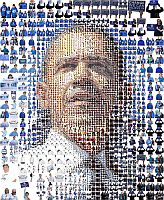
Digital mosaic portrait of Barack Obama using photos of hundreds of his supporters. Credit: tsevis
Thus Obama arrived one step closer to his goal in these late winter days. Taking the lead in pledged delegates over his Democratic rival, Sen. Hillary Clinton, Obama became the frontrunner to win his party’s nomination.
His journey to this point, as he is fond of pointing out, is a unique one. The self-described “skinny kid with a funny name” presents a new moment in U.S. politics – but not simply because of his race.
Obama’s campaign, much like his meteoric rise into the national consciousness, is predicated on change. Not limited to the oval office, or just Washington, Obama has his sights set higher – proposing to change the political sensibility of the entire country; the world even.
In the contest for the Democratic nomination, Obama has made a name for himself not so much on issues or policy platforms, but rather on his booming oratory on the stump calling for citizens to have “hope” and claiming his campaign to be “change we can believe in”.
Some critics doubt his ability to pursue change – deriding his lofty rhetoric as the shallow idealism of a young politician. They point to his inexperience and claim that he will not be able to be the executive of a cumbersome bureaucracy and that he won’t know how to pull the levers of government.
“I ask my staff never to hand me paper until two seconds before I need it, because I will lose it,” said Obama in a debate when asked to identify a weakness. “And my desk in my office doesn’t look good.”
Nonetheless, the Obama campaign has presented the candidate as a sort of saviour, and not just a political saviour, but also a saviour of the U.S. soul – a man ready to offer instant absolution from the “politics of the past” and all that it has wrought on the people.
“Barack Obama is the only person in this race who understands that before we can work on the problems, we have to fix our souls. Our souls are broken in this nation,” said Obama’s wife, Michelle, on the campaign trail.
And while critics call Obama a false messiah, he will, in fact, be able to seize some opportunities early in office.
With presumed Republican nominee Sen. John McCain poised to be the war candidate, either Democratic nominee can present himself or herself as a new face for U.S. foreign policy. But it’s widely thought that Obama’s international and multicultural background will give him more leeway with world opinion – giving the U.S. a better chance to mend its largely unpopular image abroad both amongst disillusioned allies and historic enemies.
Born in Hawaii to a white middle-class mother from Kansas and a Muslim Kenyan father studying in the U.S. at the time, Obama lived several years of his youth in Indonesia before moving back to Hawaii for the remainder of his youth.
This background, contend Obama supporters, will at the very least jar the world into taking notice that there will be a more globally conscious approach for the U.S. overseas. And Obama has largely campaigned on this window of opportunity, saying that he would be open to unconditional talks with any world leader – friend and foe alike.
But experience, again, leads to a criticism of this tack.
While Obama’s youth and idealism bring comparisons of President John Kennedy, some observers seize upon Kennedy’s own inexperience as a strike against Obama.
“Despite [Kennedy’s] years of public policy experience and political acumen, that Obama can’t match, he was still woefully ill-equipped to deal with the two biggest crises that confronted his administration; the Cuban Missile crisis and the civil rights crisis,” wrote political commentator Earl Ofari Hutchinson on the widely-read Huffington Post blog, referring to the two-week ordeal that brought the U.S. and the Soviet Union to the brink of nuclear war.
But unwilling to suffer attacks on his experience, Obama has turned his relatively short stay thus far in Washington – he became the fifth black senator just three years ago – as a positive. He is not entrenched, he says, with the special interests that so many voters see as a corrupting force in politics.
As he said about his messy desk, Obama is likely to surround himself with experienced people who are fully able to handle the reins of the government while he, infused with idealism, will be able to set the vision for the country as a whole.
Perhaps this harkens back to his days as a community organiser on the South Side of Chicago. Indeed, the bottom-up approach would present a very new political model. And the notion of inclusion on a Foucaultian omni-directional power structure is something he hopes not only to bring to his administration, but also to the U.S. public at large – proposing to use the internet as a way to bring transparency and accountability into the homes of citizens.
This approach, like many of Obama’s strengths – and some of his weaknesses – emanate from his ability to straddle lines.
He’s black, but was brought up by a middle-class white family. He went to prep school and Harvard Law, but organised on the tough streets of the South Side. He won largely black Democratic states like South Carolina, but also has taken some mostly white states like Iowa, Idaho, Nebraska and Utah – often bringing out staggering numbers in states that usually go for Republican candidates in the general election.
It’s the blurring of those lines, though, that give some commentators pause. Obama seems to get away with an awful lot, they say.
He manages to talk about uniting red states and blue states, but is accused of being too far left by his opponents on the right, and even lambasted by some on the far-left for not being out front enough on their positions of choice.
Obama has eschewed taking a lot of tough positions in favour of his classic stem-winders about “change” and “hope”. While in the Illinois state senate, he voted “present” nearly 130 times – a position that does not force an aye or nay but shows that the official was there.
On a controversial bill urging the U.S. to label Iran’s Revolutionary Guard, an organisation deeply entrenched in nearly all facets of Iranian government and economics, a terrorist organisation – with broad implications, some feared, for the use of force against Iran – Obama, unable to vote present, simply did not vote.
Most troubling is that these positions, or lack thereof, show a more calculating side to the Obama campaign that one normally hears as a criticism of his rival, Clinton. Accordingly, Obama – widely considered the staunchest anti-war candidate because of his eloquent opposition leading up to the U.S.-led Iraq invasion – has voted with Clinton on nearly every vote on Iraq since he entered the Senate in 2005.
Some democrats fear that the lack of a solid record – both from examples like these and Obama’s short time on the national scene – will serve as fodder for his opponents, who will be able to project their attacks onto him throughout a long general campaign.
Based on that criticism, some close to the Clinton campaign have called Obama “an unknown quantity” or a “roll of the dice”. If that is the case, Obama may need his speeches to go beyond just rhetoric and asking voters to simply just “believe” and “hope”.
 Print
|
Print
|