Tuesday, October 20, 2026



News and Views from the Global South
ASIA: Rice Prices Add to Inflation Woes
Bruce Lim
- In Singapore, where almost 100 percent of foodstuff is imported, the government has allowed private importers to increase buffer stocks. The Philippines, the world’s largest importer of rice, has been busy shopping for the grain from producers such as China and Pakistan.
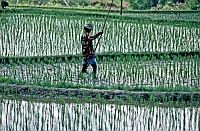
A farmer in Bali, Indonesia, tending his rice paddy. Credit: UN Photo/S. Rotner
The average export price of rice has nearly doubled to 585 US dollars per tonne today, compared to 326 dollars in 2007, according to the Philippines-based International Rice Research Institute (IRRI). The export price of rice from Thailand, the world’s largest exporter, more than doubled from 376 dollars a tonne in January 2008 to 907 per tonne in May.
Prices are expected to stay high in the near future, making Asians nervous because what used to be an affordable staple and taken for granted has become an expensive item.
This is also happening at a time of rising inflation which has economists in the region worried. Vietnam’s monthly inflation rate is the highest at 26.8 percent, while Singapore saw the largest jump in inflation rate from 0.5 percent in 2007 to 7.5 percent now, according to the Asian Development Bank.
‘‘(Current rice) prices are too high for the shortage,” Concepcion Calpe, senior economist for the Rome-based United Nations Food and Agriculture Organisation (FAO), said in an e-mail interview. Prices are expected to loosen, however, as “we are expecting new stocks around October and November”.
This is not the first time there is a global food shortage, Calpe points out, recalling that there was a more serious one in the mid-1970s. But it is not just a matter of supply and demand. The jitters in the region – and beyond – are also due to other factors such as the strength of the U.S. dollar as well as the wheat market.
Meantime, Asian countries are coping in different ways. Being at the receiving end of the rice chain, rice-importing countries are the most vulnerable to rising prices as well as stock shortages. Singapore’s senior minister of state for trade and industry S. Iswaran said the country’s move to build up reserves ‘‘will also help ensure Singapore has a slightly bigger buffer stock of rice than at present so as to cushion us even more against any future supply shock”.
Still, ‘‘it’s not easy,’’ said Khairi, a university student. ‘‘It used to cost four (Singapore) dollars for a regular meal. Now I have to pay five dollars for that meal, and still be hungry.’’
Some governments, like Malaysia’s, have had to make unpopular decisions and cut subsidies – introduced to help citizens cope – because the costs were simply too high.
Requests for subsidies were rejected by Singapore’s minister mentor Lee Kuan Yew who said that giving subsidies would eat into incentives to be competitive. Instead, he says that with a good currency, ‘‘however much the price of rice goes up, or meat, or whatever, we will not go hungry”.
Rice woes have forced the Philippine government to sit up and plan, once again, to attain rice self-sufficiency by 2010. This concept is not foreign because, as agriculture secretary Arthur Yap said, ‘‘self-sufficiency in rice, after all, is not a puzzle to us Filipinos. Not so long ago, we had produced more than enough rice for ourselves, we even shared part of our produce to the world.’’
Not surprisingly, there has been a lot of debate in the Philippine media about how the country declined from being one of the world’s leading exporters to major importer. News reports say it has managed to secure enough rice to last through 2008, and has been in contact with suppliers like Vietnam and Thailand.
But it is not a simple matter of buying rice. Producers like Vietnam and India have banned or limited exports to ensure there is enough for the domestic market – and this has its own effects on the market as well.
For Cambodia, the challenge has been how to make use of the opportunity for development.
By investing more in agriculture, it aims to increase production given the current high prices of food. Cambodia, which has been exporting some two million tonnes of rice a year, is the first country to have lifted its ban on exports earlier this year, having produced 6.4 million tonnes this year.
Even so, it might not bring direct benefits to an estimated 46 percent of the rural community that holds little or no land. Instead, the 24.2 percent increase in food prices over the last year may have a stronger effect on the poorest 20 percent of Cambodians, who spend 83 percent of their expenditure on food, according to data from the NGO Forum on Cambodia.
Even in Thailand, prices have gone up by up to 20 baht (60 cents) per meal item in some cases. ‘‘Just three months ago, a kg of rice only cost 15 baht (45 cents). Now it’s 30 baht. It’s not helping that fuel prices are rising as well, ’’ recalls Vuttikchai, a middle-aged street vendor. ‘‘Everything is rising, all but our salaries.’’
To help the poor cope with the rising cost of living, the Thai government also announced at one point that it was buying rice from farmers at higher prices, and agreed to give out subsidy vouchers as of July.
Given the region’s rice problems, some have suggested turning to potatoes. ‘‘Many developing countries are seeking new alternative crops which have high-yield productivity and require a short production cycle,’’ said Thai deputy minister for agriculture and cooperatives Theerachai Seankew. “The potato could be one of the solutions.’’
But this is quite hard to swallow for Asians, who have rice at every meal. Remarked retiree Lee Teck Huat: ‘‘It’s not that easy. I’m old, and cannot adjust to just eating potatoes. Nor can the younger ones.’’
 Print
|
Print
|