
Wednesday, October 14, 2026



News and Views from the Global South
BRAZIL: Producing Guitars and Luthiers in the Rainforest
Mario Osava
- Cuban instrument-maker or luthier Raúl Lage came for six months, but has already spent seven and a half years in Manaus, the city in the heart of the Brazilian Amazon. "The project is really fantastic," he says, explaining why he plans to renew his work contract again in September.
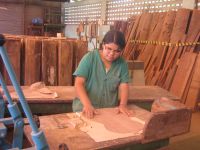
Credit: Mario Osava/IPS
String instrument-making has opened up employment and cultural opportunities for young people all over Brazil, but OELA is "the only such school in the world that works with certified tropical wood," which combines environmental and social aims, says a proud Rubens Gomes, executive secretary of the organisation that he founded in 1998.
The guitars and other string instruments produced at OELA are made with the wood from tropical rainforest trees, like the breu branco (Tetragastris panamensis) and the tauari (Couratari guianensis), which have no commercial value but are well-suited for musical instruments.
"This way we add value to species that the market does not recognise as useful timber," Gomes tells IPS.
The diversification of the sources of wood used from the jungle reduces the pressure on the most coveted species of trees and strengthens the value of the rainforest, helping "consolidate sustainable forestry management," he explains. It is one way to help prevent the deforestation of the Amazon jungle, by using limited amounts of wood to produce goods with high added value.
OELA also trains riverbank communities in forestry management, by means of a mobile school on a boat, and in the production of wooden objects and marquetry (decorative inlaid patterns of wood, ivory, etc. used in furniture and instruments).
The project’s main school in Manaus, Unit I, also offers courses in computer science, graphics, music and environmental education, besides providing psycho-pedagogical support. In addition, it has a movie club and an Internet centre for youngsters from the poor neighbourhood where it is located, Zumbi, on the east side of the city. More than 200 people a day pass through Unit I.
But its core activity is basic string instrument-making courses. The 60 students can complete the entire training course in one or two years, and can start at any time of the year.
"Not all of them have a talent or vocation for the profession, of course; only 20 or 25 percent actually become luthiers," says Gomes. But the rest receive skills training and education that enable them to become fully integrated citizens, he adds.
The best students go on to Unit II, where they learn to make 11 different kinds of instruments, including various models of acoustic and electric guitars, mandolins, banjos and cavaquinhos, a small traditional Brazilian ukulele-like instrument.
Soon the production of two more instruments will be added to the course, including the tres, a six-stringed Cuban guitar-like instrument, says Lage, who is in charge of the workshop where 10 youngsters are currently working, perfecting their skills as luthiers.
Taiene Quinto de Oliveira, 17, has been at Unit II for four months, after standing out in the basic course, which she completed in a year and a half. "My childhood dream was to go to dental school," she tells IPS. But day by day she has become more enthusiastic about making instruments, "and my dream is changing," she admits.
"The hardest part was to identify by name all of the tools we use in this work, which requires manual skill and patience, especially in the marquetry part, gluing pieces of wood in others," says the teenager, whose friends dropped out of the course.
This year, she will graduate from high school, another OELA requirement. "A good luthier needs to know about acoustics, the chemistry of wood, and ecology, and they have to study music theory as well," says Gomes, a former professor at the Federal University of Amazonas.
Unit II has begun a new phase in which it produces a set number of instruments, between 30 and 40 a month, which has also forced it to step up sales. Prices range between 1,000 and 2,000 reals (625 to 1,250 dollars), and the income is divided between the student workers and OELA, which is trying to become self-sustainable, in order to reduce the need for outside financing.
For six years, Unit II has been developing its own techniques and system, to speed up production, says Gomes. To that end, OELA purchased and adapted machinery and moulds and developed innovative cutting techniques to save wood.
It is a complex process to make a guitar, which consists of six different parts. The wood cannot tolerate more than 50 percent humidity – a real challenge in the Amazon rainforest, where closed workshops with dehumidifiers are needed.
It takes 22 different mechanical procedures and one manual to produce the guitar’s fingerboard alone, says Lage, who hasn't stopped smoking despite the complaints from Gomes every time he visits Unit II.
Gomes, a brawny man with long hair and a thick salt-and-pepper beard, has lived in different Amazon jungle states, studied classical music on the double bass, and learned to repair and make instruments because he couldn’t afford to buy his own. He eventually became a professor at the Federal University of Manaus, a job he left to join OELA.
He met Lage in 1996 while participating in the Havana International Guitar Festival on one of several visits he has made to Cuba. He says he convinced his Cuban colleague to join him in the project, because he "didn't have any experience in getting a guitar factory off the ground," and he wanted to set up Unit II.
The two men positively glow when they talk about Antonia Souza, an outstanding student who became a master luthier and now teaches at OELA, and about Francimar Meireles, another former student who, at the invitation of the government of the Amazon state of Acre, set up a similar school there.
Meireles was a poor adolescent whose mother, a seamstress, tried to discourage him from studying instrument-making because she believed he would not be able to make a living at it. However, the boy’s training enabled him, even at a young age, to earn a good salary as a public employee in the state government, recalls Gomes.
One big concern of the founder of OELA is to consolidate and expand the production chain of instrument-making, that starts in the forest communities that provide the wood, which can do the initial processing and thus expand their incomes. Bringing know-how and skills to these communities benefits both the production of instruments and sustainable forest management, he says.
A number of as-yet unfamiliar Amazon tree species could also have good properties that could be identified by scientific studies. Instrument-making is like that, says Gomes, an activity that promotes social inclusion and environmental benefits, and whose final product is music – "in other words, happiness."
 Print
|
Print
|



Pictures for this story
This story includes downloadable print-quality images -- Copyright IPS, to be used exclusively with this story.


