
Sunday, October 25, 2026



News and Views from the Global South
DEVELOPMENT: Social Enterprise in the Swazi Highveld
Mantoe Phakathi
- In 2006, faith-based charity organisation Bulembu Ministries Swaziland took over management of an all-but abandoned mining town, situated on a 1,700 hectares in northwestern Swaziland.
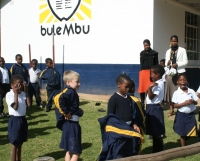
BMS hopes to care for up to 2,000 orphans and vulnerable children at Bulembu by 2020. Credit: Mantoe Phakathi/IPS
The town had lost its heartbeat 15 years previously, when the Havelock Asbestos Mining Company folded, leaving behind an exhausted mine and yanking the supports from under a town complete with schools, clinics and a population of 10,000.
The government moved to buy the property from liquidators, but when the sale was not completed, a private concern, the Bulembu Development Corporation stepped in. Shortly after that, BDC's two directors, attorney David Millin and forester Neal Rijkenberg, abandoned their plans for the town and it was transferred to Bulembu Ministries (BMS) in 2006.
BMS wasted no time in embarking on an ambitious reconstruction of physical and social infrastructure. The organisation has so far rehabilitated almost a third of the town's 1,500 dilapidated housing units.
Income generation
Many have been rented to traders who run shops in the village, while others house over 400 BMS employees and their families, who are engaged in income-generating projects involving timber and tourism, a dairy and a beekeeping operation.
Joel Mokoena, a former lab technician at the Havelock Mine, is one of the new bee-keepers.
"Historically there has always been beekeeping in the area. From a geographic point (of view), Bulembu has the right altitude, climate and plant species that are good for keeping bees.
"Beekeeping also became an obvious choice when considering that we have our own carpentry, therefore we would be able to make our own bee boxes which proved to be much cheaper than investing in a project where we would be buying everything."
BMS has combined funds donated in the North – six million dollars invested so far, according to general manager Andrew Le Roux – with schemes that make the most of under-utilised skills and natural resources. Alongside the community enterprises, the organisation's activities are divided into two other main departments.
A refurbished clinic provides health services to all residents of Bulembu and surrounding communities. "The Bulembu clinic cared for 6,000 patients last year," said Le Roux.
Orphans and vulnerable children
But the centrepiece of the effort is caring for orphans and vulnerable children. All profits generated at Bulembu, said le Roux, are meant to provide for a livelihood for the orphans and vulnerable children which is BMS's main project.
"We rely on these enterprises and donations to run the town and, through these, we’re going to fulfil our vision," said le Roux.
For now there are 180 orphans and vulnerable children at Bulembu and BMS's goal is to accommodate 2,000 orphans by the year 2020.
According to Rolly Anderson, the BMS compassion ministries coordinator, BMS is assigned children who need care through the Swazi department of Social Welfare from the nearby town of Pigg’s Peak. When they arrive at Bulembu, said Anderson, the children are accommodated at a place called the Welcome Centre, where they are introduced to one another and to the caregivers whom they call their aunts.
"While we also rely on the report card from the department of social welfare to learn about each child's background, we also do our assessment which includes a medical examination," said Anderson.
About 20 percent of the children are HIV positive, and some of them are already on antiretroviral therapy. A doctor from the Baylor Children’s Clinic in the Swazi capital Mbabane makes a stop once a month at Bulembu to monitor the children’s health.
The children spend 60 days at the Welcome Centre where they bond with one another before they are taken in groups of eight to a home where they live as a family.
"I enjoy living with the children," said Nomphumelelo Maphanga, an "aunt" at the Welcome Centre.
"I make sure that they get up in time for school, wash properly, have breakfast, carry a tea-break snack, have lunch after school and that they also eat before they go to bed."
Maphanga also helps the children with their homework.
In these homes they are under the care of trained women and a man visits each home once a week and tries, in BMS's words, to play the role of a father to the children. Explaining his role, Clement Dlamini says he tries to help with disciplinary issues and also gives advice to the boys on matters of growing up.
Education
The children all go to Bulembu Christian Academy (BCA) where they are enrolled in an Accelerated Christian Education (ACE) programme. BMS considered the ACE programme, which grew out of Christian homeschooling programmes in the United States, to be suitable, considering that many orphans have lost a number of years of schooling.
Unlike in the traditional school system where pupils have to start school in January, in BCA's highly individualised curriculum the children can be enrolled at any time of the year. Students are promoted to higher grades as they make up the lost years.
"This is a special programme where the learning process is centred on the pupil rather than the teacher," said BCA principal Jon Skinner. "Most pupils are able to adapt to this curriculum within a week."
However, BMS general manager Andrew Le Roux said ACE is a every expensive system to run in terms of personnel and infrastructure.
"The fact that this programme operates on a student to teacher ratio of 1:10 means that it would cost you more money because you need more teachers and classrooms," said Le Roux. BMS pays the $70 per month school fees for all the orphans and vulnerable children under their programme.
The government does not pay anything towards the school fees or maintenance of the children at Bulembu. The money to keep BMS's programmes alive comes from timber, tourism, dairy and bee-keeping enterprises the Society has established, combined with funds raised by two dedicated offices in the United Kingdom and Canada.
Le Roux says BMS has invested six million dollars in the town already, and plans to spend $40 million by 2020.
 Print
|
Print
|



Pictures for this story
This story includes downloadable print-quality images -- Copyright IPS, to be used exclusively with this story.


