
Thursday, October 8, 2026



News and Views from the Global South
ZIMBABWE: Water Rationing Looms in Bulawayo
Busani Bafana
- Bulawayo city council is to tighten a water rationing programme relaxed last year because residents are rapidly pushing up the city’s daily consumption by using municipal water supplies for non-domestic activities.
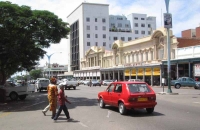
Downtown Bulawayo: the city's dams are 64 percent full, but water use has spiked alarmingly. Credit: Radozw/Wikicommons
Council raised alarm after the daily water use rate peaked in May, when Bulawayo consumed an average of 173,000 cubic metres of water a day. Though this fell slightly to 156,000 cubic metres in June, it was still well above the city’s targeted daily consumption rate of 110,000 cubic metres per day.
“If the consumption continues as it is, we will have no choice but to introduce restriction disks which control the amount of water which goes into properties as well as the rationing exercise,” he said. It fell.
Residents of Bulawayo usually use the most water in October, during the hot season, when they bath more and water their gardens frequently. In 2008, council put a cap on water use and consumption for October 2008 was 90,000 cubic metres of water a day – 30 percent less than usual.
According to Ndebele, the present extraordinarily-high water use in Bulawayo is due to the use of domestic water for washing cars, watering gardens using hose pipes, brick moulding and constructing houses in residential areas. Residents have resumed building houses, an activity many abandoned at the height of Zimbabwe’s economic crisis, and this has created a proliferation of brick-moulding enterprises. Growing demand for vegetables has also led many urban families to plant back yard gardens as a means to quickly generate income.
According to council, borehole water is to be used for all these activities. Unless residents of this city of close to a million people become water thrifty, the city council will be forced to tighten a water-shedding programme first introduced 25 years ago during one of the worst droughts in the country.
“It is now a must to save water by all means possible,” said Ndebele. “Any tips and techniques which will halt the high rate of water use by residents, some of whom have abused the monthly allocation of 5,000 litres should be adopted.”
The Department of Engineering Services submitted a report to the Council Future Water Committee in July, proposing to impose new penalties for residents who exceed their free monthly allocation. Penalties have been set at between 20 and 100 U.S. dollars for violations including exceeding the monthly allocation and making illegal water connections on properties.
“We are talking to all residents to save water today for the sake of tomorrow,” Bulawayo United Residents Association chairman, Winos Dube, told IPS. “Jokingly, people have always said, ‘Save water – bath with your neighbour’s daughter’, but as an organisation we cannot encourage that.
“The message is clear though: that residents need to save water. There is a case for using buckets when we are doing laundry (rather) than washing under a running tap and that using containers should become part and parcel of our strategies to keep a check on water use.”
Water resources and infrastructure development minister Sam Sipepa Nkomo told IPS that water challenges faced by cities such as Bulawayo called for the promotion of water conservation and appropriate water saving technology. He said his ministry had not yet looked into such technologies as part of national policy.
“We are open to ideas and proposals,” said Nkomo adding, “Awareness should be raised over water efficient technologies to bring the private sector and research institutions to work with government.”
Some simple water saving techniques are being popularised. According to a guideline issued by Bulawayo Water, an initiative of the city council, residents should read their water meters regularly to keep track of water usage, and familiarise themselves with the stopcock valve to shut off water quickly in the event of a burst pipe.
The guide offers more tips on reducing water use by flushing toilets only when necessary, not letting water run while rinsing dishes and to use a glass of water to rinse after brushing teeth instead of a running tap. According to the guide, a full bath uses up to 150 litres of water; a shower can use 10 litres of water a minute, while a slow dripping tap wastes more than 1500 litres of water in a month.
“By placing a brick in the (toilet) cistern, which holds about 15 litres, you save at least five litres of water (per flush),” Ndebele told IPS. “We are encouraging residents to install and use water-saving technologies within their homes even though for now there are very few people who are using it. It is also important that we look at such technologies and encourage the private sector to get business out of such technologies.”
 Print
|
Print
|




