
Monday, September 21, 2026



News and Views from the Global South
NAMIBIA: Banking Water for the Future
Servaas van den Bosch
- In the driest capital city south of the Sahara, water engineers are “banking” ground water to meet future demand, but the enormous costs might sink the project before water can be harvested.
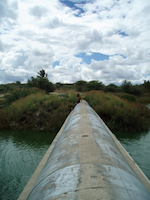
Windhoek is trying to create a backup to the vulnerable pipelines that supply the city with water. Credit: Servaas van den Bosch/IPS
The riverbed is in the catchment area of what ought to be Windhoek’s largest fresh water reserve, the four million cubic metre Goreangab Dam, which is rendered useless by human waste that is flushed into it.
This is why 70 percent of Windhoek’s water is pumped from dams as far as 160 kilometres away through old and worn out pipelines. Another 25 percent) of the city’s daily water needs of between 58,000 and 70,000 cubic metres comes from a sewage reclamation plant that’s running at full capacity. A mere five percent of the drinking water is extracted from the aquifer below the city.
The aquifer should be the city’s lifeline in times of drought, but it’s almost empty because of over-extraction since the 1950s. “If the pipeline bursts there might be a water shortage for the entire city,” says Windhoek’s chief water engineer Ferdinand Brinkman.
That informal settlements such as Hameva’s grow by 10 percent a year only increases the pressure on the water supply.
With low rainfall and high evaporation rates, water is always in short supply and this is reflected in its price and availability. Poor communities get water from communal taps – paying roughly 14 U.S. cents for 25 litres – that are often far away and shared with hundreds of people. Industries are allocated a carefully-monitored quota, and pay a punitive tariff if they use more.
“Building and unsustainable use caused a cone of depression or a ‘hole’ in the aquifer. If this is recharged the city would recoup 47 million cubic metres of water, or even 66 million if we use so called ‘deep-drill’ boreholes,” says the Deputy Director of Geo-Hydrology in the Ministry of Agriculture, Water and Forestry, Greg Christelis.
“This would provide Windhoek with an emergency water supply if pipelines burst or if there is a drought and we cannot pump enough water from the dams,” adds Brinkman.
But “banking” the water will be a costly affair. Recharging the depleted aquifer will take fourteen years, during which the city will minimise its outtake.
However even with recharge complete, groundwater cannot replace other water sources, warns Brinkman. “Only one percent of rainfall trickles down to the aquifer, or some 1.73 million cubic litres per year. That should be our sustainable yield.
“Only in times of emergency – such as prolonged drought – can we go up to five million cubic metres, but it’s really a strategic reserve that we are trying to build up here.”
Windhoek’s aquifer is an underground reservoir fed by fractures in quartzite, the hard rock the city rests on; this means any pollution can spread quickly, says Christelis.
“If the aquifer is polluted it needs many years to get clean, it could even be totally destroyed. Lusaka, for instance, has large reserves of fresh water under the city, but it’s heavily polluted.”
To prevent pollution, only treated water from the general supply mix is pumped into the aquifer, where water can move as much as 900 metres a day.
As a further measure, a special water conservation zone has been established. A yellow line appears on urban planning maps, south of which no development is allowed in order to not jeopardise the recharge of the aquifer.
“This means that 10,000 plots cannot be sold, constituting a 2-3 billion rand (210-410 million dollars) loss for the city,” says Brinkman. “Or an investment in clean water, depending on how you look at it.”
Another big cost is the drilling of specialised boreholes through which to pump water in and out of the aquifer, precisely situatied along geological fault lines that act as conduits to the underground resource.
The total cost of this and an overhaul of the main pipeline from the supply dams is estimated to be 62.5 million dollars, with the state picking up only part of the tab.
“The cost of the recharge of the aquifer for the city will be between R200 and R300 million ($27-40 million),” says Brinkman. “Our annual budget is only R240 million ($32.5 million) and just a fraction is allocated to such infrastructure investment.”
Recovering the cost from consumers would require doubling the price of water: an unattractive proposition given that Windhoek’s water users already pay more than their counterparts in neighbouring South Africa, while generally earning far less.
“There is not really such a thing as independent water producers that we can partner up with, so instead we are looking into international loans, but the interest and redemption conditions on these can be very steep.”
The city hopes to negotiate financing that will allow servicing and repayment of a loan to be spread over a long enough period that it does not stifle service delivery and the economic life of industries around the city.
 Print
|
Print
|



Pictures for this story
This story includes downloadable print-quality images -- Copyright IPS, to be used exclusively with this story.


