Sunday, September 6, 2026



News and Views from the Global South
Environment
GEF Approves Adaptation Funds Strengthening Resilience in Vulnerable Countries
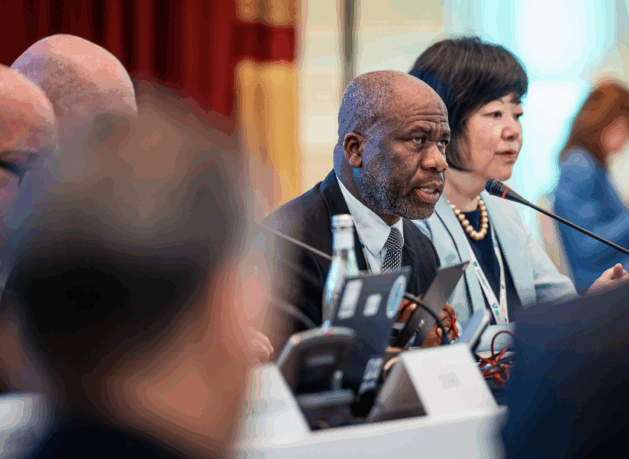
Evans Njewa, on behalf of the Least Developed Countries Group, addresses the 71st GEF Council Meeting. Credit: IISD_ENB
- Bangladesh, the Democratic Republic of Congo, Guinea-Bissau, Niue, Senegal, Solomon Islands, Sudan, and Togo will receive over USD 67 million in new funding to help strengthen resilience.
The funding for vulnerable countries aims to strengthen resilience through a package of projects approved by the Least Developed Countries Fund (LDCF) and Special Climate Change Fund (SCCF) Council, along with a new strategy to guide the funds through 2030.
Meeting in Samarkand ahead of the Eighth GEF Assembly, Council members approved the final LDCF/SCCF Work Program of the GEF-8 period, comprising seven projects under the Least Developed Countries Fund and one project under the Special Climate Change Fund. Along with the USD 67 million, the projects are expected to mobilise nearly USD 218 million in co-financing.
The funding is expected to assist with mitigating flood and coastal risks, strengthen food and water security, protect ecosystems, improve disaster preparedness, and expand resilient economic opportunities for vulnerable communities.
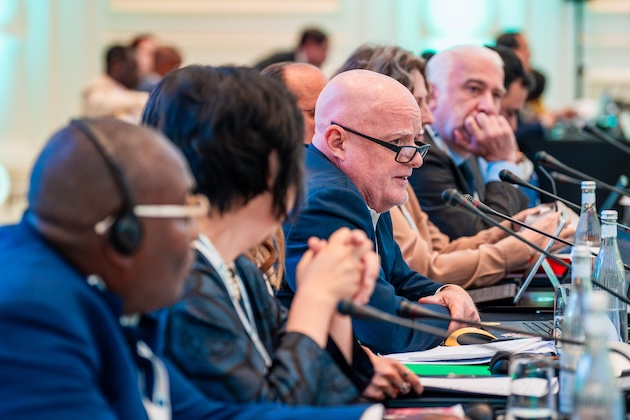
Claude Gascon, Interim CEO and Chairperson, GEF. Credit: IISD/ENB | Danny Skilton
Claude Gascon, GEF Interim CEO, said the latest tranche of programming responded to evolving national needs, showing how targeted finance was essential in helping countries advance their adaptation priorities while leveraging wider partnerships.
“The work program reflects this demand and the continued relevance of these funds,” Gascon said. “It also shows the catalytic nature of the LDCF and SCCF – working with MDBs and other climate funds and increasingly supporting multi-trust fund projects that align resources across the GEF family of funds.”
The projects include:
- Inclusive and Resilient Agricultural and Rural Entrepreneurship in the DRC, which aims to build community resilience, reduce vulnerability, and strengthen adaptive capacities to climate hazards in the provinces of Congo Central, Kwilu, Kwango, and Haut Katanga. About 200,000 people should benefit. IFAD will implement the project.
- Safeguarding Guinea-Bissau’s Coastlines and Urban Areas from Climate Risks aims to strengthen the adaptive capacity of coastal and urban communities, critical infrastructure, and ecosystems. About 120,000 people are expected to benefit, and the UNDP will implement the project.
- An integrated project to Strengthen the Resilience of Vulnerable Communities and Ecosystems in a Changing Climate in Dakar, Senegal, aims to strengthen the resilience of agricultural communities and populations to floods in the Niayes area and the urban and peri-urban areas of Dakar. It’s expected to deliver direct adaptation benefits to 362,882 people.
- Strengthening Climate-smart Agribusiness and Natural Resource Management for Adaptation and Resilient Livelihoods in Sudan’s River Nile and Northern States aims to reduce vulnerability and enhance the adaptive capacity of agropastoral communities. About 27,000 people should benefit.
- The Sustainable Transport Solutions in Lomé project aims to reduce flood risk and improve the sustainability of urban mobility in Lomé, Togo. It is expected to provide direct adaptation benefits for 45,000 people and will be implemented by BOAD.
- Infrastructure, Ecosystems and Communities Integrated Project in Niue is aimed at climate change adaptation, mitigation, and biodiversity. It is expected to directly benefit 1,142 people, with UNDP as the implementing agency.
- Community Access and Urban Services Enhancement Project II will expand successful models for climate-resilient urban services in Honiara, Solomon Islands, by using integrated flood mitigation, nature-based solutions, and community-based interventions. Expected to benefit 153,285 residents. The World Bank is the implementing agency.
- Enhancing Coastal Adaptation and Resilience in Bangladesh will enhance coastal climate adaptation and resilience improving livelihoods and adaptive capacity for 43,050 people. The Implementing agency is CI.
The approval concludes a significant period of delivery for the two adaptation-focused funds. With this work program and pending medium-sized projects, the LDCF will have supported 90 projects and programs during GEF-8, reaching 44 Least Developed Countries and programming a total of more than USD 750 million. Over the same period, the SCCF is expected to support 40 projects, including 25 projects benefiting non-LDC Small Island Developing States through its dedicated SIDS window, as well as support for technology transfer, innovation, and private sector engagement.
Looking to the Future
Council members also endorsed the GEF-9 Programming Strategy on Adaptation to Climate Change for the LDCF and SCCF, setting the direction for programming under the two funds from July 2026 to June 2030.
The strategy provides a framework to help vulnerable countries move from adaptation planning to implementation, with a stronger focus on integrated solutions, locally led action, innovation, private sector engagement, blended finance, and better collaboration across climate funds and development partners.
Evans Njewa, speaking on behalf of Ambassador Adao Soares Barbosa, Chair of the LDC Group, welcomed the work program and strategy while emphasising the continued importance of predictable support for Least Developed Countries in the face of intensifying climate impacts.
“These discussions are not merely procedural. They shape whether adaptation support reaches the countries and communities that need it most,” Njewa said. “Each approval, each endorsement, and each new strategy represents a step closer to a world where the most vulnerable are empowered, supported, and included in the transition toward a climate-resilient future.”
The GEF-9 LDCF/SCCF Programming Strategy sets out two financial scenarios for each fund: USD 1 billion to USD 1.3 billion for the LDCF and USD 200 million to USD 300 million for the SCCF, and it also introduces operational improvements to strengthen access, delivery, innovation, and finance mobilisation. Together, these measures will help the LDCF and SCCF provide more predictable, catalytic support for Least Developed Countries and Small Island Developing States.
The work program also reflects the growing role of the LDCF and SCCF in leveraging wider sources of finance. The LDCF projects are expected to mobilise USD 207.9 million in co-financing, while the SCCF project in Niue is expected to mobilise USD 9.8 million. Several projects involve multilateral development banks and international financial institutions, and they also use multi-trust fund approaches that align LDCF and SCCF financing with broader GEF investments.
Gascon said the decisions in Samarkand would help provide continuity and predictability for countries relying on LDCF and SCCF support.
“With just a few years remaining to deliver on global commitments to 2030, the role of these funds is even more central,” he said. “By endorsing the strategy, this Council has provided a clear framework for the years ahead. The momentum is there, the demand is clear, and the opportunity is in front of us.”
Note: The Eighth Global Environment Facility Assembly is underway until June 6, 2026, in Samarkand, Uzbekistan.
This feature is published with the support of the GEF. IPS is solely responsible for the editorial content, and it does not necessarily reflect the views of the GEF.
IPS UN Bureau Report


 Print
|
Print
|