Thursday, August 27, 2026



News and Views from the Global South
ARTS-MALI: Festival Fosters Cultural Exchange in the Desert
Jennifer Hollett
- A polar bear is in the middle of the Sahara desert. It is not a mirage.
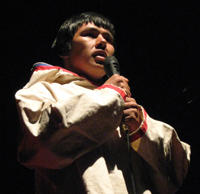
Artcirq on stage Credit: Jennifer Hollett/IPS
The festival is the largest concert in Mali, and probably the most remote in the world. Set in the Sahara sand dunes north of Timbuktu, it brings people from everywhere to the middle of nowhere for a mix of music and a celebration of culture.
The festival is in its eighth year – and is growing in popularity – thanks to word of mouth and media coverage. This year Vogue magazine used the event as a backdrop for one of their fashion photo shoots. Bono, the world famous musician and human rights activist, was reportedly considering checking out the festival as well.
The three-day concert attracts thousands of music fans from around the world, as well as Malians. Locals receive a discount and many enter free of charge.
The musical line-up is announced only a few days before the show. The event started as a showcase of Malian music but has expanded to promote Tamasheq culture and include other African artists and international acts. The Director of the festival, Manny Ansar, says that the current goal of Festival in the Desert is “contact and human relations”.
Artcirq, founded in 1998 in response to the suicide problem in the small island community of Igoolik, Nunavet, Canada, was the most unique act to perform at the festival this year. The group uses traditional culture, circus arts, and videography to empower youth as well as to connect artists from the Arctic to the rest of the world. Their performance festival here coincided with a celebration back in their hometown that marks the return of the sun after two months of darkness.
When Artcirq left Igloolik, it was negative 60 degrees. “We had to take seven planes to come here,” Guillaume Saladin, the co-founder of the group, told IPS. “Now in an hour we’ll be going on camel rides.”
Despite the drastic change in climate, the artists of Artcirq see many similarities between life in the Arctic and life in the Sahara, including a slower pace, listening to the land, and the collision between traditional and modern life.
Saladin, a 35-year-old white French Canadian from a family of anthropologists, grew up in Igloolik. After university he ran away to join the circus and later returned to Igloolik to teach acrobatics. He hopes the gravity defying circus tricks and the success of the group internationally will inspire youth in Igloolik. “We’re opening doors to show anything is possible. We’re building dreams,” he says.
For Artcirq to travel to Timbuktu was a dream come true for Saladin, he explained. “Everywhere in the world people are saying ‘all the way to Timbuktu.’ It’s just like people all around the world knowing Eskimos kiss with their nose.”
“Being here is like being in a giant sandbox,” says Jacky Qrunnut of Artcirq. The 22-year-old acrobat and technician says the trip has been the cultural exchange of a lifetime.
“When I got here and told them where I was from, they told me I was strong. I told them they were strong living here,” Qrunnut told IPS.
Artcirq members explained to international journalists at a press conference that the media has misrepresented the Inuit. Growing up the artists had watched Chinese and Native American actors on TV, posing as Eskimos, telling their stories. “We never call ourselves Eskimo, we call ourselves Inuit,” explained Sylvia Cloutier, 31, a singer with the group.
Despite the clarification, the festival announcer still introduced the troupe as Eskimos – which has been defined as eater of raw meat – whereas Inuit means person.
In hopes of breaking stereotypes, Artcirq presented a film screening of The Fast Runner at the festival. The internationally acclaimed film about life in the Arctic drew a significant crowd in the sand dunes.
During the film screening, one member of Artcirq started lifting another member over his back. This caught the attention of a member of the local Tuareg tribe in a purple headscarf. “Are you from Canada?” he asked the duo. He was confused by the positive reply. “You have the face of Japanese people. Do you practice Kung Fu?” he asked.
The Artcirq members explained that they were from the white desert of snow and ice featured in the movie. The Tuareg man then attempted to lift one of the men over his back but failed miserably, collapsing into the sand. With very little effort the Artcirq performer then picked him up from the sand and lifted him repeatedly over his head. This led to lots of laughter and a conversation about building igloos, hunting seals, and Inuit greetings.
The Tuareg man seemed impressed. “You’ve come to show how you live. Very good,” he said.
“And we’ve come to see how you live,” the Artcirq members replied.
The men then smiled, shook hands and parted ways, in the middle of the Sahara desert.
 Print
|
Print
|