
Monday, August 31, 2026



News and Views from the Global South
COLOMBIA: New Meaning in Life for Young Shantytown Dwellers
Mario Osava
- After three of Viviana’s friends were killed, and one of them dismembered, she began to think things over, and decided to join the Legión del Afecto project in Colombia, leaving six years of gang life behind her.
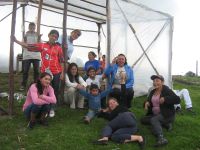
Part of the Legión del Afecto team at their headquarters. Credit: Mario Osava/IPS.
Jerry Leaccot’s brother was killed when he was just 15. And when he was in prison, his mother was murdered when thieves broke into their house. “Without the project, I would have come out of prison and killed somebody, and maybe I wouldn’t be alive today,” says the 27-year-old.
Juan Carlos Lukumi, whose surname is the name of his neighbourhood because his family was the first to settle there 25 years ago, was a member of a “parche” (“gang” in Colombian street slang) made up of 25 to 30 youngsters, “only three or four of whom are still around; the rest are in prison or are dead.”
Miriam Callejos, 43, raised six children on what she earned cleaning houses from early in the morning until nighttime. Her second son, Ronal, was 20 when he was stabbed to death in March 2006, after the Legión del Afecto (Legion of Affection) had already begun some of its activities in her neighbourhood.
Ronal’s death ended up strengthening the group. The immediate reaction was that of “a bunch of armed kids looking for the attacker or for anyone with ties to him, seeking vengeance,” says Callejos. But later, many people, even strangers, showed up to give her a hug late that night, when she was feeling “a hole in my chest, the sharpest pain I’ve ever felt.”
That sense of solidarity and emotional support began to be repeated in case after case, and “our meetings helped people purge their rage, hatred and thirst for revenge,” which were gradually replaced with “strong ties among the kids, who stood by me,” and the desire to avoid further violent deaths, she says.
Violence levels have dropped 90 percent in Ciudadela Sucre, a neighbourhood in Soacha, a vast shantytown in the hills on the southwest side of Bogotá, estimates Callejos, who works with Legión del Afecto.
The project is an initiative of Acción Social (Social Action), a Colombian government programme, and the United Nations Development Programme (UNDP).
While her estimate may be an exaggeration, it reflects the upbeat perception of the participants in the three-year-old Legión del Afecto project. Around 20 of them spoke with IPS one afternoon in November, in a transparent plastic tent where they meet and work on their small garden, up on the hills in the Buenos Aires neighbourhood in Soacha.
Almost all of them are survivors, who have experienced tragic losses as well as the forced displacement of their families from rural areas around the country by the armed conflict that has had Colombia in its grip for over four decades, or who have fled rural poverty, flocking to the poor districts surrounding the capital.
As it took in more and more internally displaced persons, Soacha became one of the fastest-growing municipalities in Colombia, seeing its population nearly double in 15 years.
The high rates of violence and deaths among young people were one result of the chaotic growth of neighbourhoods like Ciudadela Sucre and Altos de Cazucá, where recent arrivals crowded into tin-roofed shacks and simple cinder-block houses higher and higher up in the hills, where there is no garbage collection or piped water, and raw sewage runs down the dirt tracks that pass for roads.
Fights between rival youth gangs have left a huge death toll. Turf wars, fought with stones, knives and guns, have made crossing invisible internal boundaries a mortal risk.
But the youth gangs are added to the bigger sources of violence in Colombia, which make their presence heavily felt in the poor districts to the south of Bogotá: the armed conflict, far-right paramilitary groups, drug trafficking, and “social cleansing” of “undesirable” elements.
Offering an alternative
One day, “these crazy-looking people with long hair and colourful clothing showed up,” says Callejos.
It was the Peace Circus, headed by José Montoya, the local coordinator of the Legión del Afecto, which organised its first circus, dance and theatre activity in the streets of Ciudadela Sucre in January 2006, drawing around 600 people.
“It was a light of hope,” even though at first, she admits, she was wary of these strange-looking outsiders who offered “to pay people to dance and see other parts of the country.” She was afraid they were guerrillas or paramilitaries out to recruit young people under the guise of a social programme.
So far, 700 people around the country are involved in the project, whose goal is to expand that number to 20,000.
Participants are paid a “social salary” of between 90 and 270 dollars a month as remuneration for community services, especially “socialisation.” In Ciudadela Sucre, 75 people – mainly youngsters – are involved, as well as a few adults, chiefly mothers.
To help young people transform their lives and feel valuable and useful to society, “restore deteriorated social fabric,” and “render the invisible visible,” the project uses 16 tools, including dance, martial arts, music, sports and art, with each participant choosing the activities they most enjoy.
Dancing is the most popular activity, but the programme also helps keep alive Colombian folk music and national rhythms, says Jimmy Monroy, one of the young toughs who used to terrorise his neighbourhood, and who is now a witty, eloquent young man carrying physical scars from his street gang years on his neck and arms, and the psychological scars of losing a close friend.
For his part, Germán Alfonso joined the group to dance and sing rap music. He says he feels a new sense of self-worth, and that he left behind “years of destruction in the streets.” Now he writes music about local life and dreams of recording an album, while singing at parties and other events.
“I enjoy meeting a wide variety of people, like indigenous people,” and bringing them lyrics that entertain them, says Leaccot, referring to the trips around the country made by the so-called “Legionnaires of Affection”, who provide emotional and other support for the victims of forced displacement and for those who have decided to return to their homes, all over Colombia.
Leaccot, who has two pre-adolescent children born “before my time in prison,” now lives in the Lukumi neighbourhood and gets on fine with former “enemies” from the Buenos Aires neighbourhood, like “Lechero”, who “used to fight every day” because he went to school in a different neighbourhood, or Milena Chirivi, who he says used to be “very aggressive.”
Chirivi agrees, saying “I used to like ‘changones’,” homemade shotguns that are popular in Colombia.
She started living on the streets at the age of 11, playing Russian roulette and “selling marijuana and ‘basuco’” – a highly toxic cocaine derivative – and already had three children by the time she was 17.
Her transformation has surprised her mother, who says she gives thanks to “God and the people from the project.”
Many of the “legionnaires” were teenage mothers. Deissy Bogotá, 25, still cries for “the father of my son, who they killed seven years ago.” But she says that in the Legión she has found “affection, and a family,” the absence of which pushed her onto the street, where she says she lived a reckless existence.
Teen pregnancy, combined with domestic violence and alcoholism among parents, pushes many girls onto the streets.
But the Legión del Afecto, which holds that “lo afectivo es lo efectivo” (roughly “affection is effective”), has given a number of these girls a new lease on life.
“Feeling like heroes”
Organising community feasts based on traditional dishes, providing assistance to the victims of disasters like landslides, or tending a collective garden to develop a love for land and respect for biodiversity are other activities used by the group to help youngsters discover their skills and interests and gain a sense of meaning in life, and to help them “feel like heroes,” according to the group’s leaders.
Once 44-year-old Gloria Bedoya gets going, it’s hard to stop her. Through the project, she discovered a passion for biodiversity, which she has read up on, becoming a well-informed environmentalist, who cleans the streets in her neighbourhood, collects old batteries to dispose of properly, and is working on plans to replant trees on the hills.
The youngest member of the group, 13-year-old Jennifer Bedoya, is also a talker, giving articulate descriptions of the work of the Legión del Afecto.
It is paradoxical that this project, which seeks to restore the value of life, is sponsored by a right-wing government accused of providing incentives for thousands of extrajudicial killings of young civilian men kidnapped or lured in by false job promises by the army, which presents the bodies as battlefield casualties, in order to show “results” in the fight against the irregular armed groups.
In Soacha and the neighbouring poor district of Ciudad Bolívar, which together are home to over one million people, the human rights group Justice and Life documented more than 600 murders between 2002 and 2006, based solely on official figures. In virtually every case, there was no investigation of any kind.
 Print
|
Print
|

Pictures for this story
This story includes downloadable print-quality images -- Copyright IPS, to be used exclusively with this story.


